A lot of English learners have trouble building sentences. I’ve literally heard this countless times from my students: “I know a lot of English words, but when I try to speak, I struggle to put them together into proper sentences.”
And honestly, this problem is much more common than you might think. You can have a strong vocabulary, understand complex texts, and know plenty of grammar rules, yet still struggle to express your thoughts naturally when speaking English.
Why does this happen? Because knowing individual English words is not the same as knowing how to use them to build sentences.
Think about it. When you speak your native language, you don’t stop after every few words to analyse the grammar. You have internalised thousands of sentence patterns through years of listening, reading, and speaking. These patterns help you express your thoughts almost automatically.
English learners can develop the same skill.
One of the most effective ways to improve your English fluency is to learn common English sentence structures that native speakers use every day. Instead of memorising isolated vocabulary, you learn reusable formulas that help you create dozens of sentences of your own.
In this article, you’ll discover 10 practical English sentence patterns for intermediate and advanced learners (B1–C1), complete with examples, useful variations, and tips for using them in real conversations.
1. It is + adjective + to do something
When to use it: To express opinions, evaluate situations, and explain whether an action is easy, difficult, necessary, or worthwhile.
This is one of the most useful English sentence structures because it allows you to discuss almost any topic, from learning languages to making career decisions.
Formula: It is + adjective + to + base verb
Examples:
- It is necessary to practise a language regularly.
- It is difficult to concentrate when you’re tired.
- It is important to set realistic goals.
- It is worth exploring different career options.
- It is becoming increasingly difficult to find affordable housing.
Make it more advanced: Add for someone to explain who the statement applies to.
- It is important for students to receive regular feedback.
- It is difficult for beginners to understand native speakers at first.
- It is beneficial for employees to develop their communication skills.
Try it yourself: Complete this sentence: It is important to…
2. There is / There are / There was / There were + noun
When to use it: To describe what exists, what is available, or what happened in a particular place or situation.
English learners often use this structure when describing places, discussing problems, or introducing new information. It is simple, but mastering its different forms makes a real difference to your fluency.
Formula: There + form of be + noun + place or additional information
Examples:
- There are many nice cafés in this district.
- There is a lot of room for improvement.
- There was a misunderstanding during the meeting.
- There were several unexpected problems with the project.
- There has been a significant increase in living costs.
Make it more advanced: Experiment with other verb forms and modal verbs.
- There will be more opportunities in the future.
- There seems to be a problem with the system.
- There must be a better way to solve this issue.
- There might be a misunderstanding between the two departments.
Grammar tip: Use there is with singular or uncountable nouns and there are with plural nouns.
3. I find it + adjective + to do something
When to use it: To describe your personal experience of an activity or situation.
This pattern is especially useful when you want to express opinions without repeating I think or I feel in every sentence.
Formula: I find it + adjective + to + base verb
Examples:
- I find it difficult to make decisions under pressure.
- I find it easier to learn new vocabulary in context.
- I find it helpful to take notes during meetings.
- I find it rewarding to help people achieve their goals.
- I found it challenging to adapt to a new working environment.
Make it more advanced: You can also use a clause after find it.
- I find it frustrating when people interrupt me.
- I find it hard to believe that nobody noticed the mistake.
- I find it interesting how differently people approach the same problem.
Why this pattern matters: It helps you explain your experiences in a more natural and varied way, especially in speaking exams, job interviews, and everyday conversations.
4. The more…, the more…
When to use it: To explain how two things change in relation to each other.
This structure is excellent for discussing personal development, making observations, and expressing more sophisticated ideas in English.
Formula: The + comparative…, the + comparative…
Examples:
- The more you practise, the more confident you become.
- The harder you work, the better your results tend to be.
- The more experience you gain, the easier it becomes to make decisions.
- The longer I live abroad, the more I appreciate my native language.
- The less time we have, the more carefully we need to plan.
Make it more advanced:
- The more dependent we become on technology, the more important digital literacy becomes.
- The sooner we address the problem, the less damage it is likely to cause.
- The more carefully we analyse the data, the more reliable our conclusions are likely to be.
Speaking tip: Use this pattern when answering questions about education, technology, work, or society. It helps you develop an idea instead of giving a short, basic answer.
5. What I like / appreciate / find interesting about… is…
When to use it: To emphasise a particular aspect of a person, place, experience, or situation.
Compare I like my job with What I like most about my job is the flexibility. The second sentence gives your listener a clearer picture of what you actually mean.
Formula: What + subject + verb + about something + is/was + information
Examples:
- What I like about my job is the flexibility.
- What I appreciate most about her is her honesty.
- What I find interesting about this topic is its complexity.
- What I dislike about working remotely is the lack of social interaction.
- What surprised me most about the experience was how welcoming everyone was.
Make it more advanced:
- What matters most to me is having a healthy work-life balance.
- What makes this solution particularly effective is its simplicity.
- What I find difficult to understand is why nobody raised the issue earlier.
Why learn it? This structure is useful for giving detailed answers, expressing preferences, and making your spoken English sound more organised.
6. One of the most + adjective + plural noun
When to use it: To emphasise the importance, popularity, or significance of something.
This is a particularly useful pattern for presentations, opinion essays, academic discussions, and professional communication.
Formula: One of the + superlative + plural noun + additional information
Examples:
- English is one of the most widely spoken languages in the world.
- Communication is one of the most important skills in the workplace.
- This is one of the best books I have ever read.
- Time management is one of the biggest challenges for freelancers.
- Climate change is one of the most pressing issues facing society today.
Make it more advanced:
- Digital literacy is one of the most valuable skills in today’s job market.
- This is one of the most effective strategies for improving employee engagement.
- Access to affordable housing is one of the most significant challenges facing young adults.
Grammar tip: After one of the, use a plural noun, but the main verb is generally singular.
- One of the main reasons is the lack of funding.
- One of the people who work here speaks five languages.
The second sentence uses work because the relative clause refers to people, not one.
7. I would rather + verb / I would prefer to + verb
When to use it: To express preferences, make choices, and explain what you would like to do.
These patterns are particularly useful in everyday conversations, negotiations, and workplace communication.
Formula A: Subject + would rather + base verb + than + base verb
Formula B: Subject + would prefer to + base verb + rather than + base verb
Examples:
- I would rather stay at home than go out tonight.
- I would rather discuss this in person than exchange dozens of emails.
- I would prefer to work independently rather than manage a large team.
- I would prefer to postpone the meeting until next week.
- I would rather not comment on the issue until I have all the facts.
Make it more advanced: Use would rather + subject + past simple to express a preference about someone else’s actions.
- I would rather you told me the truth.
- I would rather we dealt with this issue now.
- I would rather he didn’t bring up the subject during the meeting.
Although the verb is in the past simple, the meaning refers to a present or future preference.
8. It depends on whether / how / what…
When to use it: To give a nuanced answer when the situation is not straightforward.
Instead of giving a simple yes-or-no answer, you can use this pattern to explain what influences your decision or opinion.
Formula: It depends on + noun / whether + clause / question word + clause
Examples:
- It depends on whether we have enough time.
- It depends on how much money we can invest.
- It depends on what the client expects from us.
- It largely depends on whether the company is willing to change.
- Whether this approach works depends on how consistently it is implemented.
Make it more advanced:
- It really depends on how you define success.
- The outcome will largely depend on whether both sides are willing to compromise.
- I wouldn’t say there is one correct answer. It depends on the circumstances.
- Whether this strategy is effective depends on the needs of the people involved.
Speaking tip: This is an excellent pattern for B2 and C1 speaking exams. It gives you a natural way to introduce a more developed answer, explain conditions, and avoid oversimplifying complex questions.
9. The reason why… is that…
When to use it: To explain causes, justify decisions, and make your arguments clearer.
If you want to move beyond simple sentences such as I changed jobs because I wanted more flexibility, this structure gives you another natural way to organise your ideas.
Formula: The reason why + clause + is/was + that + clause
Examples:
- The reason why I changed jobs is that I wanted more flexibility.
- The reason why the project failed was that we underestimated the costs.
- The main reason why people struggle with speaking is that they don’t practise enough.
- One reason why this solution works so well is that it addresses the root cause.
- The reason why I disagree with this proposal is that it doesn’t take everyone’s needs into account.
Make it more advanced:
- One possible explanation is that people tend to underestimate how much time the task requires.
- The main issue is that we haven’t considered the long-term consequences.
- This is largely because the original plan was based on unrealistic assumptions.
Grammar tip: Don’t add because after the reason why in the same clause. For example, say The reason why I left was that I was tired or simply I left because I was tired.
10. I tend to + verb
When to use it: To talk about habits, typical behaviour, and things that usually happen.
This pattern is extremely common in natural English. It is particularly helpful when describing your personality, work habits, reactions, or general observations about people and society.
Formula: Subject + tend(s) to + base verb
Examples:
- I tend to overthink things when I’m under pressure.
- I tend to work better in the morning than in the evening.
- People tend to underestimate how long certain tasks will take.
- She tends to avoid difficult conversations.
- Prices tend to increase during periods of high inflation.
- I tend to lose concentration when I’m tired.
- Children tend to learn languages more easily when they are exposed to them regularly.
- Companies tend to invest more when economic conditions are favourable.
Make it more advanced: Use tend not to to describe behaviour that is not typical.
- I tend not to make important decisions when I’m tired.
- He tends not to express his opinions openly.
- People tend not to question information that confirms their existing beliefs.
You can also use have a tendency to + verb for a slightly more formal alternative.
- People have a tendency to focus on short-term benefits rather than long-term consequences.
- He has a tendency to interrupt others during meetings.
Grammar tip: Remember to use tends with he, she, and it in the present simple.
Try it yourself: Complete these sentences with your own ideas.
- I tend to feel more productive when…
- People tend to forget that…
- When I’m stressed, I tend to…
- Companies tend to struggle when…
Bottom Line
If you feel that your English has plateaued despite knowing plenty of vocabulary, don’t automatically assume that you need to learn thousands of additional words. You may need to focus more on how words work together to form natural sentences.
Native speakers use familiar grammatical patterns all the time. By learning and practising these structures, you can organise your thoughts more effectively, express more complex ideas, and speak with greater confidence.
Start with a few patterns, practise them in different contexts, and gradually add more to your repertoire. With consistent practice, building sentences becomes less of a conscious effort and more of a natural habit.
Remember: English fluency isn’t just about knowing more words. It’s about being able to use the English you already know.
Your next step
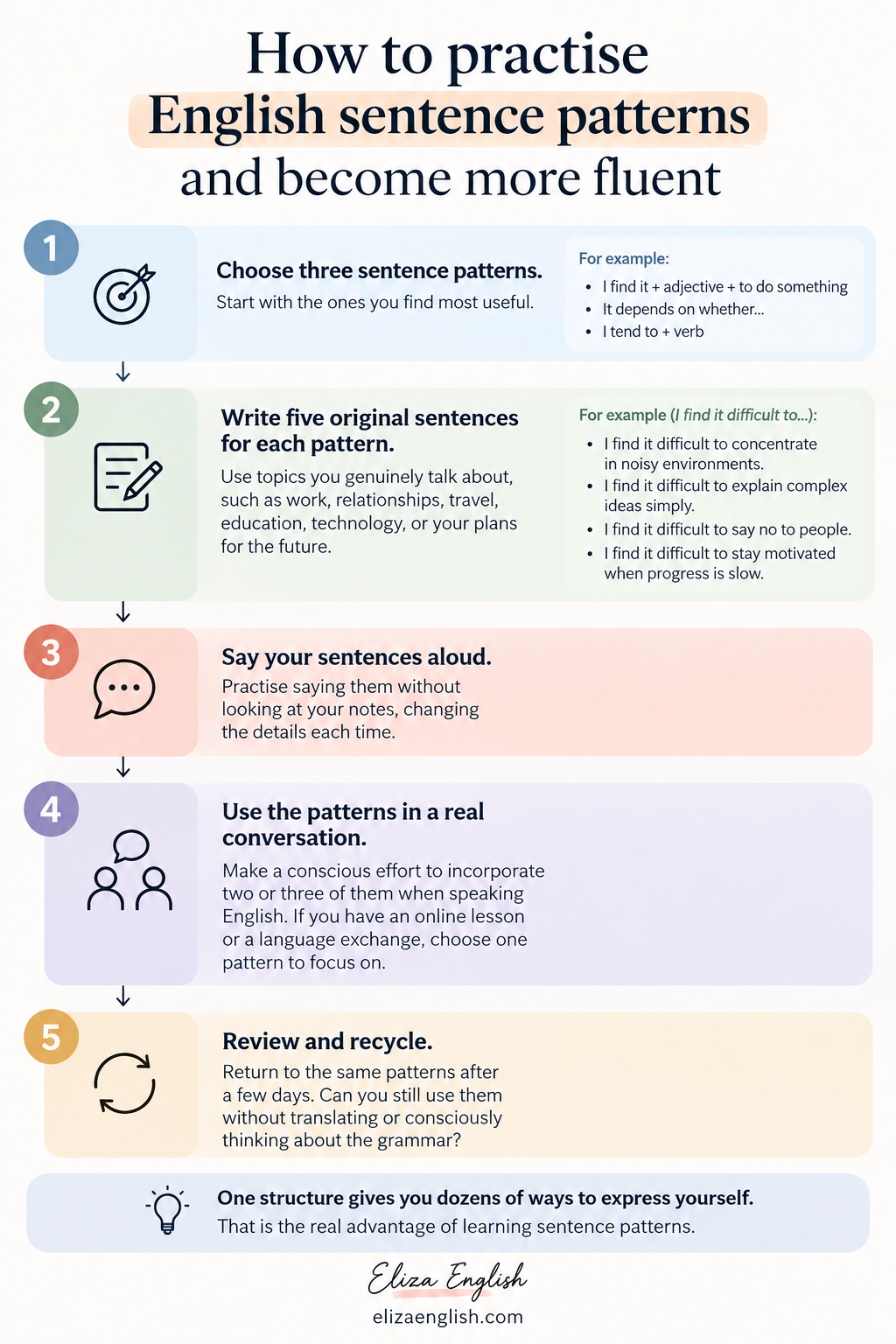
Save this article and choose three sentence patterns to practise this week. Write five sentences for each one, then challenge yourself to use them in your next English conversation.
If you teach English, you can also use these patterns as a practical speaking activity: ask students to complete the examples, personalise them, and then use the same structures in short discussions.
Small, consistent practice can make a real difference to how naturally you express yourself in English.