You can have an excellent idea, a strong argument and years of professional experience, yet still lose your audience after the first few minutes.
Why?
Because people do not listen to ideas in isolation. They respond to the language used to package those ideas.
Compare these two sentences:
“The presentation was very stressful.”
and:
“By the time I walked onto the stage, my knees had turned to jelly and my heart was pounding.”
The first sentence communicates information. The second creates an experience.
You can almost feel the nerves.
That difference is at the heart of magnetic speaking. If you want people to remember what you said at a conference, trust you during a business presentation, enjoy talking to you at a networking event or become absorbed in a story, you need more than correct English. You need language that makes people see, hear, feel, taste and imagine what you are saying.
The good news is that you do not need an enormous vocabulary to achieve this. You need the right words in the right places.
What makes language magnetic?
Magnetic speakers do something very clever. They turn abstract ideas into concrete experiences.
Instead of saying that someone was nervous, they might say:
“My stomach was doing somersaults.”
Instead of saying that something was extremely exciting:
“The atmosphere was electric.”
Instead of saying that a new idea attracted everyone’s attention:
“It hijacked everyone’s attention.”
Instead of saying that a project involved many emotional ups and downs:
“It was an emotional rollercoaster.”
These expressions work because they activate more than one level of understanding.
The listener does not simply process the meaning intellectually. They create a mental image, connect it with a physical sensation and often attach an emotional reaction to it.
That makes the message more persuasive, evocative, compelling, attention-grabbing and memorable.
In other words, you are not merely giving your listener information. You are giving them something to experience.
The multisensory advantage: make people experience your words
Think about the difference between hearing:
“The restaurant smelled good.”
and:
“The smell of freshly baked bread hit me the moment I walked through the door.”
The second sentence immediately gives your listener a sensory experience.
You can almost smell the bread.
This is particularly powerful because sensory language creates a multisensory, multidimensional representation of what you are describing. Your audience can visualise the scene, imagine the sensation and connect it with their own experiences.
This is why expressions such as mouth-watering, heart-warming, bone-chilling, ear-splitting, eye-opening and gut-wrenching can be so effective.
They compress an entire experience into a few words.
1. Words and expressions that create physical sensations
Some of the most powerful expressions in English are connected to the body.
That is not accidental.
Physical sensations are immediate. Your audience does not need to intellectually decode what you mean because they already know what it feels like to have butterflies in their stomach or their knees turn to jelly.
Use these expressions when telling stories, describing emotions or making your speech more vivid.
To give someone goosebumps
To cause someone to experience small bumps on their skin because of excitement, fear, emotion or awe.
“Her performance was so powerful that it gave me goosebumps.”
To have butterflies in your stomach
To feel nervous or excited, especially before an important event.
“I had butterflies in my stomach before I walked onto the stage.”
My knees turned to jelly
To suddenly feel extremely weak or nervous.
“When they announced my name, my knees turned to jelly.”
To have your heart pounding
To have a very fast or forceful heartbeat because of fear, excitement or physical exertion.
“My heart was pounding as I waited for the results.”
To be on the edge of your seat
To be extremely interested or excited about what is happening.
“The audience was on the edge of their seats throughout the presentation.”
To send shivers down your spine
To cause a strong physical reaction, usually because something is frightening, emotional or intensely impressive.
“The final scene sent shivers down my spine.”
Mouth-watering
Extremely appealing, especially because of food.
“The description of the dessert was absolutely mouth-watering.”
Heart-warming
Making you feel happy, touched or emotionally comforted.
“It was a heart-warming story about how the community came together.”
Gut-wrenching
Extremely upsetting or emotionally painful.
“It was a gut-wrenching decision.”
Bone-chilling
Extremely frightening or cold.
“We heard a bone-chilling scream from the other side of the building.”
These expressions are particularly useful in storytelling because they allow you to show emotion rather than simply label it.
Instead of:
“I was terrified.”
try:
“My heart was pounding, my palms were sweating and my knees had turned to jelly.”
Now the listener is inside the scene with you.
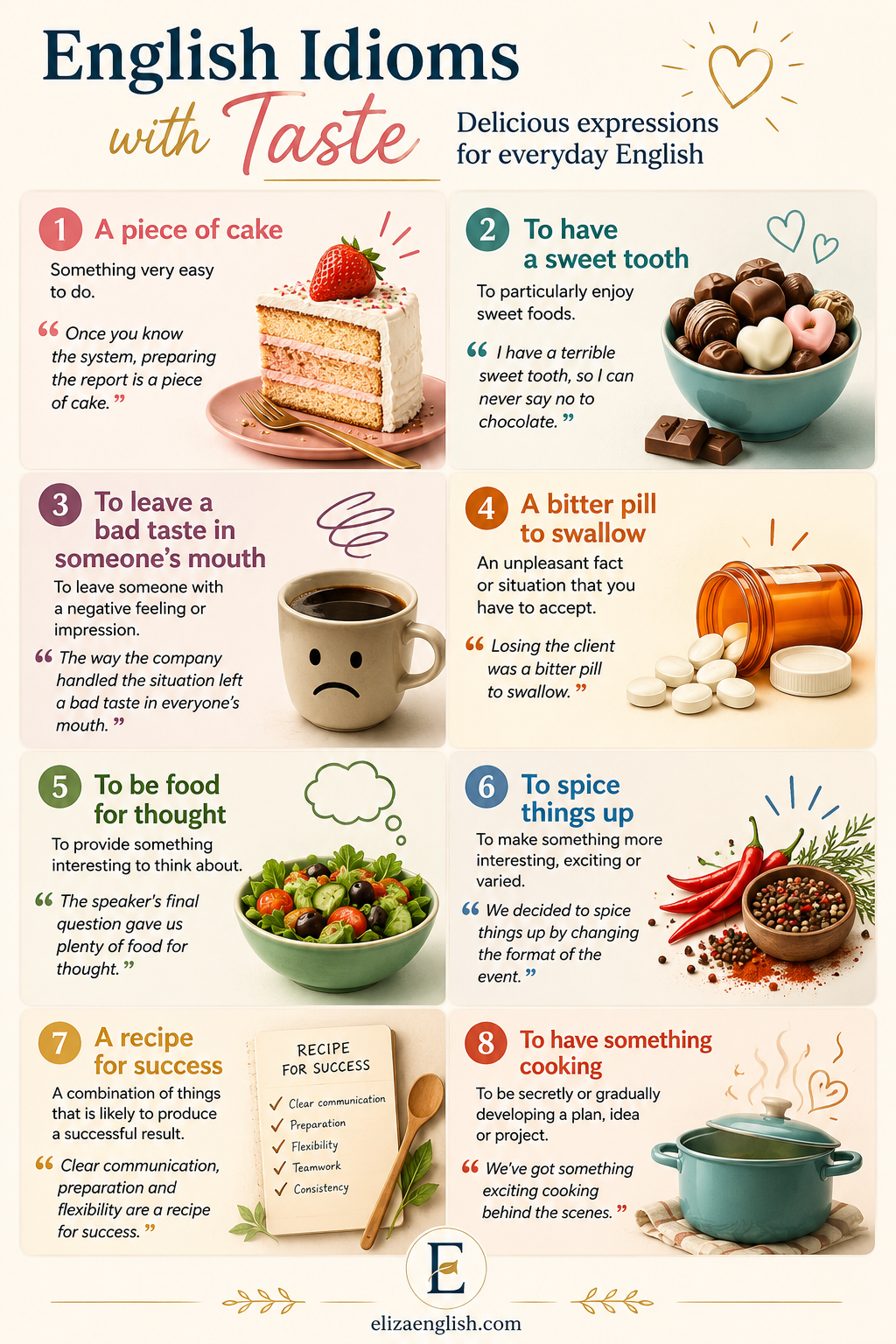
2. Taste, smell and food: surprisingly powerful language
Food vocabulary is everywhere in English, and some of these expressions have become extremely useful metaphorical tools.
They work beautifully in professional and social communication because they make abstract concepts feel concrete and familiar.
Humour is one of the most powerful attention-management tools available to a speaker.
You do not need to tell jokes. Sometimes one unexpected comparison is enough to make your language memorable.
English is full of colourful expressions involving animals, objects and amusing mental pictures.
An eager beaver
Someone who is extremely enthusiastic and willing to work hard.
“She’s an eager beaver who always volunteers for new projects.”
To have ants in your pants
To be unable to sit still because you are excited, nervous or impatient.
“The children had ants in their pants before the trip.”
A wet blanket
Someone who spoils other people’s enjoyment or enthusiasm.
“Don’t be such a wet blanket. Come and join us.”
A joy-killer
Someone or something that destroys enjoyment or enthusiasm.
“Another two-hour meeting? That’s a real joy-killer.”
A social butterfly
Someone who enjoys meeting and talking to lots of people.
“She’s a real social butterfly and knows everyone at the conference.”
A couch potato
Someone who spends a lot of time sitting or lying around watching television or doing very little physical activity.
“I used to be a complete couch potato, but now I go running three times a week.”
A busy bee
Someone who is always busy doing things.
“I’ve been a busy bee this week preparing for the conference.”
These expressions work especially well in networking and informal professional communication because they add personality.
Compare:
“I’m very sociable.”
with:
“I’m a bit of a social butterfly.”
The second one tells the listener something about your personality while also giving them an image to remember.
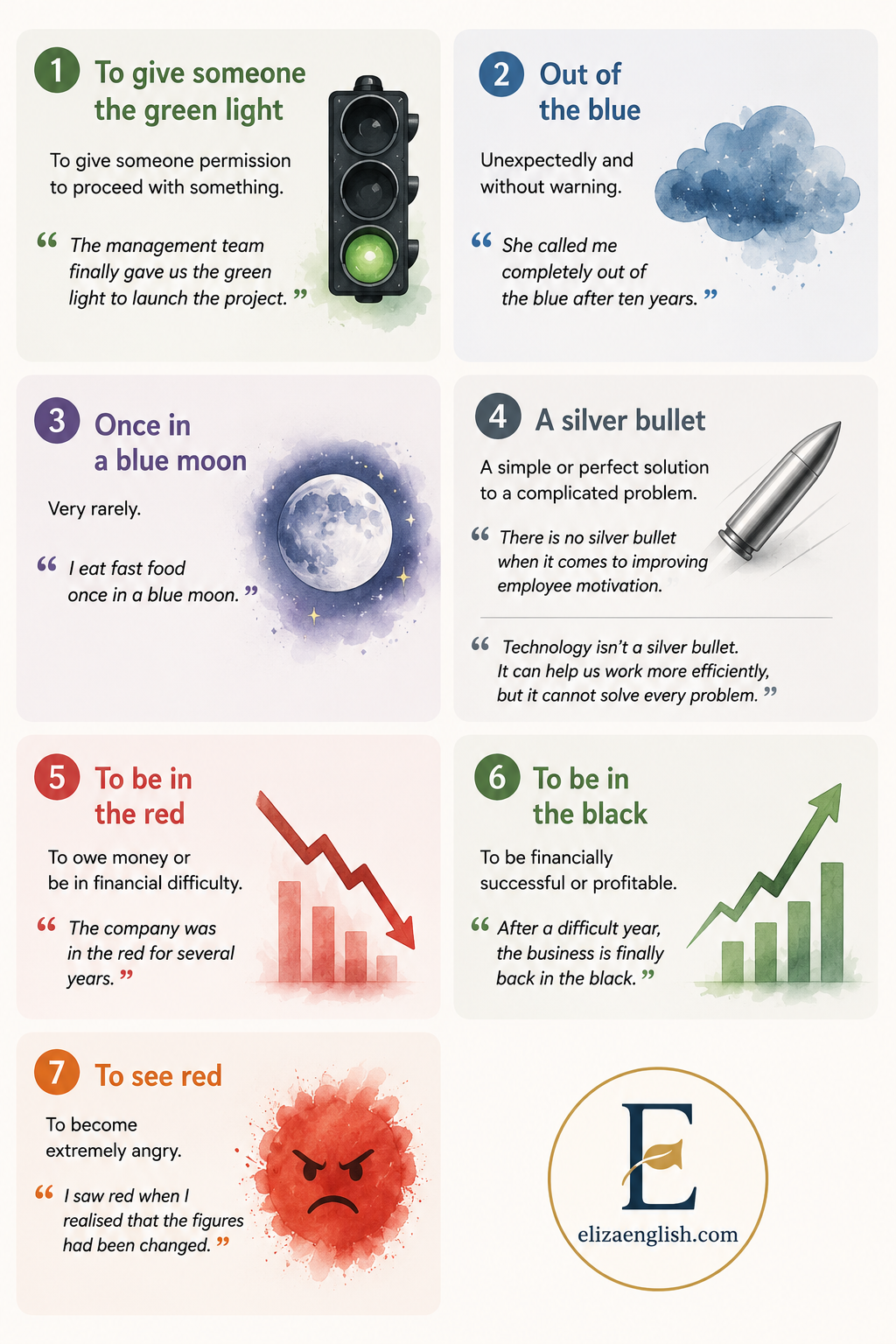
4. Colourful idioms that instantly create an image
Colour is another fantastic resource for magnetic speaking.
Some English expressions use colours metaphorically, allowing speakers to communicate complicated ideas through very short phrases.
Some expressions are particularly effective because they contain movement, drama or surprise.
These are the phrases that can make an audience sit up and listen.
To hijack someone’s attention
To capture someone’s attention so strongly that they stop focusing on something else.
“The opening image immediately hijacked the audience’s attention.”
This is a particularly useful phrase when talking about presentations, advertising, social media or storytelling.
An emotional rollercoaster
A situation involving dramatic changes between different emotions.
“Starting my own company was an emotional rollercoaster.”
To hit a nerve
To affect people emotionally because you touch on something important or sensitive.
“The speaker really hit a nerve when she talked about work-life balance.”
To strike a chord
To create an emotional response because something feels familiar or meaningful.
“His story struck a chord with the audience.”
To paint a picture
To describe something vividly so that people can imagine it.
“Let me paint a picture of what our workplace could look like in five years.”
To open the door to something
To create an opportunity or possibility.
“This partnership could open the door to new markets.”
To be a game-changer
Something that significantly changes a situation or creates a major advantage.
“Artificial intelligence could be a game-changer for small businesses.”
To be a turning point
An event or moment that causes a major change.
“That conversation was a turning point in my career.”
To be at a crossroads
To be at a point where an important decision about the future has to be made.
“After ten years in the industry, I found myself at a crossroads.”
To go down a rabbit hole
To become deeply involved in something, often spending much more time on it than originally intended.
“I started researching one statistic and ended up going down a rabbit hole for three hours.”
This is excellent storytelling language because it introduces a sense of movement and progression.
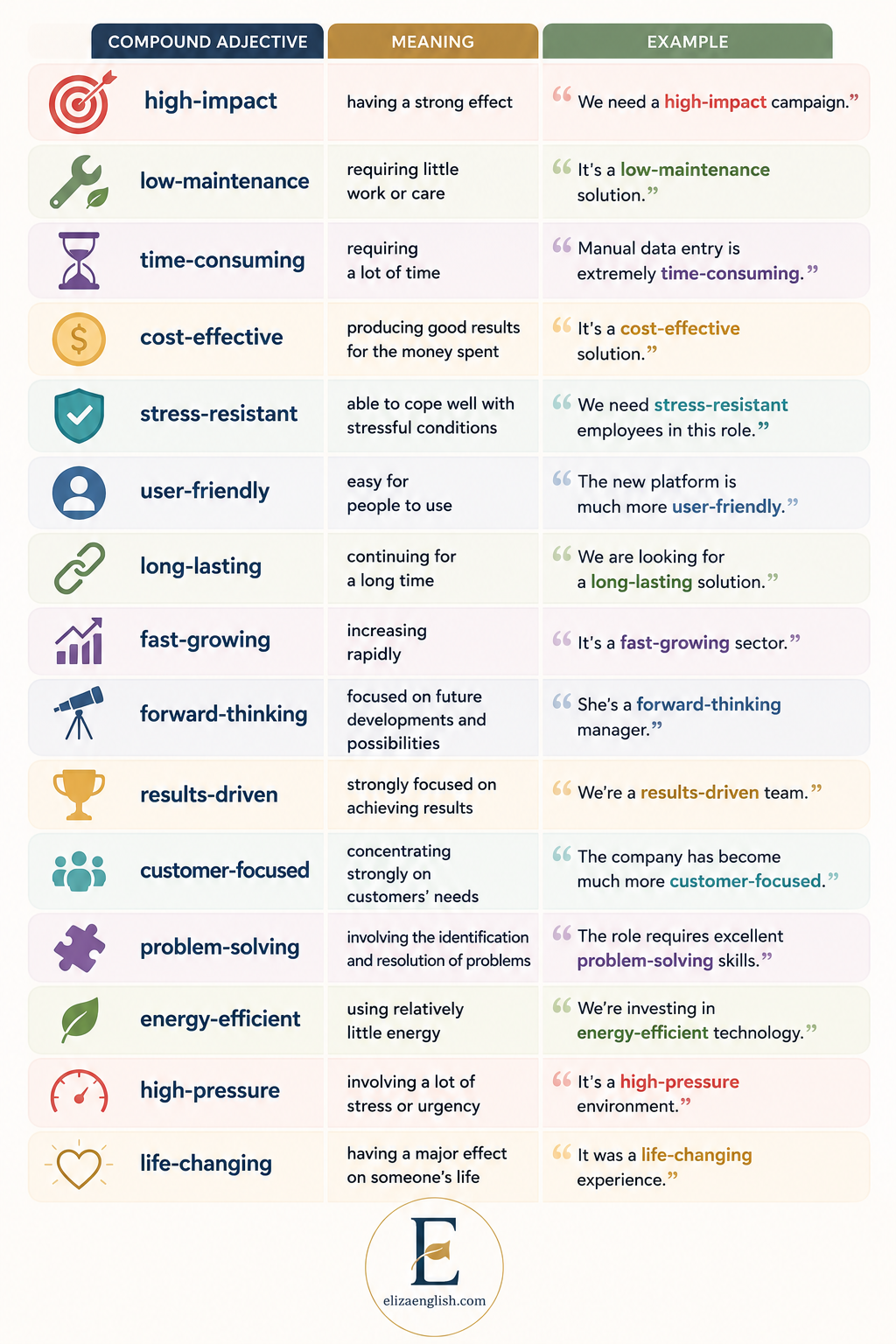
6. Compound adjectives: say more with fewer words
Another powerful way to upgrade your spoken English is to use compound adjectives.
These are combinations of two or more words that work together as one adjective.
They allow you to package a surprisingly large amount of meaning into a compact expression.
7. The language of movement makes stories come alive
One of the biggest mistakes speakers make is describing everything as a static fact.
Stories become much more engaging when your language suggests movement.
Compare:
“We had a problem with the project.”
with:
“The project started smoothly, but then everything began to unravel.”
The second sentence creates a trajectory.
Here are some useful expressions:
To kick things off means to start something.
“Let’s kick things off with a quick question.”
To get the ball rolling means to start an activity or process.
“Let’s get the ball rolling.”
To pick up speed means to become faster or develop more quickly.
“The project really picked up speed in March.”
To hit a wall means to reach a point where progress becomes extremely difficult.
“After six months of negotiations, we hit a wall.”
To get back on track means to return to the correct direction or plan.
“We had a few problems, but we’ve finally got the project back on track.”
To move the needle means to produce a noticeable effect or improvement.
“We need an initiative that actually moves the needle.”
To reach a tipping point means to reach the moment when a situation is likely to change dramatically.
“The market has reached a tipping point.”
This kind of language gives your speech a sense of direction, momentum and drama.
8. How to choose powerful words without sounding unnatural
There is a trap here. Once learners discover metaphorical language, they sometimes try to use it everywhere. That can make a speech sound artificial.
A presentation containing “game-changers”, “silver bullets”, “emotional rollercoasters”, “tipping points”, “blue-sky thinking” and “moving the needle” in every paragraph does not sound sophisticated.
It sounds rehearsed. The goal is not to make every sentence colourful. The goal is to make the important sentences memorable.
A useful rule is:
Use ordinary language for information and vivid language for impact.
For example:
“Our sales increased by 18% last year.”
There is no need to turn that into a metaphor.
But when you interpret the result, you might say:
“That growth was a real turning point for the company.”
The statistic provides evidence. The metaphor provides meaning. That combination is powerful.
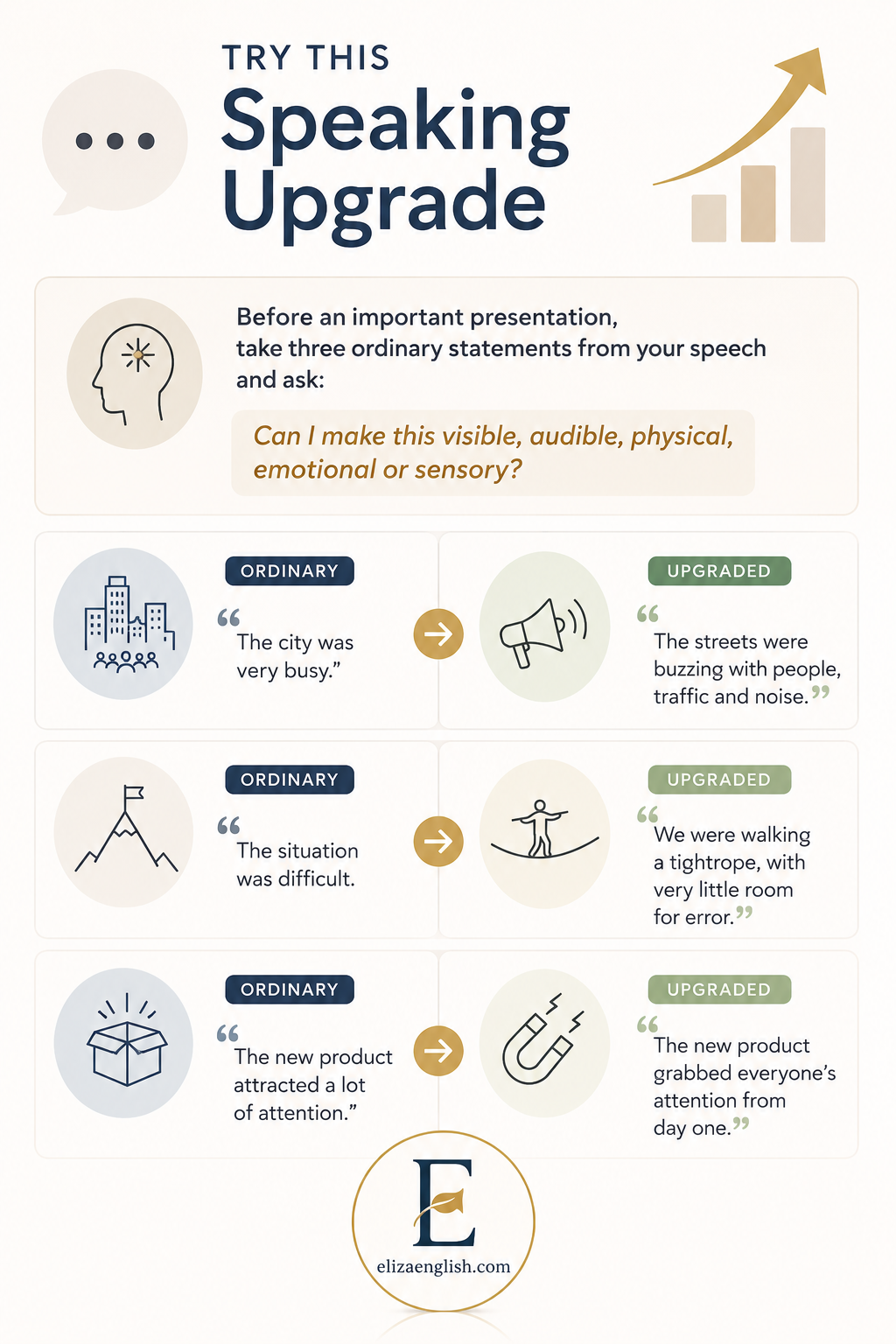
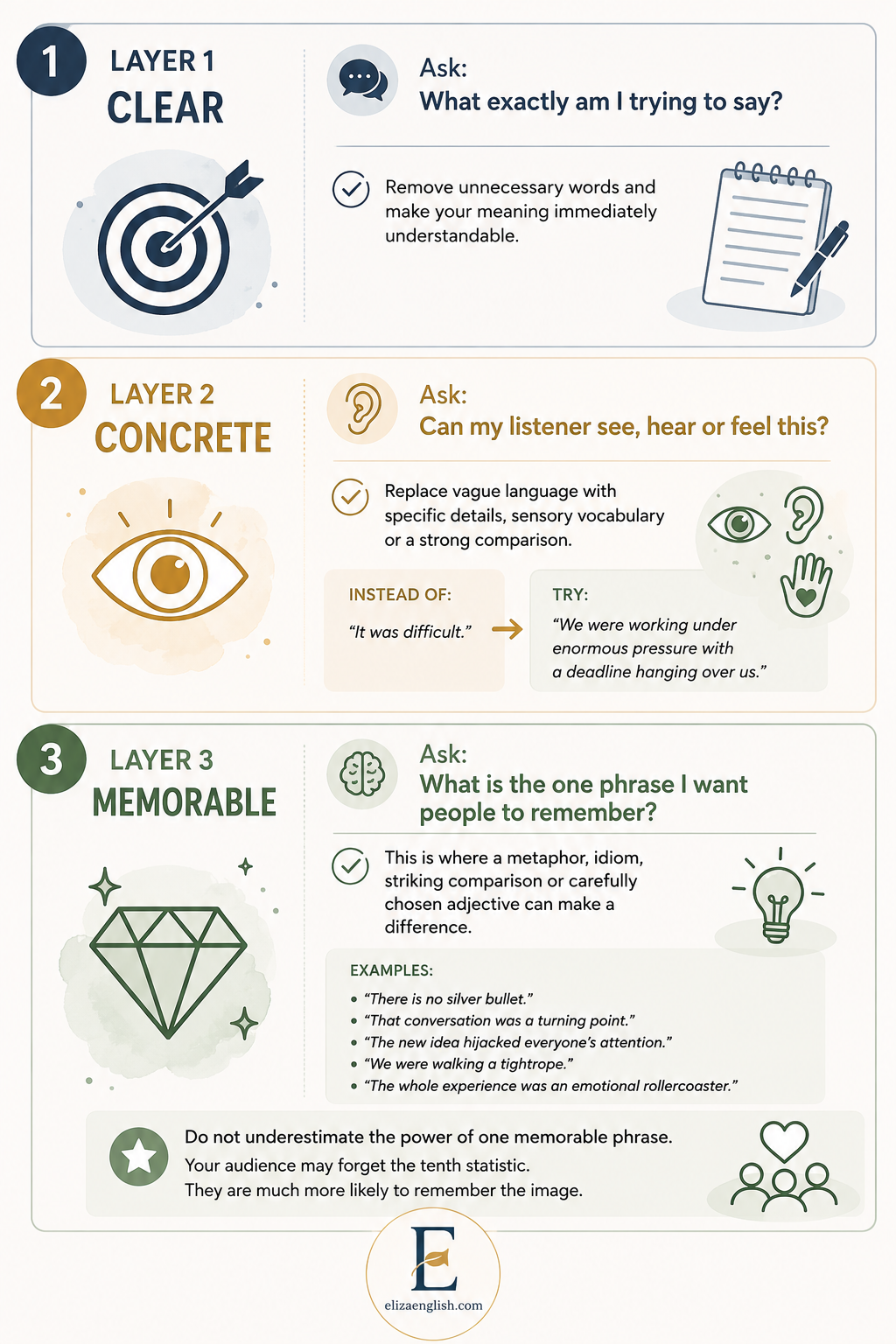
9. The 3-layer protocol for magnetic speaking
Before an important speech, presentation or networking conversation, take your key message through three layers.
10. The “one vivid phrase per minute” technique
Here is a simple exercise I recommend to English learners preparing for an important speaking task.
Record yourself giving a one-minute answer.
Then listen to it and identify the most interesting phrase you used.
If the answer contains nothing particularly vivid, upgrade one sentence.
For example:
“I was very surprised.”
becomes:
“It completely caught me off guard.”
Then:
“The project was very successful.”
becomes:
“The project exceeded all our expectations.”
Then:
“I was very nervous.”
becomes:
“I had butterflies in my stomach.”
You do not need to transform every sentence.
One memorable phrase can change the texture of an entire answer.
As your confidence grows, you can gradually increase the number of vivid expressions you use.
11. How to use magnetic language in different situations
In a public speech
Use vivid language at the beginning and at key transition points.
Instead of:
“Today I’d like to talk about climate change.”
try:
“Imagine waking up one morning and discovering that the place you call home is no longer recognisable.”
The second opening creates curiosity before you even introduce the topic.
In a presentation at work
Use metaphors to explain complex ideas.
“We’re currently at a crossroads.”
“The old system has become a bottleneck.”
“This investment could be a game-changer.”
“We need to get the project back on track.”
These expressions make abstract business processes easier to visualise.
At a networking event
Use colourful language to make yourself easier to remember.
Instead of:
“I work in education and I teach English online.”
try:
“I’m an English teacher, and I help professionals turn their English from something they worry about into something they can actually use with confidence.”
The second version creates a clearer picture of the transformation you provide.
When telling a story
Focus on sensations, movement and emotional shifts.
Instead of:
“I was nervous before my presentation.”
try:
“I was standing outside the room with butterflies in my stomach, wondering whether I was actually ready.”
Now the listener has entered the moment with you.
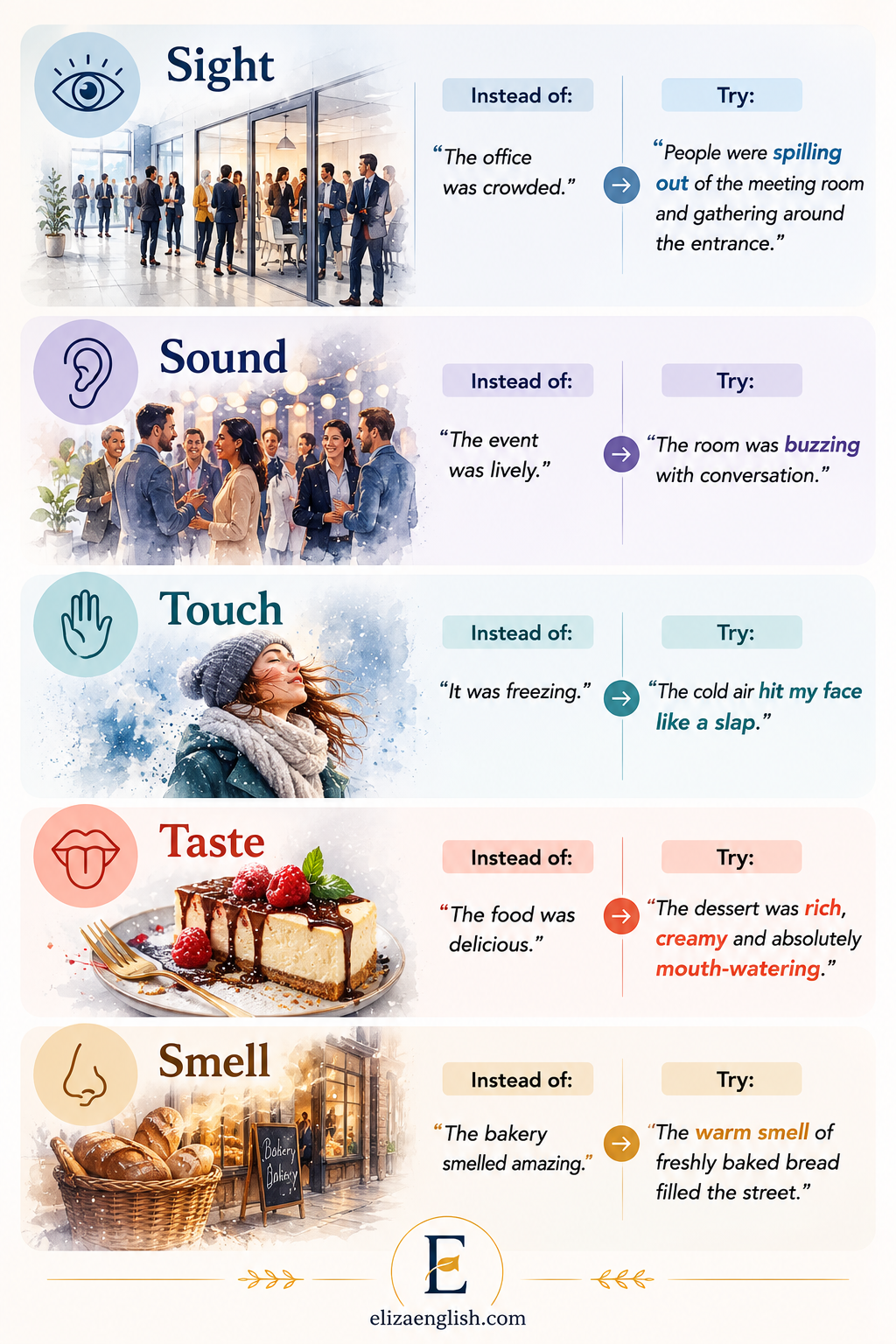
12. The sensory upgrade exercise
Take any ordinary sentence and upgrade it through the five senses.
If you want a compact bank of expressions to practise, start here.
For attention
- hijack someone’s attention = capture someone’s attention very strongly
- grab someone’s attention = make someone notice something
- command attention = attract and hold people’s attention
- make people sit up and take notice = make people suddenly pay serious attention
- catch someone’s eye = attract someone’s visual attention
For emotion
- strike a chord = create a strong emotional response
- hit a nerve = affect a sensitive or important issue
- give someone goosebumps = cause a strong physical/emotional reaction
- send shivers down someone’s spine = create an intense emotional or physical reaction
- pull at someone’s heartstrings = make someone feel strong emotions, especially sympathy or affection
For change
- a turning point = a moment when a situation changes significantly
- a game-changer = something that dramatically changes a situation
- a tipping point = the moment when a major change becomes likely
- open the door to = create a new possibility
- get back on track = return to the intended direction
For difficulty
- hit a wall = reach a point where progress becomes difficult
- walk a tightrope = deal with a situation where balance is difficult
- be an uphill battle = be very difficult to achieve
- be a bitter pill to swallow = be unpleasant but necessary to accept
- be in deep water = be in serious difficulty
For success
- exceed expectations = perform better than expected
- move the needle = make a noticeable difference
- gain momentum = begin developing more quickly or successfully
- pay off = produce a positive result after effort or investment
- be a recipe for success = contain the elements likely to produce success
14. The final rule: don’t try to sound impressive, try to be unforgettable
The most compelling speakers are not necessarily the people with the largest vocabulary. They are the people who understand how language affects attention. They know when to be precise. They know when to tell a story. They know when to use a metaphor. They know when to replace an abstract adjective with a physical sensation.
And they know that sometimes a single unexpected phrase can do more than an entire paragraph of explanation.
So the next time you prepare an important presentation, speech, networking introduction or story, don’t simply ask:
“Is my English correct?”
Ask:
“What will my listener see?”
“What will they feel?”
“What image will stay in their mind?”
“Which phrase will they remember tomorrow?”
That is where truly magnetic English begins. Because powerful speaking is not about using complicated words. It is about choosing the right words to make people experience what you mean.