AI is creating a strange new labour market where some people cannot find one job, while others are juggling three. Developers are considering completely different careers, writers are watching the internet fill with generic content, musicians are competing with synthetic music, and employers are still trying to work out what they actually need. So what the hell is happening?
AI adoption, job displacement, changing careers, freelance work, AI skills and the future of work
There is a strange feeling in the world of work right now.
It is difficult to describe precisely, but once you start talking to people in different professions, you notice it almost immediately.
A software developer tells you they are thinking about a Plan B. A writer complains that the internet is filling up with articles that sound polished but say very little. A teacher is frustrated because students can generate assignments in seconds, while the teacher is simultaneously being told to use AI to become more productive. A music professional watches AI-generated tracks flood streaming platforms. Designers are trying to work out what their skills are worth when anyone can generate a hundred visual concepts before breakfast.
And then you meet someone who is doing extremely well.
They might be freelancing for three companies, working remotely from their apartment, using AI to automate half of their administrative work and earning considerably more than they did in their old full-time job.
This is where things start to feel surreal.
One person is struggling to find a single job. Another has three.
One professional is terrified that AI will replace them. Another has quietly turned AI into a productivity multiplier.
One company is laying people off. Another cannot find people with the right skills.
One freelancer is charging less because AI has made their work easier to produce. Another is charging more because they have learned how to use AI to deliver something clients could not previously afford.
So what the hell is happening?
We are not simply experiencing an AI revolution
Calling this an AI revolution is technically accurate, but it does not really capture what it feels like to live through one.
Revolutions sound exciting when you read about them in history books. They feel rather different when your profession is somewhere in the middle of one.
Generative AI is particularly disruptive because it does not affect just one industry. It can produce or assist with many forms of digital knowledge work that previously required human labour.
What can generative AI produce?
✍️ Text and articles · 🎨 Images and illustrations · 🎵 Music and audio
💻 Code and software · 🌍 Translations · 📊 Presentations
📣 Marketing campaigns and advertising copy · 📚 Lesson plans and educational materials
🔎 Research summaries and analysis · 🎙️ Voice recordings · 🎬 Videos
🖌️ Design concepts
That is what makes the current disruption unusual. AI is not simply changing how software developers work. It is changing how writers, designers, translators, teachers, marketers, researchers, musicians, consultants and many other professionals work.
Almost everyone can therefore feel two things at once:
“This technology could make my job easier.”
and
“This technology could make my job less valuable.”
That is a psychologically difficult combination.
The software developer who is quietly thinking about becoming a plumber
Imagine a software developer who spent years building a career around programming.
They studied computer science. They learned programming languages and frameworks. They worked on real products, fixed bugs, dealt with databases, attended meetings and gradually became good at solving complicated technical problems.
For years, software development looked like one of the safer choices for someone entering the knowledge economy.
Then the environment changed.
AI coding assistants became much better. Companies started asking how much more productive a smaller engineering team could become. Junior developers began facing a more difficult entry-level market, while experienced developers were increasingly expected to know how to work effectively with AI.
Eventually, the developer starts making a joke that contains a little more truth than they would like to admit.
“Maybe I should become a plumber.”
The joke is not really about plumbing. It is about security.
There is something psychologically comforting about a job that requires you to physically show up somewhere and do something that cannot simply be generated inside a chatbot.
- A plumber still has to find the leaking pipe.
- A gardener still has to work in the garden.
- A mechanic still has to inspect the car.
- An electrician still has to deal with the physical environment.
Meanwhile, a surprising amount of white-collar work happens entirely inside a computer, which is exactly where generative AI operates.
That does not mean software developers are going to disappear. It means something more subtle is happening.
The economic value of individual tasks is changing.
The question is no longer simply:
Can AI code?
The more interesting question is:
Which parts of software development have become cheaper because of AI, and which parts still require expensive human expertise?
That distinction is going to matter enormously.
The music industry has its own version of the problem
Now imagine being a professional musician, composer, producer or audio engineer.
You have spent years developing something that is difficult to quantify: taste.
You know why one arrangement works and another feels flat. You understand rhythm, dynamics, production, mixing and sound. You have developed an ear that took years to train.
Then somebody with very little musical experience can type a description into an AI music generator and produce a complete track.
One track becomes ten. Ten become a hundred. Soon there is an enormous amount of synthetic music competing for attention.
The uncomfortable part is that technical quality and popularity have never been the same thing.
A song does not necessarily need to be sophisticated to become popular. It might need to be catchy, familiar, emotionally obvious, unusual enough to attract attention or perfectly suited to a particular social media trend.
Generative AI can produce enormous quantities of content designed around those patterns. For professional musicians, that raises a difficult question.
What happens when the market is flooded with technically acceptable music and the cost of producing another track approaches zero?
The answer may not be that human musicians become irrelevant.
It may be that the value moves somewhere else:
- Identity becomes more important.
- Taste becomes more important.
- Live performance becomes more important.
- Reputation becomes more important.
- A recognisable artistic voice becomes more important.
- A genuine connection with an audience becomes more important.
In a world where everyone can generate music, being someone whose music people specifically want to hear may become more valuable, not less.
Writers are discovering the strange economics of “good enough”
Writers have perhaps the most visible version of this problem.
The internet already had a quality problem long before ChatGPT appeared. Content farms, clickbait, keyword stuffing and generic SEO articles were hardly invented by generative AI.
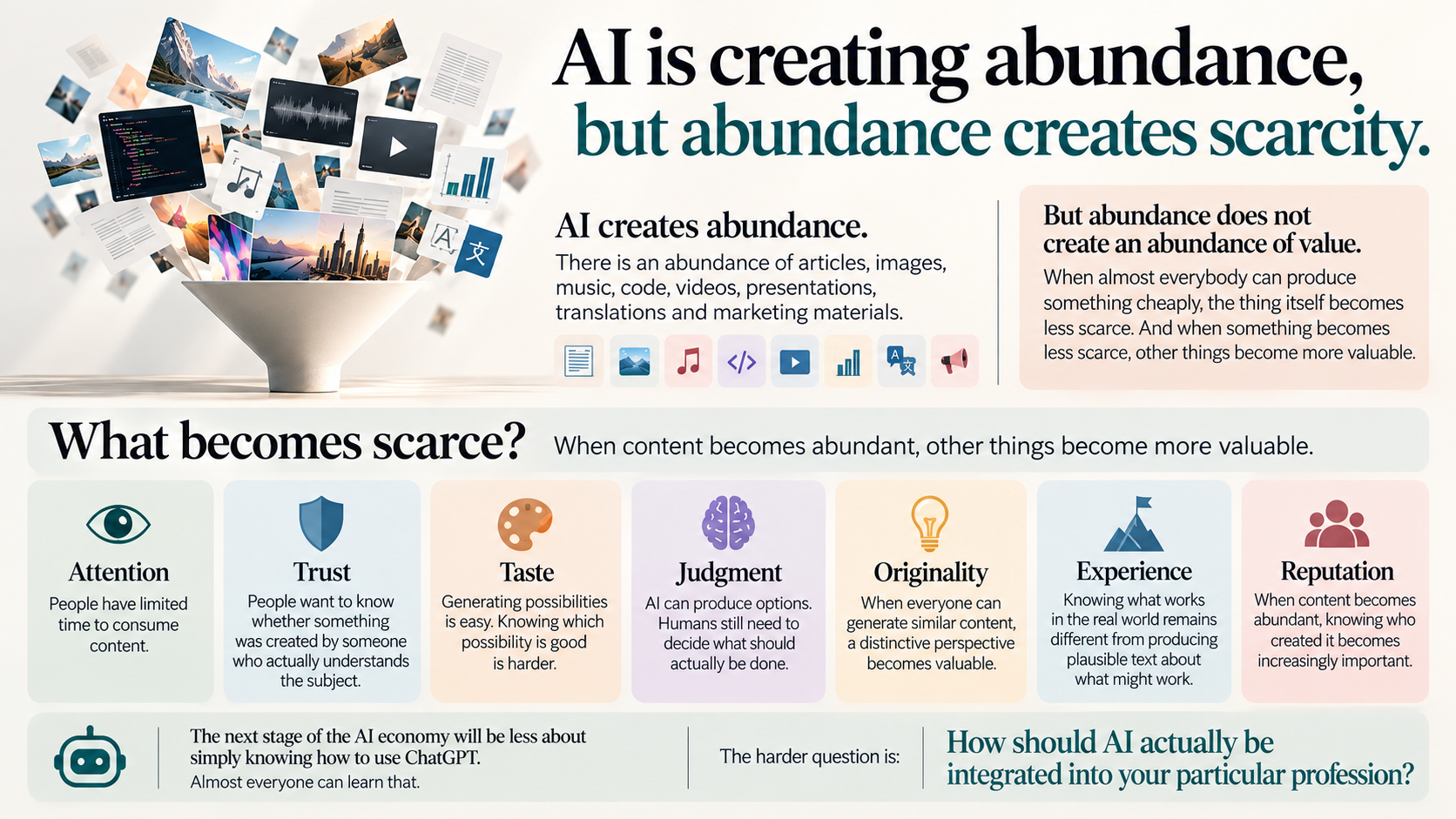
AI simply made mediocre content dramatically cheaper to produce. A company that once needed a writer to produce ten articles can now ask an AI system to produce fifty. The problem is that the internet does not necessarily need fifty articles. It might need one genuinely useful article.
You have probably experienced this yourself. You search for a topic because you want a useful answer. You click on an article and immediately encounter something like:
“In today’s fast-paced digital world, effective communication is more important than ever.”
You continue reading. The next paragraph tells you that technology is transforming our lives. Then you get three generic headings, a list of obvious recommendations and a conclusion telling you that the future is exciting. You close the tab.
You learned almost nothing.
That is one of the great paradoxes of generative AI. AI can produce excellent writing. It can also produce an almost infinite amount of writing that sounds like it was written by nobody in particular. The problem is not simply that AI writes.
The problem is what happens when people use AI without adding enough human judgment.
A good writer brings experience, context, opinion, research, observation and a distinctive voice. A weak AI workflow simply produces more words. And the internet already has enough words.
And then there are the AI pictures
You have probably noticed it too. You see an image online and immediately think:
“That’s AI.”
Maybe the hands look strange. Maybe the text on a sign is almost readable but not quite. Maybe everyone’s skin is suspiciously perfect. Maybe the lighting has that glossy, hyper-real quality that feels strangely familiar. The technology is improving rapidly, but something else is happening at the same time.
The internet is becoming saturated with synthetic visual content.
People are beginning to develop a kind of AI fatigue. Not necessarily because they hate AI. Because they are tired of being surrounded by content that feels manufactured. And this creates another interesting paradox.
The easier it becomes to create content, the more valuable genuinely human content may become.
- A slightly imperfect photograph can feel more authentic than a flawless synthetic image.
- A writer with a distinctive voice can stand out among thousands of generic articles.
- A teacher who understands a particular student’s personality can provide something that another automatically generated worksheet cannot.
- A musician with a recognisable artistic identity may become more valuable precisely because the internet is full of technically competent synthetic music.
The rise of the “three-job freelancer”
There is another phenomenon that deserves more attention. Some professionals are quietly abandoning the idea that a career has to mean one employer and one job.
Instead, they have a portfolio.
They might:
- teach several hours a week
- consult for a company
- take freelance projects
- create digital products
- produce online content
- sell courses or services
- work remotely for multiple clients
- use AI to automate repetitive parts of their workflow
They might technically have three or four sources of income. And some are doing extremely well. Meanwhile, someone else with an impressive corporate CV may be desperately searching for one full-time position.
This is one reason the current labour market feels so confusing.
The question is no longer only:
“Do you have a job?”
It increasingly becomes:
“What combination of skills, clients, projects, platforms and technology generates your income?”
For some people, this flexibility is liberating. For others, it is exhausting.
Having three income streams sounds wonderful until you realise that it can also mean three sets of clients, three calendars, three sources of uncertainty and no real sense of security.
The gig economy did not disappear. AI may simply be accelerating its evolution.
The people who benefit most may not be the people who use the most AI
Imagine two teachers.
Teacher A generates 100 worksheets with AI every week.
Teacher B uses AI to:
- analyse recurring student mistakes
- generate possible activities
- adapt authentic materials to different proficiency levels
- create differentiated versions of tasks
- reduce repetitive preparation
- brainstorm alternatives when a lesson is not working
Teacher A may be using more AI. Teacher B is probably using it better.
The same principle applies to developers, marketers, translators, designers, writers, consultants and many other knowledge workers.
The objective should not be maximum AI adoption. The objective should be optimal AI adoption.
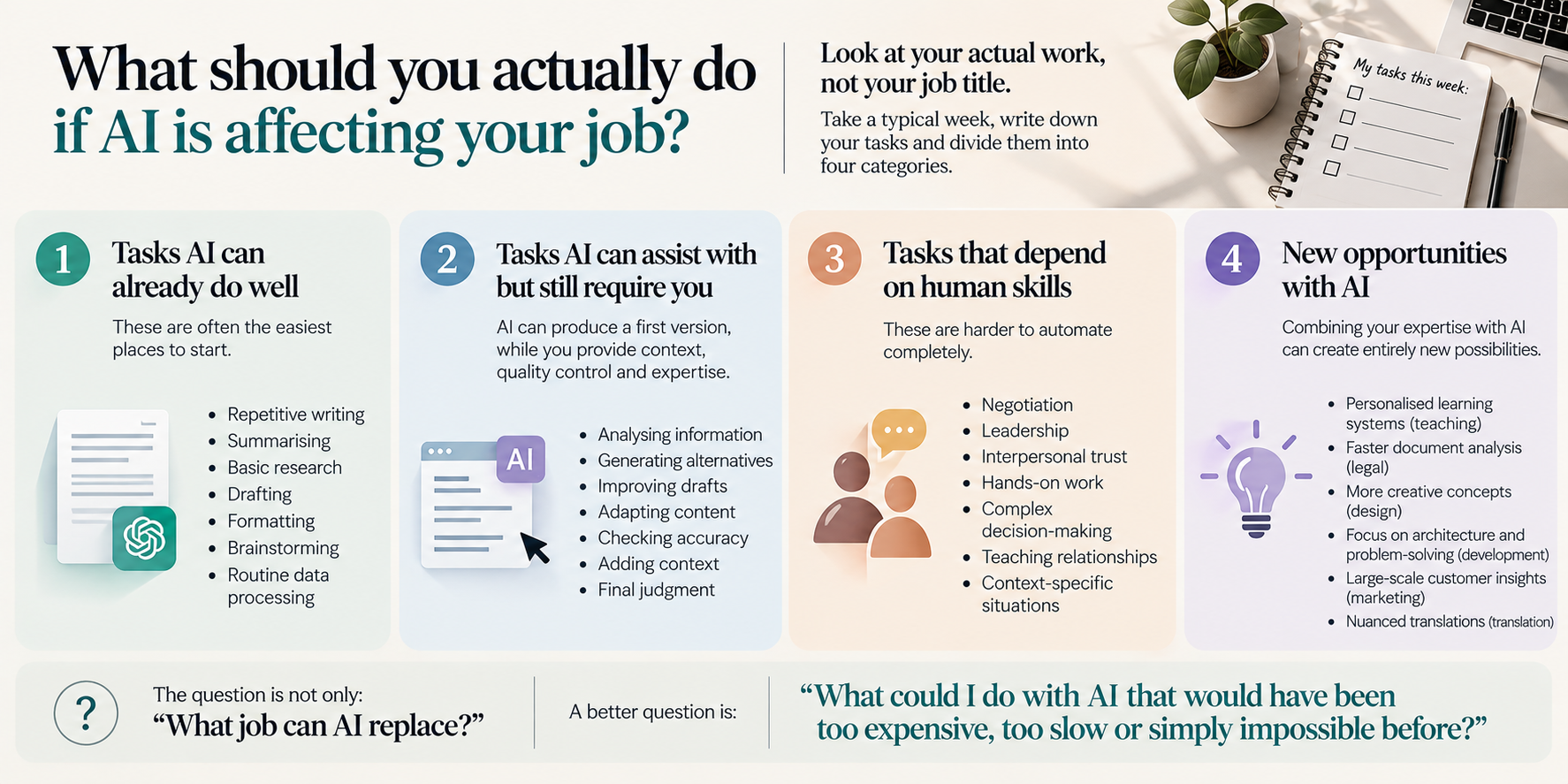
That means identifying the parts of your job where AI can genuinely increase productivity, improve quality or create new possibilities, while protecting the areas where human expertise remains your competitive advantage.
The real question is not “Will AI replace my job?”
This is perhaps the wrong question to begin with.
A better starting point is:
Which parts of my work are becoming easier to automate, which parts are becoming more valuable because of AI, and what new opportunities can I create by combining AI with my existing expertise?
That is a much more useful way to think about the future of work. It moves the conversation away from panic and towards strategy. It also acknowledges something important.
Your professional experience did not suddenly become worthless because AI arrived.
In many cases, your expertise is the thing that allows you to use AI effectively in the first place. The experienced developer can evaluate generated code in ways a beginner cannot.
- The experienced marketer can recognise when an AI-generated campaign sounds completely disconnected from the customer.
- The experienced writer can see immediately when an article is technically coherent but intellectually empty.
- The experienced teacher knows whether an AI-generated activity will actually work with a particular group of students.
The technology matters. But context matters too.
This is where AI adoption coaching comes in
This is exactly why I offer AI adoption coaching for professionals who are trying to figure out where AI actually belongs in their work.
This is not about throwing a list of 50 AI tools at you and telling you to “embrace the future.” It is much more practical.
We start with your actual job.
We look at:
- what you do every week
- where you lose time
- which tasks are repetitive
- where you struggle to produce enough
- which parts of your workflow AI could genuinely improve
- where AI might actually make your work worse
- which new opportunities could emerge from combining your expertise with AI
An AI adoption session can help you:
Identify high-value AI opportunities in your current role.
Find repetitive tasks that could be automated or accelerated.
Choose AI tools based on your actual needs, rather than chasing every new tool that appears online.
Redesign parts of your workflow around AI-assisted work.
Identify new services, products or income opportunities that could emerge from combining your expertise with AI.
Develop a realistic AI adoption strategy that fits your profession.
The goal is not to use more AI.
The goal is to use AI where it actually makes sense.
🎯 Want to explore what AI could do for your specific job?
Bring your actual job, your current workflow and the problems you are dealing with.
We can look at your situation together, identify realistic opportunities to leverage AI tools and develop an adoption strategy that makes sense for your profession, rather than following generic AI advice.
BOOK AN AI ADOPTION COACHING SESSION ON ITALKI
Frequently Asked Questions
How is AI changing the world of work?
AI is changing the world of work by automating or accelerating many digital tasks, including writing, coding, research, translation, design and data analysis. It is also changing employer expectations and creating demand for people who can combine professional expertise with effective AI use.
Will AI replace my job?
AI is more likely to change many jobs by automating particular tasks rather than simply eliminating entire professions overnight. The important question is which parts of your work can be automated, which require human judgment and which new opportunities emerge when AI is combined with your existing skills.
What is AI adoption?
AI adoption is the process of integrating artificial intelligence tools into real workplace processes in a useful and strategic way. Effective AI adoption is not about using as many AI tools as possible. It is about identifying where AI can improve productivity, quality, decision-making or business opportunities.
What skills are becoming more valuable because of AI?
Skills such as critical thinking, judgment, creativity, communication, domain expertise, problem-solving, relationship building and the ability to evaluate AI-generated output are becoming increasingly important. Knowing how to use AI is useful, but knowing when and why to use it can be even more valuable.
How can I use AI in my profession?
Start by mapping the tasks you perform regularly. Identify repetitive activities, time-consuming processes and areas where you need to produce large amounts of content or analyse information. Then explore where AI can assist while keeping human oversight for tasks that require expertise, judgment, context or relationships.
Do I need to become an AI expert to benefit from AI?
No. You do not need to become a programmer or machine-learning specialist. A more useful goal for most professionals is to understand the capabilities and limitations of relevant AI tools and learn how to integrate them into the specific workflows of their profession.