You know the word. You have used it before. You recognise it immediately when you see it in a book, yet when you need it in a conversation, your mind goes blank. You start a sentence confidently, only to lose track of what you wanted to say. You understand the first half of a long sentence but forget the beginning before the speaker finishes.
If this sounds familiar, your vocabulary or grammar knowledge may not be the only factors involved. One piece of the puzzle is working memory, the mental system that allows you to hold information in mind and work with it while performing a task.
Think of your brain as a computer. Learning vocabulary, grammar, and pronunciation is like installing software. Working memory helps you run that software while doing something demanding. Even with excellent software, a system can struggle when too many processes compete for its resources.
Of course, the brain is not literally a computer, and working memory is not a fixed hardware specification that can be upgraded indefinitely. However, the analogy highlights an important principle: learning more English is not always enough. You also need effective ways to process, retrieve, and use what you learn.
So, what is working memory, how does it differ from other types of memory, and which exercises are genuinely worth your time?
The Different Types of Memory and Their Roles in Language Learning
Memory is not a single storage system. Psychologists distinguish between several interacting systems that help us retain, retrieve, and use information. Understanding their differences can help you choose more effective learning strategies.
Short-term memory refers primarily to the temporary retention of a limited amount of information. For example, you might remember a new English word long enough to repeat it immediately after hearing it, or hold a short instruction in mind while carrying it out.
Imagine hearing the sentence:
“Despite the heavy traffic, we arrived at the airport on time.”
If you repeat the sentence immediately after hearing it, you rely partly on short-term retention, alongside language perception and production.
Short-term memory is useful for language learning because information must often be held briefly while you process what you hear or read. However, simply retaining information does not necessarily mean you can manipulate it or use it flexibly.
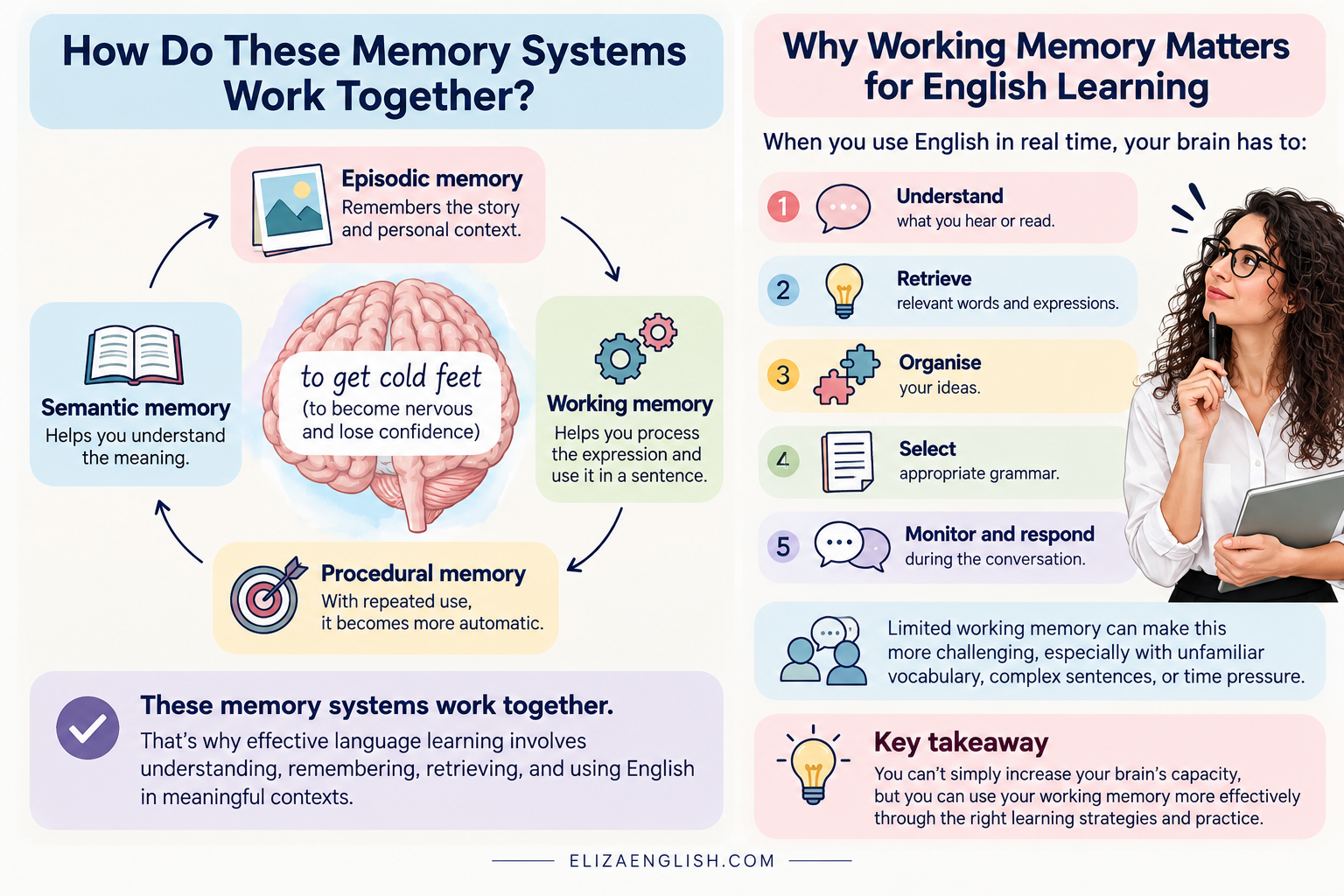
Working memory goes a step further. It allows you to maintain information in mind while actively processing, organising, or manipulating it.
For example, you might hear the sentence about arriving at the airport, explain why the travellers were still on time, paraphrase the sentence, or use its structure to create a new example.
In simple terms, short-term memory helps you hold information; working memory helps you hold and work with it. The distinction is not absolute, and researchers sometimes use the terms differently, but it is a useful way to understand their roles.
Working memory is particularly relevant when you need to follow a conversation, construct a complex sentence, retrieve vocabulary, or respond spontaneously in English. It helps coordinate the information you need while you complete these tasks.
3. Episodic Memory: Remembering Experiences
Episodic memory allows you to remember personal experiences and events, including where they happened and how they unfolded.
You might remember your first English lesson, a conversation you had during a trip abroad, or a moment when you successfully gave a presentation in English.
These experiences can provide meaningful contexts for language. A phrase learned during an amusing conversation may be easier to recall than one copied from an isolated vocabulary list.
How to use it: Connect new vocabulary with personal experiences. Instead of memorising relieved as simply meaning “no longer worried”, remember a situation in which you felt relieved and describe it in English.
For example:
“I felt relieved when I discovered that I had passed the exam.”
Personal examples give abstract vocabulary a context that can make it more meaningful and memorable.
4. Semantic Memory: Your Store of Knowledge
Semantic memory contains general knowledge, facts, concepts, and word meanings.
When you know that reluctant means unwilling or hesitant, that despite is followed by a noun phrase or an -ing form, or that Warsaw is the capital of Poland, you are drawing on semantic knowledge.
This type of memory is essential for language learning because understanding English requires knowledge of vocabulary, grammar, meanings, and the relationships between words.
How to use it: Learn words through meaningful relationships rather than isolated definitions. For example, compare reluctant, hesitant, unwilling, and eager. Notice their differences and use them in contrasting sentences.
“She was reluctant to accept the offer, whereas her colleague was eager to take the opportunity.”
5. Procedural Memory: Developing Skills and Automaticity
Procedural memory supports learned skills and routines that become increasingly automatic through practice.
Think about typing without looking at the keyboard or performing a familiar sequence of movements. You do not need to consciously plan every individual action.
Language use also develops elements of automaticity. With sufficient meaningful practice, familiar grammatical patterns, collocations, and pronunciation sequences can become easier to produce without consciously recalling every rule.
For example, an experienced English speaker usually does not need to stop and analyse the structure of I’ve been working here for three years before using it.
Language automaticity is complex and should not be reduced to procedural memory alone. Nevertheless, the practical lesson is valuable: repeated, meaningful use can make familiar language easier to access.
The 7 Most Effective Exercises to Practise Working Memory for English
Not all memory exercises are equally useful for language learning. Reversing random numbers or playing a memory game may help you practise that particular task, but it does not automatically improve your ability to speak English.
For the greatest practical value, prioritise activities that combine working-memory demands with real language use. These exercises focus on retaining information, manipulating it, retrieving it, and using it to communicate.
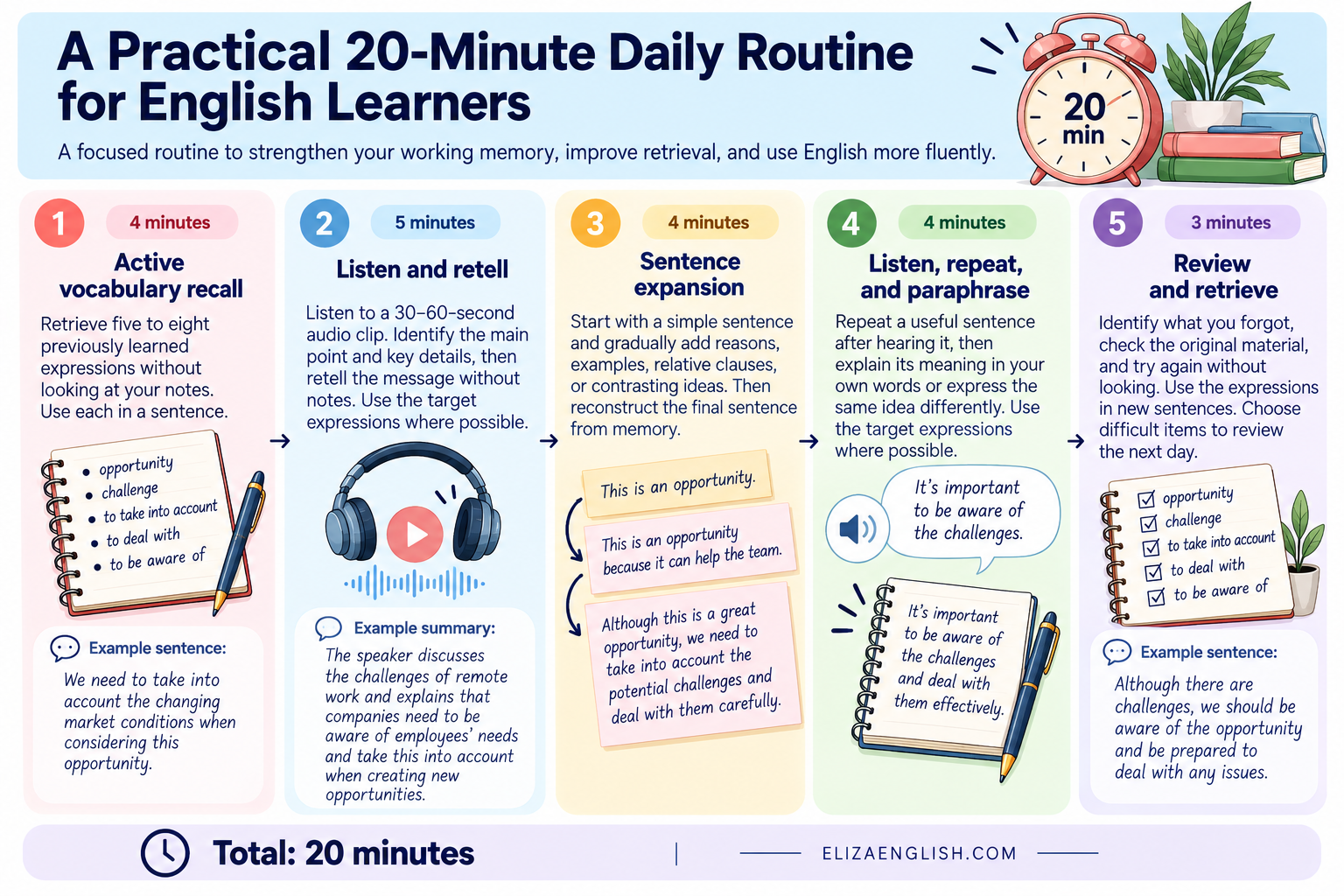
1. Listen, Hold, and Retell
Best for: Listening comprehension, speaking fluency, and remembering spoken information.
This exercise requires you to retain the meaning of a short passage while reconstructing it in your own words.
Choose a 30–60-second extract from a podcast, interview, or educational video. Listen once without taking notes.
Then close the recording and answer three questions:
- What was the main point?
- What were the two most important supporting details?
- What example or conclusion did the speaker mention?
Now summarise the passage aloud in your own words.
For example, suppose you listen to a short explanation of why people procrastinate. Your summary might be:
“The speaker explains that people sometimes postpone difficult tasks because they feel overwhelmed. One suggested solution is to break a large task into smaller, more manageable steps.”
Finally, listen again and identify any important information you missed.
As you improve, use longer recordings or more complex arguments. You can also practise giving a summary in 30 seconds, which requires you to prioritise the most important information.
Why it works: You practise listening, retaining meaning, retrieving information, and producing language. These are directly relevant to real communication, although the exercise does not guarantee an increase in general working-memory capacity.
2. Expand and Reconstruct Sentences
Best for: Speaking fluency, grammar, and constructing complex sentences.
When speaking a foreign language, you may know a grammar rule but struggle to apply it while managing the content of your message. Sentence reconstruction provides a structured way to practise familiar language patterns.
Start with a simple sentence:
“I changed my job.”
Add a time reference:
“I changed my job last year.”
Explain the reason:
“I changed my job last year because I wanted more flexibility.”
Add a consequence:
“I changed my job last year because I wanted more flexibility, which allowed me to spend more time with my family.”
Now look away from the original sentences and try to reconstruct the final version from memory.
For an advanced variation, add a contrast:
“Although the new position offered greater flexibility, it also required me to learn several unfamiliar skills.”
You can practise this with conditional sentences, relative clauses, reported speech, or structures you frequently use in IELTS, TOEFL, or everyday conversation.
Why it works: You rehearse retrieving grammatical patterns and combining ideas without having to invent every sentence from scratch. Over time, meaningful repetition can make familiar structures easier to produce.
3. Learn Vocabulary in Chunks, Not Isolated Words
Best for: Vocabulary retention, collocations, and spontaneous speaking.
Suppose you want to learn the word decision. Memorising the word and its translation is a useful starting point, but it may not be enough to help you use it naturally.
Learn it as part of a phrase:
- make an informed decision
- reach a difficult decision
- reconsider a decision
- a life-changing decision
Now choose one phrase and use it in a personal example:
“Before accepting the job offer, I needed time to make an informed decision.”
Cover the phrase and try to reproduce it from a cue such as make an ___ decision. Then use it in a different context.
Repeat the process with several collocations, but keep the number manageable. Five well-practised phrases are often more useful than twenty phrases you have only read once.
Why it works: Meaningful chunks provide ready-made combinations of words. Familiar chunks can reduce the amount of conscious processing needed during speaking and help you produce more natural English.
4. Retrieve Vocabulary at Increasing Intervals
Best for: Long-term vocabulary retention and easier retrieval.
Learning a word once does not guarantee that you will remember it when you need it. Spaced practice gives you repeated opportunities to retrieve information after some time has passed.
A 2022 meta-analysis by Kim and Webb examined 48 experiments involving 3,411 participants and found that spaced practice had a medium-to-large positive effect on second-language learning. The benefits of spacing were particularly relevant to delayed retention.
Here is a simple schedule you can use:
Day 1: Learn. Learn five useful expressions and create an example for each.
Day 2: Retrieve. Recall the expressions from their meanings without looking at your notes.
Day 4: Apply. Use them in a short spoken response.
Day 7: Reuse. Write a paragraph or tell a story using the expressions.
Day 14: Review. Test yourself again and review the expressions you have forgotten.
These intervals are a practical starting point rather than a scientifically optimal schedule for every learner. Review difficult expressions sooner and extend the intervals for those you remember easily.
Why it works: Spaced retrieval supports long-term retention and gives you repeated practice accessing vocabulary without relying on immediate visual prompts.
5. Listen, Repeat, and Paraphrase
Best for: Listening accuracy, pronunciation, and temporary retention of spoken language.
Choose a short English sentence, preferably one that contains useful vocabulary or a grammatical structure you want to practise.
For example:
“Despite the initial difficulties, the team managed to reach an agreement before the deadline.”
Listen once. Pause the recording and repeat the sentence without looking at a transcript.
Next, try to reproduce it again, paying attention to stress and rhythm. Finally, explain its meaning in your own words.
For example:
“Although the beginning was difficult, the team agreed on a solution in time.”
There are two related activities here. Immediate repetition emphasises temporary retention and speech production. Paraphrasing requires you to understand the message and reconstruct it using different language.
Why it works: The exercise integrates listening, temporary storage, pronunciation, and language production. It is particularly useful when practised with material that is challenging but still understandable.
Best for: Practising information retention while processing something else.
Working memory is often required when we maintain information while performing another mental task. You can practise this in a language-learning context without making the activity unnecessarily complicated.
Read this short statement:
“Many employees prefer flexible working arrangements because they allow them to organise their schedules more independently.”
Hide the statement. Now do a simple mental calculation, such as 18 + 27.
Then explain the original statement in your own words.
A possible answer is:
“Some employees like flexible working because it gives them greater control over their time.”
Start with short, simple material. If you cannot recall the main point, reduce the difficulty rather than repeatedly forcing yourself to complete a task that is too demanding.
Why it works: You practise retaining a message while attention is occupied by another task. However, there is limited evidence that practising these combinations will automatically improve unrelated language skills. Use this exercise as supplementary practice, not as the foundation of your study routine.
7. Summarise the Same Message in Three Different Ways
Best for: Flexible language use, paraphrasing, and organising ideas.
Take a short paragraph or a one-minute audio extract. Your task is to express the main message in three formats:
- A one-sentence summary.
- A 30-second spoken explanation.
- A detailed explanation with one example.
For instance, the original message might explain that regular physical activity can support general health and wellbeing.
Your one-sentence summary could be:
“Regular exercise supports physical health and can contribute to overall wellbeing.”
Your longer explanation might include an example of how walking or cycling can be incorporated into a daily routine.
Finally, explain the same message to a child or to someone unfamiliar with the topic.
Why it works: You practise selecting important information, retrieving vocabulary, reorganising ideas, and adapting your language to different purposes. These are valuable skills for speaking examinations, presentations, and everyday conversations.
Do Brain-Training Apps and Memory Games Improve English Fluency?
You may have heard that playing memory games, completing number-sequence challenges, or using brain-training applications can dramatically increase your working-memory capacity.
The evidence is more nuanced.
Working-memory training research has found that people can improve on the specific tasks they practise. However, improvements do not reliably translate into broader cognitive abilities or unrelated real-world skills.
This distinction matters. Getting better at a particular memory game does not necessarily mean you will remember English vocabulary more effectively or speak more fluently.
If you enjoy memory games, there is no reason you cannot include them in your routine. However, if your main objective is to improve English, give priority to activities that require you to process, retrieve, and use English itself.
You will be practising the mental processes that matter while simultaneously developing the language skills you want to improve.
Bottom Line: Improve the Way You Learn, Not Just What You Learn
Working memory is an important part of the language-learning process, but it is not a magic switch that determines how fluent you can become.
You cannot guarantee a dramatic increase in your general mental capacity by completing a few memory exercises. What you can do is make your learning more efficient, practise retrieving information, learn meaningful language chunks, and gradually become more comfortable processing English in real time.
Think again about the computer analogy. Downloading more software is not always the solution when a system struggles with demanding tasks. Sometimes, you need to manage the workload, remove unnecessary demands, and learn to use the tools you already have more effectively.
The same principle applies to English learning. Combine vocabulary acquisition with retrieval practice, listening and retelling, sentence reconstruction, and meaningful speaking. Give yourself enough time to revisit what you learn, and choose tasks that challenge you without overwhelming you.
Your goal is not simply to remember more English words. It is to make the English you already know easier to retrieve, combine, and use when it matters most.
Further Reading
- Kim, S. K., & Webb, S. (2022). The Effects of Spaced Practice on Second Language Learning: A Meta-Analysis. Language Learning, 72(1), 269–319. Read the research.
- Rodas, J. A., Asimakopoulou, A. A., & Greene, C. M. (2024). Can we enhance working memory? Bias and effectiveness in cognitive training studies. Psychonomic Bulletin & Review, 31, 1891–1914. Read the research.
Frequently Asked Questions
What is working memory in language learning?
Working memory is the mental system that temporarily holds and processes information while you perform a task. In language learning, it helps you follow conversations, construct sentences, retrieve vocabulary, and respond to what other people say.
Can you improve working memory?
You can improve your performance on specific working-memory tasks through practice, but evidence that this reliably increases general capacity or improves unrelated abilities is limited. Language-focused exercises, retrieval practice, and effective learning strategies can help you perform the language tasks that matter to you.
What is the best exercise for working memory?
For English learners, listening to a short passage and retelling it without notes is a useful starting point. It combines comprehension, temporary retention, retrieval, and spoken production. Pair it with vocabulary recall and sentence reconstruction for a more varied routine.
How does working memory affect English speaking?
Working memory helps you retain the meaning of a conversation while retrieving words, organising ideas, and constructing sentences. However, speaking fluency also depends on vocabulary knowledge, grammar, pronunciation, automaticity, and opportunities to practise.