



How to Make Your English Speech Magnetic
Learn how to make your English speech more magnetic with powerful words, vivid metaphors, sensory language and memorable expressions for public speaking, presentations, networking and storytelling.
You start preparing for an English exam with energy. You buy the books, download the apps, make vocabulary lists, practise speaking every day and promise yourself that this time you are going to reach the score you need. For the first few weeks, everything feels encouraging. You learn new expressions, your practice-test scores begin to move, you understand more when you listen, speaking feels easier and even difficult grammar starts to become familiar.
Then something strange happens. After several weeks or months, your progress seems to slow down. You are still studying and completing exercises, and you may even be spending more time on English than before, yet your scores barely change. Worse, English starts to feel boring. The same vocabulary exercises that once felt useful now feel pointless. Another reading passage produces an internal sigh before you have even started it. You know the exam format so well that opening another practice test feels like watching the same film for the tenth time.
This is often described by learners as English study burnout, although there is an important scientific distinction to make.
The term burnout is widely used to describe prolonged exhaustion and loss of motivation during studying, but the World Health Organization has a specific definition of burnout in ICD-11. WHO classifies burnout as an occupational phenomenon, rather than a medical condition, and defines it through three dimensions:
WHO specifically says that this definition applies to the occupational context and should not automatically be applied to other areas of life.
Therefore, calling every tired English learner burned out would be scientifically too broad. For exam candidates, it is more accurate to talk about a combination of study fatigue, motivational decline, perceived learning plateau and, in some cases, academic burnout.
And this phenomenon is not imaginary. Research on student burnout shows that it can be substantial. For example, a systematic review and meta-analysis covering 42 studies and 26,824 medical students estimated an overall burnout prevalence of about 37.2%, although the figures varied considerably between studies and countries.
Another meta-analysis covering 55 studies and 27,940 university students in low- and middle-income countries estimated burnout prevalence at 12.1%, while much higher proportions experienced individual dimensions such as cynicism and emotional exhaustion. The enormous variation between studies is important: there is no single universal student burnout percentage.
So what happens specifically to the English learner who spends months preparing for IELTS, TOEFL, the Duolingo English Test, CAE, SAT or another high-stakes examination? The answer has a lot to do with how learning changes once the brain becomes familiar with a task.
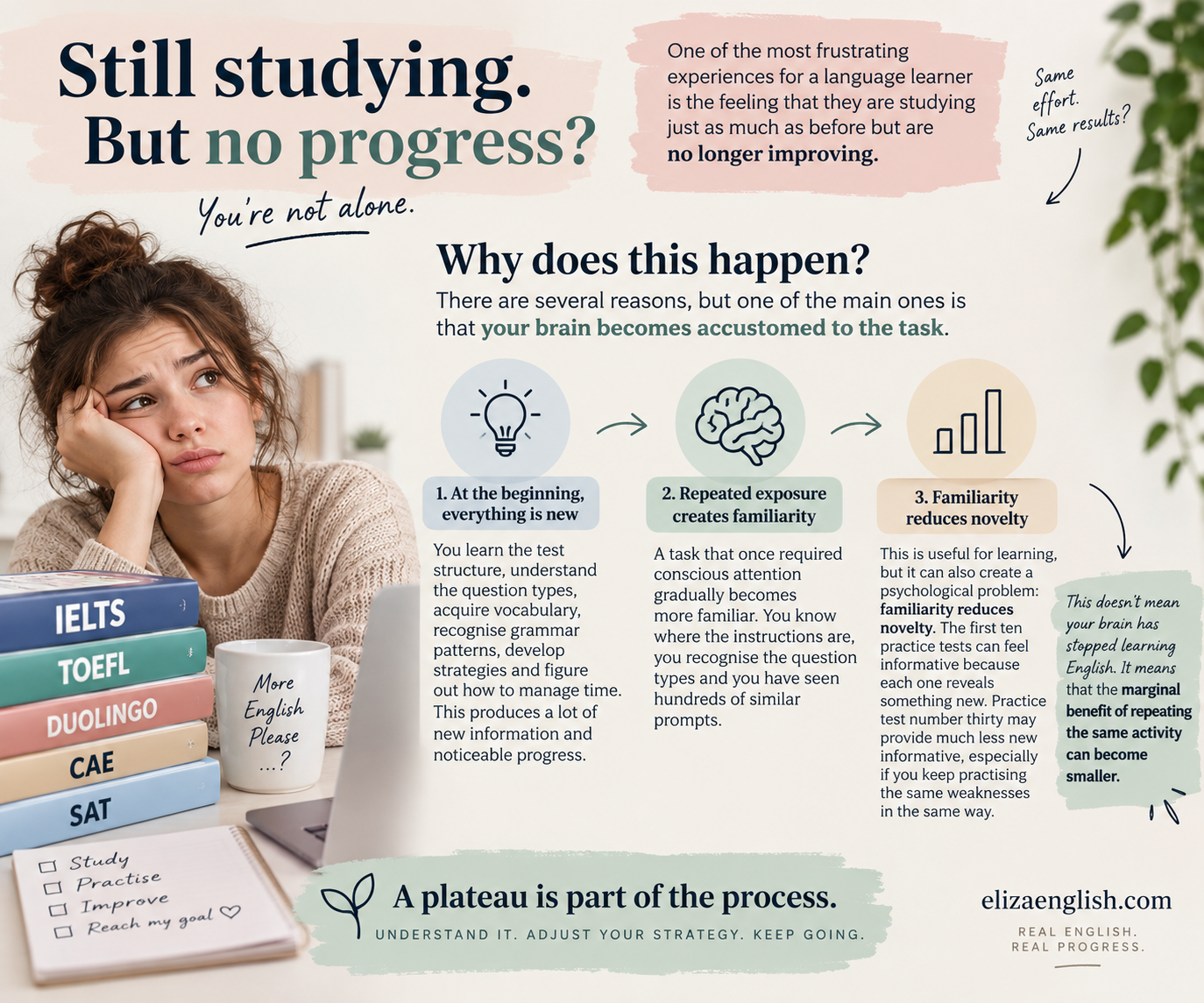
Language learning is not a straight line. A learner might experience:
rapid improvement → slower improvement → plateau → breakthrough → another plateau
This is particularly common at higher levels. Moving from beginner English to intermediate English involves acquiring enormous amounts of new, immediately useful language. Moving from B2 to C1 is different. The student already knows thousands of words and understands most ordinary conversations, so improvement may involve much subtler changes:
These improvements can be real without producing dramatic changes in a weekly test score. That is one reason students can feel that nothing is happening even when their underlying competence is changing.
Imagine a student preparing for IELTS. For six weeks, she does vocabulary exercises, grammar exercises, reading tests, listening tests, speaking questions and writing corrections. Her score improves, so she continues doing exactly the same things.
After another six weeks, however, the improvement becomes much smaller.
The natural reaction is to think that more practice is needed, so she increases the number of exercises. But quantity is not necessarily the missing ingredient.
If the student has already adapted to the task, doing another 100 nearly identical questions may provide considerably less benefit than changing what kind of learning is happening.
This is where research on learning becomes particularly useful. Decades of research support distributed practice, meaning that learning is spread across time rather than concentrated into massed sessions. A large quantitative review of verbal learning examined hundreds of experiments and found that spacing study episodes can substantially influence long-term retention.
Retrieval practice is also important. Research has repeatedly shown that actively retrieving information from memory can strengthen learning, rather than simply studying the same material again.
A more recent systematic review of distributed practice and retrieval practice in health-professions education found significant benefits over comparison conditions in 43 of 63 experiments. Although this evidence comes from a different educational context, it supports the broader learning principle rather than providing a specific prescription for English exam preparation.
More studying is not always the same as better studying.
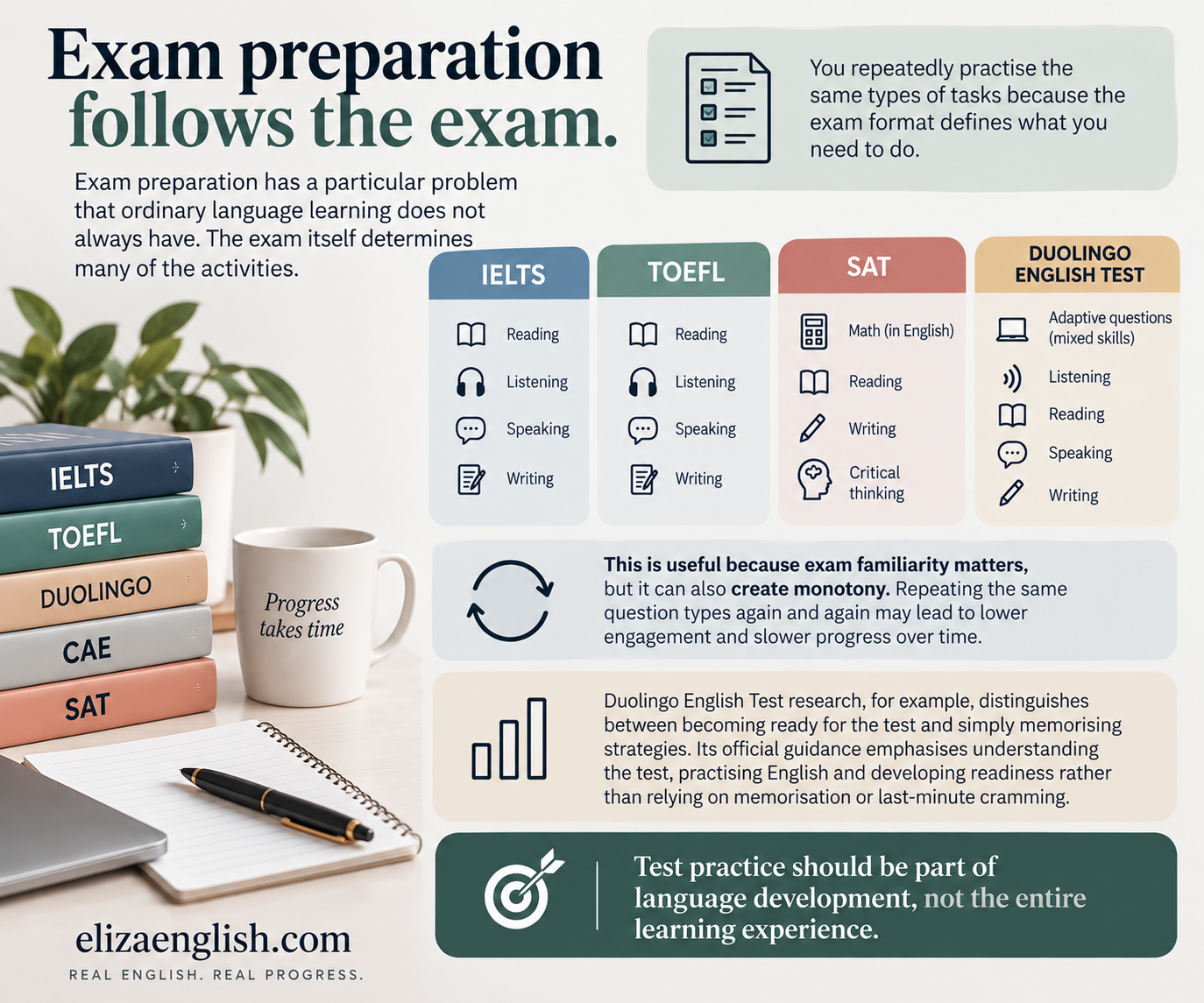
This is where online advice often becomes misleading. You will find claims that three months is perfect or that you need six months. Neither statement is universally correct.
The required preparation time depends on at least four major variables:
IELTS itself notes that many learners need substantial amounts of study to progress between CEFR levels. Its guidance cites a commonly used estimate of at least 120 hours of study to progress one CEFR level, with the amount increasing at higher levels. IELTS also cites studies in which students improved by up to half a band over approximately three months, with greater gains associated with lower starting levels, high study time and motivation.
Cambridge English similarly estimates approximately 700 to 800 cumulative guided learning hours from beginner level to C1, and 1,000 to 1,200 hours to reach C2. These are guidelines, not guarantees.
For exam-specific preparation, however, shorter periods can be perfectly reasonable when a student’s English is already close to the required level.
College Board recommends that students begin SAT practice at least two to three months before the test, while its guidance also notes that many students study for two to three months. ETS provides an eight-week TOEFL preparation plan, and its guidance recommends spreading study across several days rather than concentrating it into exhausting sessions. ETS has also published a three-month TOEFL study plan for the 2026 test.
There is not enough evidence to say that.
A better conclusion is that around two to three months can be a reasonable focused preparation window for a learner who is already close to the required level, while learners who need substantial language development may need considerably longer.
The longer the preparation period becomes, the more important it is to vary the learning environment and periodically redesign the study routine. That is where prevention of study burnout becomes crucial.
This is probably the most important change. If a student has been doing 40 IELTS reading questions every day for three months, the answer may not be 50 questions.
Change the cognitive task. Instead of another reading test, ask the student to:
The exam remains the destination, but the route becomes more varied. This can also make English feel like a language again rather than a collection of test questions.
One of the best ways to rekindle interest is to temporarily remove the feeling that every English activity must produce a score.
Read something interesting. Watch a documentary. Listen to a podcast. Discuss technology, travel, psychology, business, films or current events. Read a novel. Have a conversation without correcting every mistake.
Then bring the language back into exam preparation.
This creates a useful distinction: English is the subject. The exam is the measurement system. They are not the same thing.
Students often feel that they know a word because they have seen it hundreds of times. But recognition is not the same as retrieval. Instead of repeatedly looking at vocabulary lists, make students produce the language.
For example, with the word allocate, do not simply reread its definition. Ask:
This makes the learner retrieve the information rather than simply recognise it. Research strongly supports retrieval and spacing as important learning mechanisms.
A student who measures progress only through an IELTS band score or TOEFL score can become demoralised. The score may remain stable while important improvements are happening underneath.
Instead, track smaller indicators.
For speaking, look at fewer pauses, longer answers, better organisation, more precise vocabulary and fewer repeated grammatical errors.
For writing, monitor stronger paragraph structure, fewer errors, better cohesion and wider ranges of accurately used vocabulary.
For listening, track improved comprehension of unfamiliar accents, better recognition of connected speech and faster identification of key information.
For reading, monitor faster processing, improved inference and fewer careless mistakes.
These micro-measures give the learner evidence that improvement is occurring.
Burnout prevention is not about finding a magical productivity technique. It is also about managing the overall workload.
Long, exhausting study sessions are not automatically better. ETS’s current TOEFL guidance explicitly recommends short, focused study sessions, productive breaks and realistic daily goals, while warning against cramming and unsustainable study patterns.
A sustainable preparation schedule might therefore look like this:
The exact schedule should depend on the learner, but the principle is universal: recovery is part of the learning system, not a reward for finishing it.
Teachers are often the first people to notice that something has changed.
A student who used to arrive enthusiastic may suddenly say that they do not want to study anymore. The student may still complete the homework and attend lessons, but their attitude becomes passive. They stop experimenting with language, stop asking questions and make the minimum effort necessary to complete the task.
This is the point where simply assigning more homework can make the situation worse.
The teacher should first diagnose the problem. Is the student:
The intervention depends on the answer.
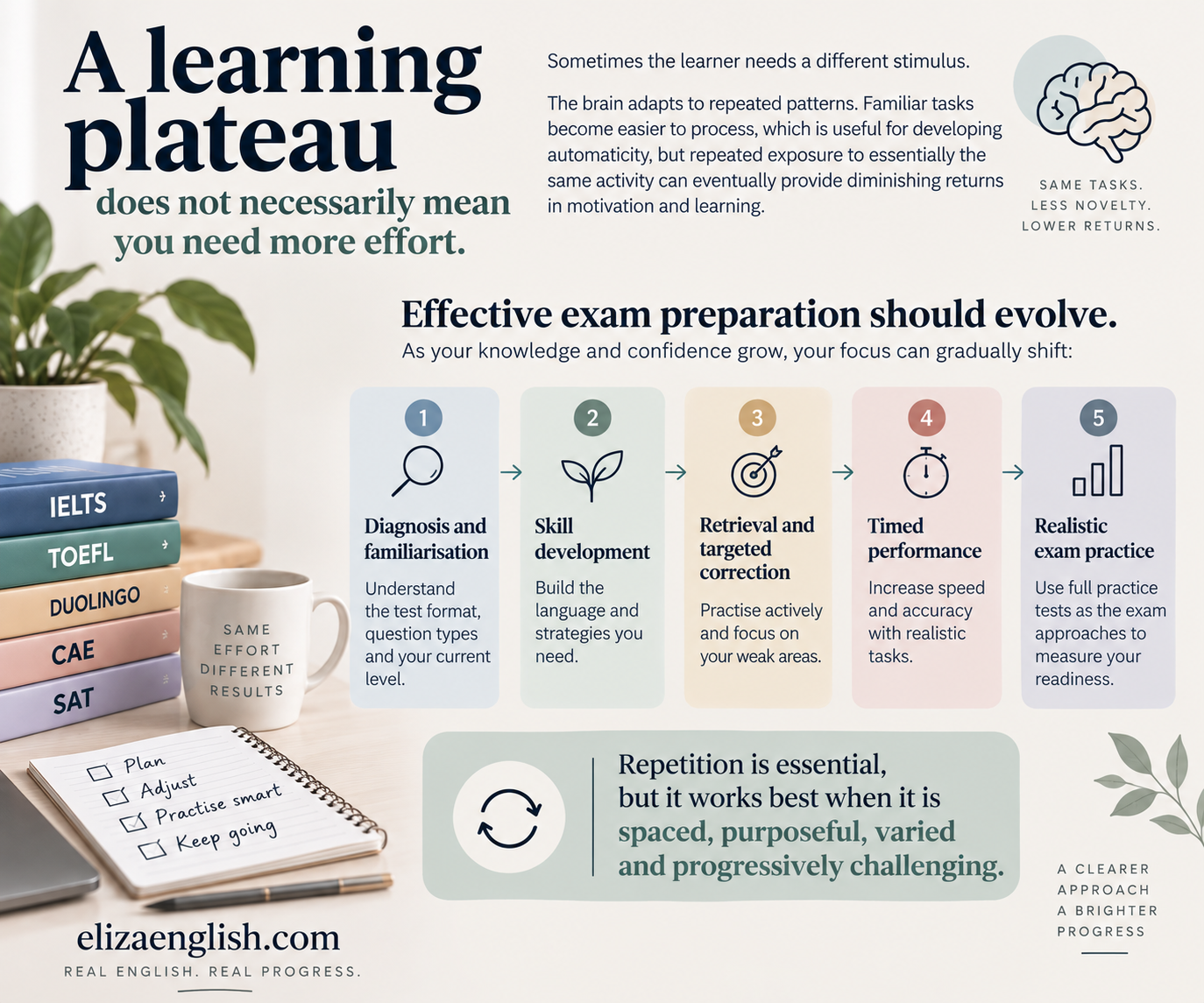
If your English exam preparation has suddenly become boring, exhausting and strangely unproductive, it does not automatically mean that you are lazy or that you have reached the limits of your ability.
You may simply have reached the point where your old learning system has stopped providing enough novelty, challenge or useful feedback.
There is no scientifically established rule saying that every learner should prepare for an English exam for exactly three, four or five months. Official recommendations range from several weeks to several months depending on the exam, while substantial language-level improvement can require hundreds of hours.
The better question is therefore not How many months should I study? It is What does my brain need at this stage of learning?
Sometimes the answer is more practice. Sometimes it is a new challenge. Sometimes it is authentic English instead of another mock test. Sometimes it is better retrieval and spacing. And sometimes, quite simply, the learner needs to stop doing more of the same thing and redesign the way they study.
That is often where the next stage of progress begins.
Learn how to make your English speech more magnetic with powerful words, vivid metaphors, sensory language and memorable expressions for public speaking, presentations, networking and storytelling.
Is English homework necessary for adults? Discover research-backed strategies for effective EFL homework, from active consolidation and retrieval practice to fun English videos, podcasts and hobby-based learning.
B2 vs C1 English explained clearly. Learn the key differences, take a quick diagnostic test, and discover effective strategies to improve your English from B2 to C1. SEO/AEO excerpt