



Working Memory: How to Improve It for English Learning
Learn how to improve working memory for English learning with practical exercises to remember vocabulary, process spoken English, and speak more fluently.
Verbal intelligence is the ability to understand, organise, express and communicate ideas effectively through language. It involves much more than having an extensive vocabulary, knowing sophisticated expressions or speaking fluently. At its core, verbal intelligence is the ability to translate thoughts into language in a way that is clear, coherent, precise and appropriate to the situation.
Think about someone who can explain a complicated economic concept to a teenager without oversimplifying it, articulate a disagreement without becoming defensive, or present a complex business idea in just two minutes. They are demonstrating verbal intelligence.
It is the combination of several interconnected abilities:
Importantly, verbal intelligence is not synonymous with verbal fluency. Someone can speak quickly, confidently and continuously without communicating anything particularly meaningful. Conversely, someone who speaks more slowly, pauses to think and carefully selects their words can demonstrate exceptional verbal intelligence.
The objective is not to produce more words. It is to make every word work harder.
Have you ever experienced this?
You have an interesting idea, a strong opinion or a perfectly reasonable argument in your head. You know what you want to communicate, but the moment you start speaking, something goes wrong.
You struggle to find the right words, jump between unrelated points, introduce unnecessary details, repeat yourself or lose the original thread of your argument.
You finish speaking and realise that what came out of your mouth was a rather poor representation of what you actually wanted to say.
This is not necessarily a lack of intelligence, knowledge or vocabulary. There are several cognitive and psychological obstacles standing between thinking and speaking.
One of the most fascinating obstacles to verbal intelligence is the fundamental difference between how we think and how we speak.
Our thoughts are often associative, interconnected and non-linear. One idea activates another, which reminds us of an experience, which connects to a different concept, which suddenly makes us see the original problem from another perspective.
We can simultaneously consider several possibilities, recognise patterns, retrieve memories and make connections.
Speech, however, has to unfold in a sequence. We cannot communicate five interconnected ideas simultaneously. We must select one, find the appropriate words, construct a sentence, articulate it and then move on to the next idea.
Psycholinguistic research describes speech production as involving several interconnected stages: conceptualisation, linguistic formulation and articulation. We first develop a message, then translate it into linguistic structures and finally produce the sounds. These processes are complex and partly overlap.
This creates a fundamental bottleneck: our minds can generate connections faster than we can organise and verbalise them.
Consider the following example.
You are asked whether remote work makes employees more productive.
Your mind immediately generates several associations:
All these ideas are relevant, but they are competing for space in your next sentence.
Without a mental structure, you might attempt to communicate all of them simultaneously, producing a long, confusing answer.
The solution is not to think less. It is to organise your thinking before and while speaking.
Unlike writing, speaking gives us very limited opportunities to revise our output.
When writing an email, you can delete a sentence, change the order of paragraphs, replace a vague expression or reconsider your argument.
Speaking is different. You are planning your next sentence while articulating the current one. You are also monitoring your word choices, grammar, pronunciation, tone and the listener’s reactions.
This creates considerable cognitive demands.
When you are discussing an unfamiliar subject, explaining something complicated or speaking under pressure, your mental resources are divided between several tasks.
The result?
This is particularly noticeable when people speak spontaneously in meetings, interviews, presentations or difficult conversations.
The important distinction is that fluency does not automatically mean clarity. Being able to keep talking is not the same as being able to organise a meaningful message.
Communication is not a one-sided process. You might be delivering a perfectly reasonable explanation, but the person listening is dealing with their own cognitive limitations.
Think about the modern listening environment: notifications, emails, competing conversations, background noise, unfinished tasks and the constant temptation to check a phone.
Attention is frequently divided, and listeners do not always process every sentence with the same level of concentration.
It is tempting to claim that people’s attention spans are universally shrinking, but the evidence does not support a simple, universal countdown of human attention. What matters in practical communication is that distractions and competing demands make sustained listening more difficult.
This means that a message that depends on the listener remembering ten consecutive details is inherently vulnerable.
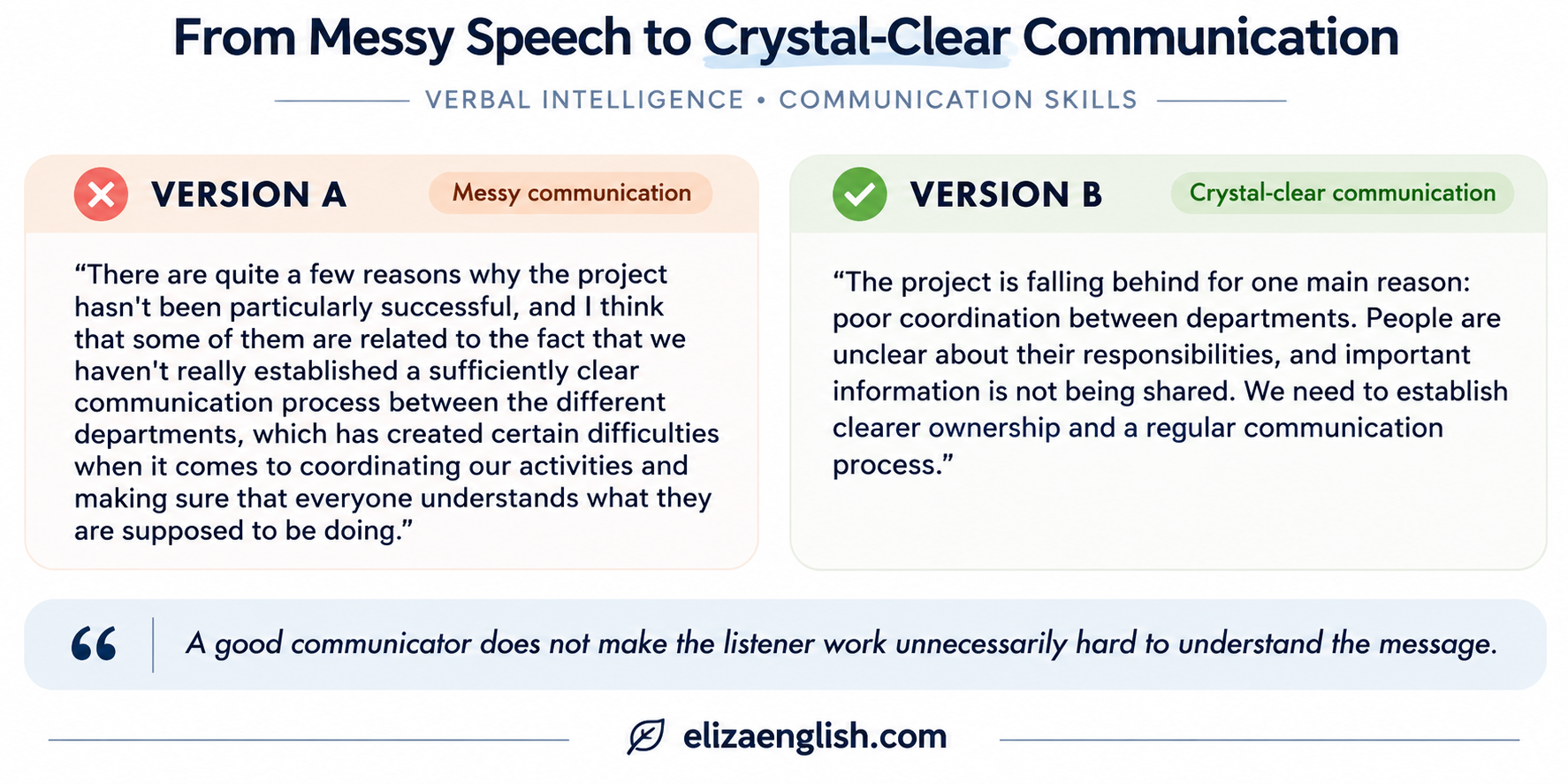
One of the most underestimated barriers to effective communication is that listening is not always passive.
While you are speaking, the other person may be:
In other words, they are not necessarily processing your message in its entirety. They may be mentally rehearsing their response before you have finished speaking.
This is particularly common in disagreements, negotiations and emotionally charged conversations.
The result is that even a well-constructed argument can be misunderstood or dismissed because the listener is too busy preparing their own contribution.
The practical implication is important: effective communication requires more than delivering information. You need to make your central point sufficiently clear and memorable that it survives the listener’s divided attention.
It also means that you should not confuse waiting for your turn to speak with genuinely listening.
Here is another fundamental obstacle: people do not receive information as completely neutral observers.
We interpret what we hear through existing beliefs, assumptions, values, expectations, personal experiences and emotional states.
Psychologists often discuss this phenomenon in relation to cognitive schemas, confirmation bias and top-down processing.
For example, imagine that a manager tells an employee:
“We need to discuss your performance.”
The employee who has recently received positive feedback might interpret this as an opportunity to discuss professional development.
Another employee who has experienced criticism from previous managers might immediately assume that something is wrong.
The words are identical. The interpretations are different.
Similarly, when discussing controversial topics, people often pay more attention to information that supports their existing beliefs and scrutinise information that challenges them.
This means that communication is not simply about what you say. It is also about what the listener is psychologically prepared to hear.
A verbally intelligent communicator recognises this and adjusts their approach accordingly.
Instead of assuming that a logical argument will automatically persuade someone, they consider the listener’s perspective, existing assumptions and potential objections.
Knowing something and explaining it are two different cognitive abilities.
You might understand a concept perfectly well but struggle to explain it to someone unfamiliar with the subject.
This is partly related to the curse of knowledge: once we become familiar with something, it becomes difficult to reconstruct what it feels like not to know it.
For example, an experienced software engineer might explain an API using technical terminology that another engineer immediately understands. However, the same explanation might be completely inaccessible to a non-technical client.
The problem is not necessarily the complexity of the subject. It is the mismatch between the speaker’s knowledge and the listener’s existing understanding.
Verbal intelligence therefore requires a degree of intellectual flexibility: the ability to step outside your own knowledge framework and reconstruct an explanation from the listener’s perspective.
This is a particularly interesting psychological trap.
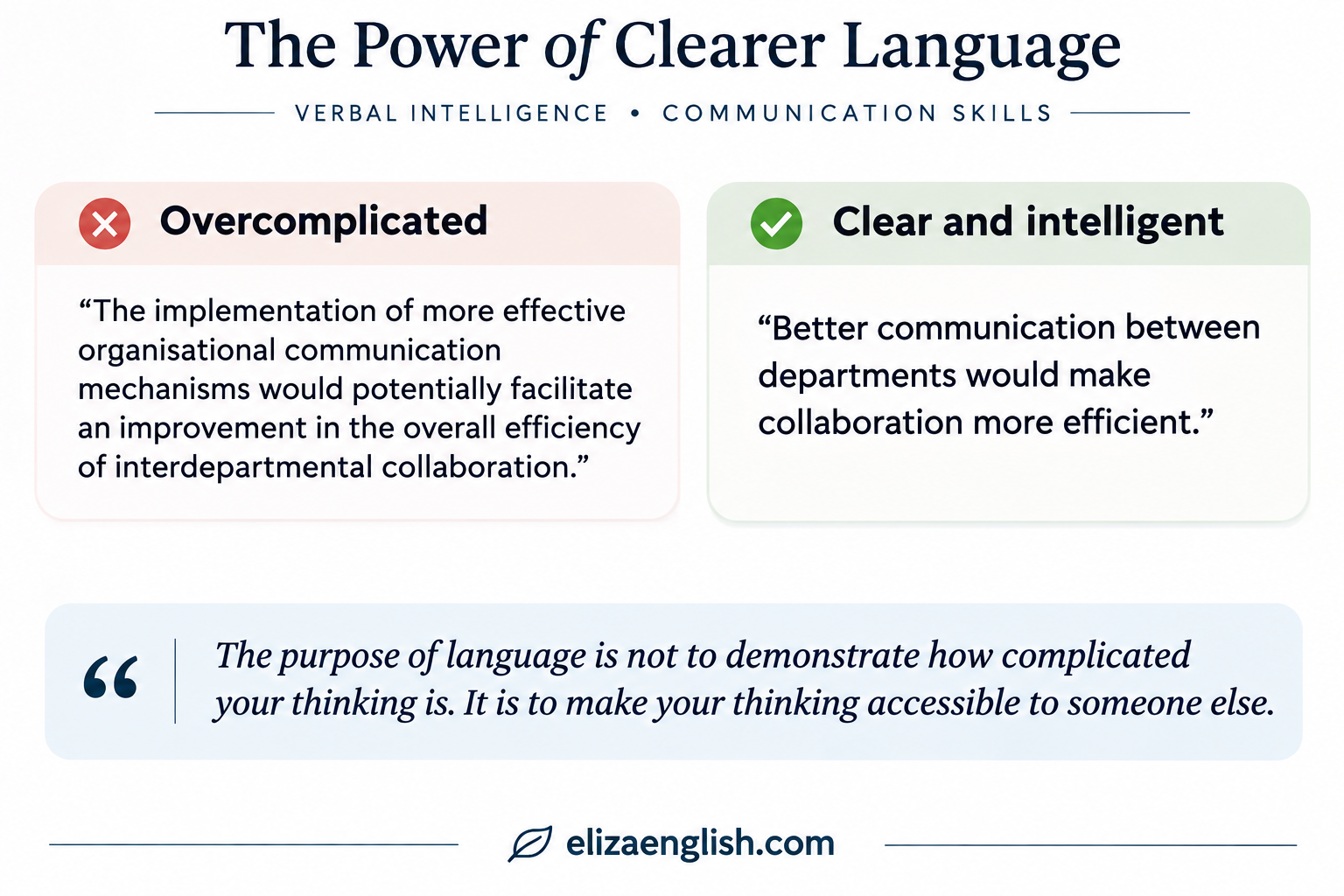
People sometimes associate intelligent communication with sophisticated vocabulary, long sentences, abstract terminology and elaborate explanations.
Consequently, they overcomplicate relatively simple ideas.
They use five words when one would be more precise, introduce unnecessary qualifications and construct sentences that are grammatically impressive but difficult to follow.
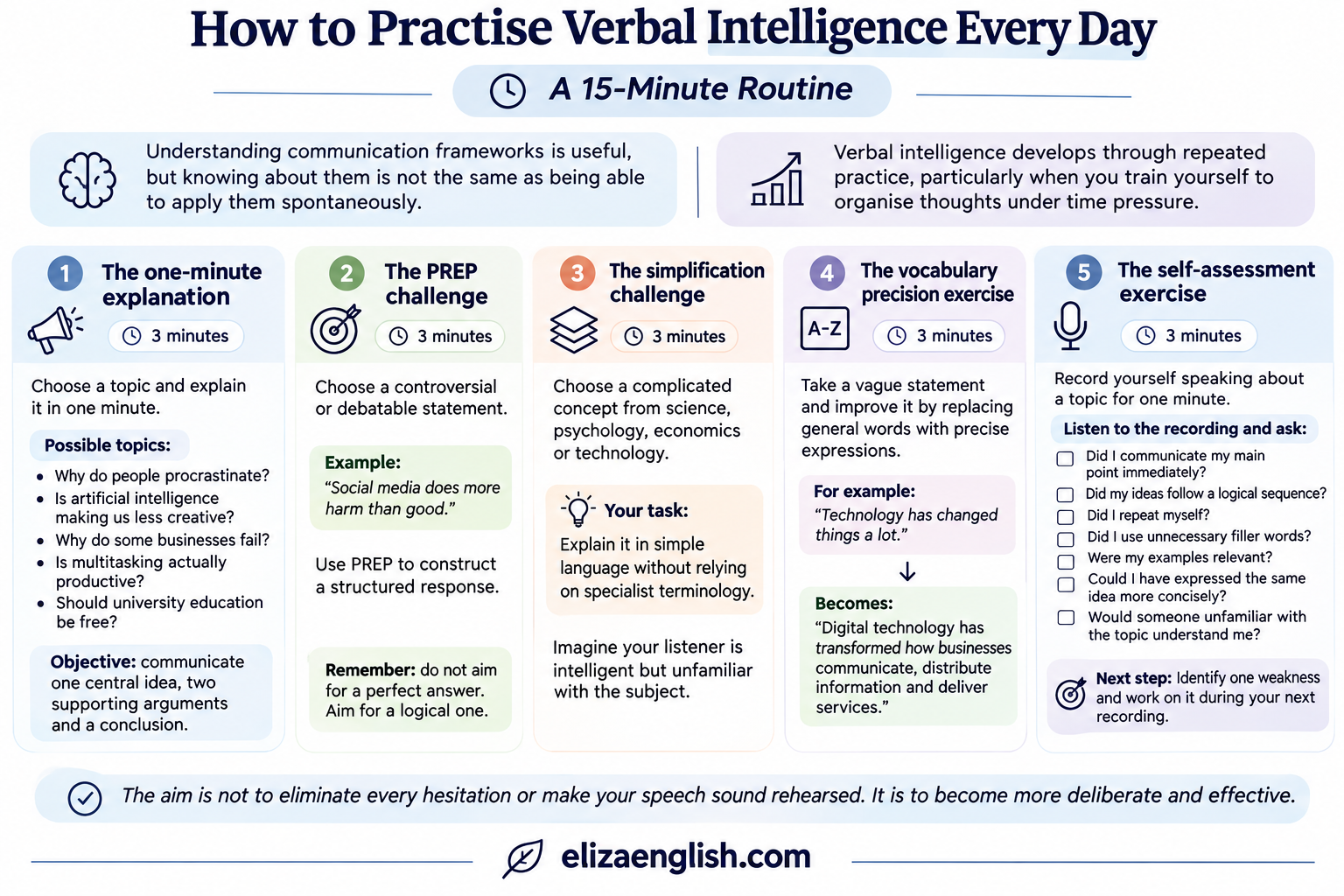
The good news is that verbal intelligence is not a fixed ability that you either possess or lack. Many of its practical components can be developed through deliberate practice.
You can become better at structuring ideas, retrieving vocabulary, identifying the main point, explaining complicated concepts and communicating spontaneously.
The following frameworks are particularly useful because they give your thoughts a structure before they become speech.
PREP is one of the simplest and most effective frameworks for organising spontaneous speech.
It is especially useful when answering questions, expressing opinions, participating in meetings or responding during job interviews.
Instead of speaking as ideas occur to you, follow four steps:
P – Point: State your main idea.
R – Reason: Explain why you think this.
E – Example: Support your point with a specific example.
P – Point: Reinforce your original message.
Example question: Should companies allow employees to work remotely?
Messy speech:
“Well, I think it depends, really, because obviously some people prefer working from home, but then there are also some disadvantages, like communication and things like that. And I suppose it also depends on the type of company…”
Crystal-clear response:
“I believe companies should offer remote work whenever the nature of the job allows it. The main reason is that flexibility can improve employees’ work-life balance and reduce commuting time. For example, an employee who saves two hours a day travelling to work can use that time for professional development or personal responsibilities. Ultimately, I think companies should focus on results rather than physical presence.”
Notice that the second answer does not necessarily contain more sophisticated vocabulary. It contains a clearer line of reasoning.
When to use it: Interviews, discussions, debates, meetings, speaking examinations and everyday conversations.
BLUF stands for Bottom Line Up Front. It is a communication principle associated with military and business communication.
The idea is simple: communicate your most important message first, then provide the supporting details.
Many people do the opposite. They begin with background information, explain the circumstances, introduce several qualifications and eventually arrive at their actual point.
This forces the listener to wait for the information they need.
Compare:
Messy speech:
“So, we’ve been working on this project for a few weeks, and initially everything seemed to be going quite well. However, there have been some issues with the supplier, and we’ve also experienced a few delays with the technical implementation, so I think we might have to reconsider the deadline.”
Crystal-clear speech:
“We need to extend the project deadline by two weeks. The supplier has delayed delivery, and the technical implementation is taking longer than expected.”
The second version immediately answers the most important question.
You can then provide additional context if necessary.
A useful formula:
Main message → Supporting information → Implications → Next step.
When to use it: Business meetings, emails, presentations, project updates, professional discussions and situations where people have limited time.
This framework helps you move beyond simply describing information and develop a more meaningful argument.
It is particularly useful when explaining situations, analysing problems, presenting observations or discussing the implications of an event.
Example: A company has experienced a decline in customer satisfaction.
Messy speech:
“Customer satisfaction has gone down recently, and there are quite a few things that could be contributing to this. We’ve had some issues with response times, and customers have complained about the service, so we should probably look into that.”
Crystal-clear speech:
WHAT: Customer satisfaction has dropped by 15% over the last quarter.
SO WHAT: The decline suggests that our current support process is not meeting customer expectations, particularly regarding response times.
NOW WHAT: We should analyse customer complaints, identify the main bottlenecks and introduce a target response time.
This framework forces you to distinguish between facts, interpretations and actions.
It also prevents a common communication problem: describing a situation without explaining why anyone should care.
When to use it: Presentations, performance reviews, problem-solving discussions, business reports and strategic conversations.
The human mind benefits from structured information. Grouping ideas into three categories is a practical way to make explanations more manageable and memorable.
Rather than presenting seven unrelated observations, identify three overarching points.
For example, if you are asked what makes a good leader, you could organise your response around:
You can then explain each point individually.
Messy speech:
“Well, I think a good leader needs to be able to communicate, but also make decisions, and they need to understand people, because everyone is different, and obviously they need to be responsible and organise things properly…”
Crystal-clear speech:
“I believe effective leadership rests on three essential abilities: communication, decision-making and emotional intelligence. Communication ensures that people understand their responsibilities. Sound decision-making provides direction, while emotional intelligence helps leaders understand and motivate their teams.”
The Rule of Three is not a rigid psychological law. It is a useful organisational technique that helps both speakers and listeners manage information.
When to use it: Presentations, interviews, explanations, arguments and discussions involving several interconnected ideas.
Signposting means explicitly indicating the structure and direction of your message.
It is particularly valuable when explaining something complex because it helps listeners anticipate what is coming next.
Think of signposting as providing a navigation system for your speech.
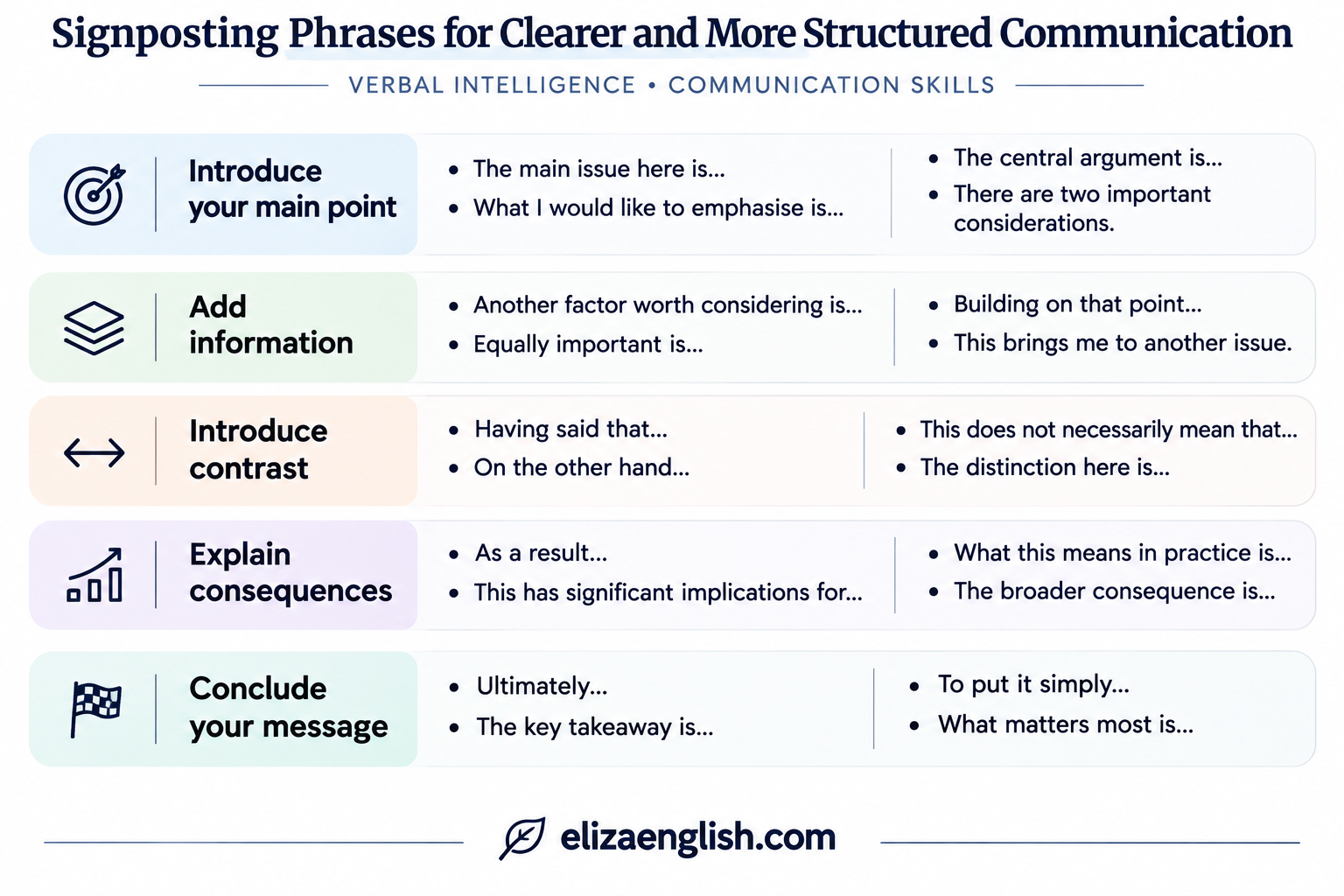
Compare these two explanations:
Without signposting:
“Remote work has benefits. People save time. Some employees feel isolated. Communication can be difficult. Companies save money on offices. It depends on the situation.”
With signposting:
“There are two main advantages to remote work: greater flexibility and reduced operational costs. However, there is an important trade-off. Employees may experience social isolation, and collaboration can become more difficult. Ultimately, its effectiveness depends on the nature of the job and how well the company manages remote teams.”
Signposting creates logical relationships between ideas rather than leaving the listener to work them out independently.
One of the quickest ways to improve verbal intelligence is to eliminate vague expressions.
Words such as things, stuff, good, bad, interesting, nice, difficult and a lot are not inherently wrong. However, overusing them can make your communication imprecise.
The solution is to develop the habit of asking yourself:
What exactly do I mean?
Consider these examples:
Precision does not mean using unnecessarily advanced vocabulary. It means selecting the most appropriate word for the meaning you want to communicate.
A useful exercise is to identify the five vague expressions you use most frequently and consciously replace them with more descriptive alternatives.
The Feynman Technique is associated with physicist Richard Feynman and is widely used as a learning and explanatory method.
Its underlying principle is that if you cannot explain something in simple language, you may not understand it sufficiently well.
The technique involves four steps:
Example: Explain artificial intelligence.
Overcomplicated explanation:
“Artificial intelligence is a computational paradigm involving algorithmic systems that process extensive datasets to identify statistical patterns and generate outputs based on learned representations.”
Simplified explanation:
“Artificial intelligence refers to computer systems that perform tasks normally associated with human intelligence. They can recognise patterns, understand language, analyse information and generate content. For example, an AI assistant can answer questions, summarise documents and help you write an email.”
The second explanation is more accessible without being inaccurate.
You can take the technique further by explaining the same concept to three different audiences:
This forces you to adjust your level of detail and terminology without losing the essential meaning.
When to use it: Teaching, presentations, technical discussions, interviews and learning unfamiliar subjects.
Abstract concepts can be difficult to process because listeners have no immediate visual or experiential reference point.
Analogies help bridge this gap by connecting unfamiliar ideas with familiar experiences.
For example:
Abstract explanation:
“Working memory is a cognitive system responsible for temporarily maintaining and manipulating information.”
Analogy:
“Think of working memory as your brain’s temporary workspace. It allows you to hold information in your mind while using it to perform a task, rather like keeping several documents open on your desk while working on a project.”
Another example:
Abstract explanation:
“Inflation reduces purchasing power.”
Analogy:
“Imagine having £100 and being able to buy ten items with it. If prices increase, that same £100 might only buy eight items. You haven’t lost any money, but your money no longer goes as far.”
The analogy makes the concept tangible.
However, analogies should clarify rather than distort. Always make sure that the comparison illustrates the relevant aspect of the concept without implying that the two things are identical.
Intelligent communication requires more than expressing ideas confidently. It requires recognising the difference between what you know, what you infer and what you believe.
Consider the following statement:
“The management team doesn’t care about employees.”
This sounds like a fact, but it is actually an interpretation of someone’s behaviour.
A more intellectually precise explanation would be:
“Management has not responded to employees’ concerns about workload. This gives the impression that employee well-being is not a priority.”
Notice the distinction:
This distinction is particularly useful when discussing sensitive topics, disagreeing with others or presenting arguments.
It also makes your communication more credible because you avoid presenting assumptions as established facts.
Useful expressions include:
These expressions allow you to communicate uncertainty without sounding indecisive.
One of the most underrated communication techniques is knowing when not to speak.
Many people interpret silence as a sign of uncertainty and instinctively fill every pause with words.
This often produces unnecessary fillers, repetitions and poorly constructed sentences.
However, a short pause can improve the quality of your communication.
It gives you time to:
Compare:
Uncontrolled speech:
“Well, I think that, you know, there are basically several reasons why, I suppose, this might be happening, and one of them could potentially be…”
Controlled speech:
“There are three possible explanations. First, insufficient preparation. Second, unclear responsibilities. Third, poor communication between departments.”
The second speaker does not necessarily think faster. They have simply learned to manage the relationship between thinking and speaking.
A useful principle is:
Pause to organise your thoughts rather than talking to discover them.
The frameworks above help you structure your ideas. The following techniques take your communication a step further by making it more engaging, memorable and persuasive.
People understand ideas more easily when they can see what they are being compared with.
Instead of describing an abstract quality, contrast it with its opposite.
For example:
“Leadership is not about controlling every decision. It is about creating the conditions in which people can make good decisions independently.”
Or:
“Productivity is not about being busy all day. It is about making meaningful progress on the things that matter.”
Contrast creates a clear distinction and gives your message rhetorical impact.
Practical formula:
“It’s not about X. It’s about Y.”
Examples:
General statements are easy to forget. Specific details make ideas more concrete and credible.
Compare:
“She is an excellent employee.”
With:
“She consistently meets deadlines, identifies potential problems before they escalate and helps colleagues resolve technical issues.”
The second statement provides evidence rather than relying on a general evaluation.
Whenever you make a claim, ask yourself:
Specificity is particularly powerful in interviews, presentations, professional discussions and persuasive communication.
The ability to compress a complicated idea into a single meaningful sentence is an excellent test of understanding.
It forces you to distinguish between essential information and secondary details.
For example:
A lengthy explanation about why a business is struggling might be reduced to:
“The company is losing customers because its product no longer meets changing market expectations.”
That sentence gives the listener a central idea around which additional information can be organised.
Try the following exercise:
Choose a news article, podcast episode, book chapter or professional topic. Explain its central message in:
The challenge is to preserve the essential meaning while changing the amount of detail.
Good communicators do not simply deliver information. They anticipate what the listener needs to know next.
Imagine explaining why a company should invest in employee training.
Your initial statement might be:
“Investing in employee training improves organisational performance.”
But the listener may immediately wonder:
A stronger explanation anticipates these questions:
“Investing in employee training can improve productivity by reducing mistakes and helping employees work more independently. Although it requires an initial financial investment, the company can measure its effectiveness through error rates, project completion times and employee performance.”
This approach makes your communication more complete and persuasive.
Verbal intelligence is not about having an immediate answer to every question.
In fact, the ability to acknowledge uncertainty, reconsider an argument and change your position when presented with better evidence is an important component of intelligent communication.
Instead of pretending to know something, try:
This is not weakness. It is intellectual honesty.
It also makes disagreements more productive because you are engaging with ideas rather than simply defending your position.
An example of verbal intelligence is explaining a complicated concept in simple language without losing its essential meaning. Other examples include presenting a logical argument, expressing disagreement diplomatically, identifying ambiguity in a conversation and adapting your communication to different audiences.
No. Verbal intelligence is related to cognitive abilities measured in certain verbal reasoning and comprehension assessments, but it is not identical to overall intelligence. A person’s ability to articulate ideas in everyday situations also depends on knowledge, vocabulary, experience, communication practice and context.
Yes. You can develop many practical aspects of verbal intelligence through deliberate practice. Techniques such as PREP, BLUF, the Feynman Technique, summarisation, vocabulary development and recorded speaking exercises can help you become clearer, more precise and more confident.
Start by identifying your main point before speaking. Organise supporting information into two or three logical categories, use signposting expressions, provide relevant examples and avoid unnecessary details. If you need time to formulate your answer, pause rather than filling the silence with words.
Verbal fluency refers primarily to the ability to produce language smoothly and efficiently. Verbal intelligence is broader: it includes understanding, reasoning, vocabulary, clarity, coherence and the ability to communicate complex ideas appropriately. Someone can be highly fluent without being particularly articulate.
Speaking requires several cognitive processes to work together, including organising ideas, retrieving vocabulary, constructing sentences, articulating speech and monitoring the listener’s response. When your thoughts are complex, you are under pressure or you lack a clear structure, these processes can become more difficult to manage.
Some useful starting points include:
Learn how to improve working memory for English learning with practical exercises to remember vocabulary, process spoken English, and speak more fluently.
Learn 10 common English sentence patterns to improve fluency, build natural sentences, and speak with confidence. Includes practical examples, grammar tips, and exercises for B1–C1 learners.
AI is disrupting jobs, careers and the world of work. Explore AI job displacement, changing skills, freelance work, AI adoption and practical ways to leverage AI without losing your human advantage.
Join the list for printable worksheets, free resources, and articles for English teachers.