Even though for many learners homework has negative connotations dating back to school, English homework can be crucial for consolidating new information. The important question, however, is not whether adult learners need more homework. It is what kind of homework actually helps them learn English without turning their free time into another source of pressure.
For adult learners, this distinction matters enormously. Unlike school students, adults often arrive at an English lesson after a full day of work, family responsibilities, errands, emails, appointments and dozens of other demands on their attention. Giving them another pile of exercises simply because “practice is important” can easily backfire.
At the same time, expecting learners to remember new vocabulary, grammar and expressions after encountering them only once in class is unrealistic. New information needs to be revisited, retrieved and used if it is going to become readily accessible in communication.
So, is English homework necessary for adults?
Not necessarily in the traditional sense. But purposeful contact with English between lessons can be extremely valuable.
The key is to stop thinking about homework as a single type of activity. For adult learners, there are several effective strategies, and teachers can choose between them depending on the learner, the lesson objectives and the amount of cognitive load involved.
Why does English homework matter for adult learners?
New English does not automatically become usable English
Imagine that an adult learner encounters five useful expressions in class:
- negotiate a deadline
- meet a deadline
- miss a deadline
- extend a deadline
- work towards a deadline
During the lesson, the learner understands the meaning, recognises the expressions in examples and perhaps uses them successfully in a controlled speaking activity.
It may feel as though the expressions have been “learned”.
But recognition is not the same as being able to retrieve language independently.
A week later, the learner may recognise extend a deadline immediately when reading it but struggle to produce it when trying to explain a problem at work.
This is one of the reasons practice after the lesson matters. Learners need opportunities to move from understanding and recognising language to retrieving and producing it.
Research on retrieval practice has repeatedly demonstrated that actively recalling information can strengthen long-term retention compared with simply being exposed to the information again. A large meta-analysis covering 122 experiments and more than 10,000 participants found that testing and retrieval can produce meaningful learning benefits and support the ability to use learned information in new situations.
For language teachers, the practical message is simple:
Don’t only ask learners to look at new English again. Give them opportunities to retrieve and use it.
Spaced practice is particularly important for language learning
Another reason homework can be useful is that it creates spacing between encounters with English. If a learner meets a new expression on Monday and then encounters it only once more several weeks later, there is a good chance that the expression will become difficult to retrieve.
Instead, learners benefit from returning to language at intervals.
Research into second-language learning provides particularly strong evidence for this. A 2022 meta-analysis examining 98 effect sizes from 48 experiments involving 3,411 participants found that spaced practice had a medium-to-large effect on second-language learning. The researchers also found evidence that longer spacing can produce stronger performance on delayed tests.
This does not mean that teachers should give learners repetitive homework every day. It means that language needs multiple encounters over time. Homework is one way of creating those encounters.
But does this mean adults should always be given homework?
No. This is where adult education requires a more nuanced approach.
The evidence for homework as a general educational intervention is stronger in school settings than in adult EFL. For example, the Education Endowment Foundation reports a positive average impact of homework in school-age education, while also emphasising that the quality and design of homework matter considerably. Its evidence review highlights the importance of connecting homework to classroom learning and providing feedback.
It would therefore be misleading to claim that a particular amount of homework automatically produces a particular amount of progress for adult English learners.
Instead, teachers should take advantage of the learning principles that make certain types of homework useful, particularly retrieval, spacing, meaningful production and relevant exposure, while taking the adult learner’s cognitive load and motivation into account.
And this leads to a much more useful question:
What should adult learners actually do between English lessons?
There are several good answers.
Strategy 1: Use homework to consolidate newly learned English
The first and perhaps most obvious strategy is active consolidation.
The learner has consumed new information during the lesson. Homework gives them an opportunity to turn that information into something they can actually produce.
This is the crucial transition:
Consumption → retrieval → production → greater accessibility
Suppose the new vocabulary in class is related to deadlines.
Instead of simply telling the learner:
Learn these five expressions.
the teacher can give them a short production-based task.
Sentence-making homework
Write five sentences using the new expressions. Make at least three of the sentences relevant to your own work or everyday life.
Short writing task
Write a short paragraph about a time when you had to meet an important deadline. Use at least four expressions from today’s lesson.
Mini essay
Why do people miss deadlines? Give two or three reasons and suggest possible solutions. Use at least five expressions from today’s lesson.
Retrieval test
Without looking at your notes, write down as many expressions from today’s lesson as you can remember. Then check your answers and correct any mistakes.
Gap-fill exercise
Complete the sentences using the appropriate expression. Then write two original sentences of your own.
Speaking homework
Record a two-minute answer to this question: “What can people do to avoid missing important deadlines?” Use at least four expressions from the lesson.
The point is not to make the learner complete all of these tasks.
The point is to give the teacher a menu of ways to transform passive familiarity into active command of the language.
From “I know this word” to “I can use this word”
This distinction is particularly important in EFL.
There are several stages between first encountering a word and being able to use it naturally:
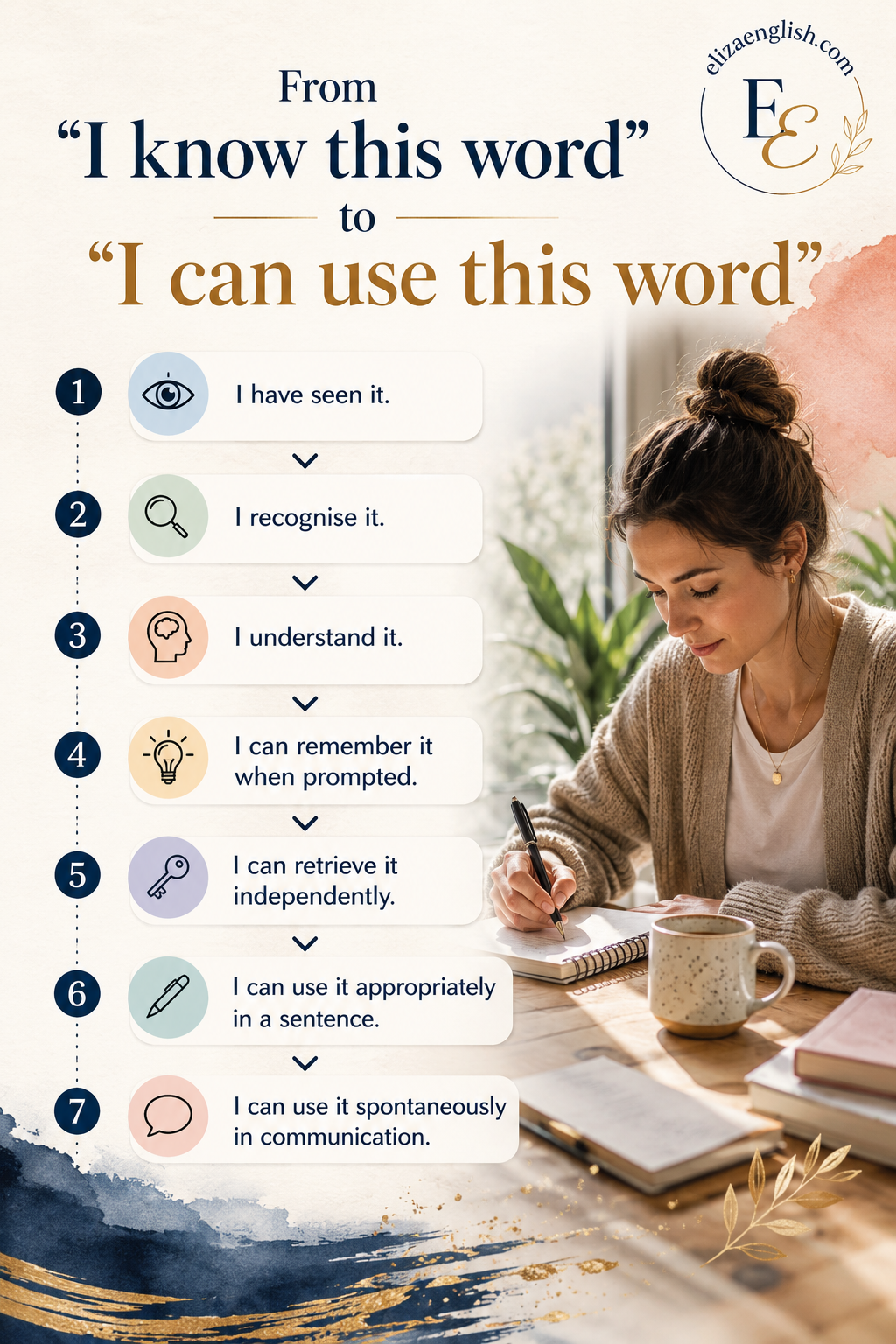
Homework can help learners move through these stages.
This is why a short task that asks a learner to produce five original sentences can sometimes be more valuable than a much longer activity in which they simply match words with definitions.
The learner has to search their memory, select the appropriate expression and construct language around it. That is genuine learning work.
Strategy 2: Give adults English they actually enjoy
However, there is another homework strategy that teachers sometimes overlook.
Homework does not always have to consolidate the language from the lesson.
Sometimes the best thing an English teacher can give an adult learner is a reason to enjoy English.
Adult brains are already dealing with a tremendous amount of information. After work and other responsibilities, a learner may simply not have the mental energy for another demanding grammar exercise or vocabulary test.
In that situation, insisting on more cognitively intensive homework can make English feel like another obligation.
Instead, teachers can provide low-pressure English exposure based on the learner’s interests.
The learner might:
- watch a YouTube video about a historical period they love
- listen to a podcast about fitness
- watch an English-language cooking channel
- read an article about travelling
- watch a documentary about science
- listen to a podcast about psychology
- watch a technology review
- follow an English-speaking creator whose content they genuinely enjoy
The instructions can be deliberately simple:
Watch or listen to something you enjoy in English. Don’t worry about understanding every word. Don’t make a vocabulary list. Don’t stop the video every few seconds. Just enjoy it.
This is still contact with English.
But psychologically, it is completely different from:
Complete exercises 1 to 6, learn 20 words and write a 200-word essay.
Why “fun English” can be an intelligent homework strategy
This approach gives the learner something that traditional homework often fails to provide:
cognitive breathing space.
The learner is still exposed to English, but the activity does not demand the same level of deliberate concentration as grammar exercises, vocabulary tests or formal writing.
More importantly, it can help establish positive associations with the language.
If every encounter with English means:
study → test → correction → homework → more study
English can become psychologically associated with effort and obligation.
But if learners also experience:
English → cooking → travel → history → fitness → music → entertainment → curiosity
the language becomes part of their leisure life.
That is a powerful shift.
The goal is not necessarily to make the learner consciously memorise vocabulary from every video. The goal is to make English something they willingly return to.
And that matters because sustainable language learning depends not only on what happens during individual study sessions, but also on whether learners continue engaging with the language over the long term.
The two homework strategies can work together
These approaches should not be seen as competing philosophies. They serve different purposes.
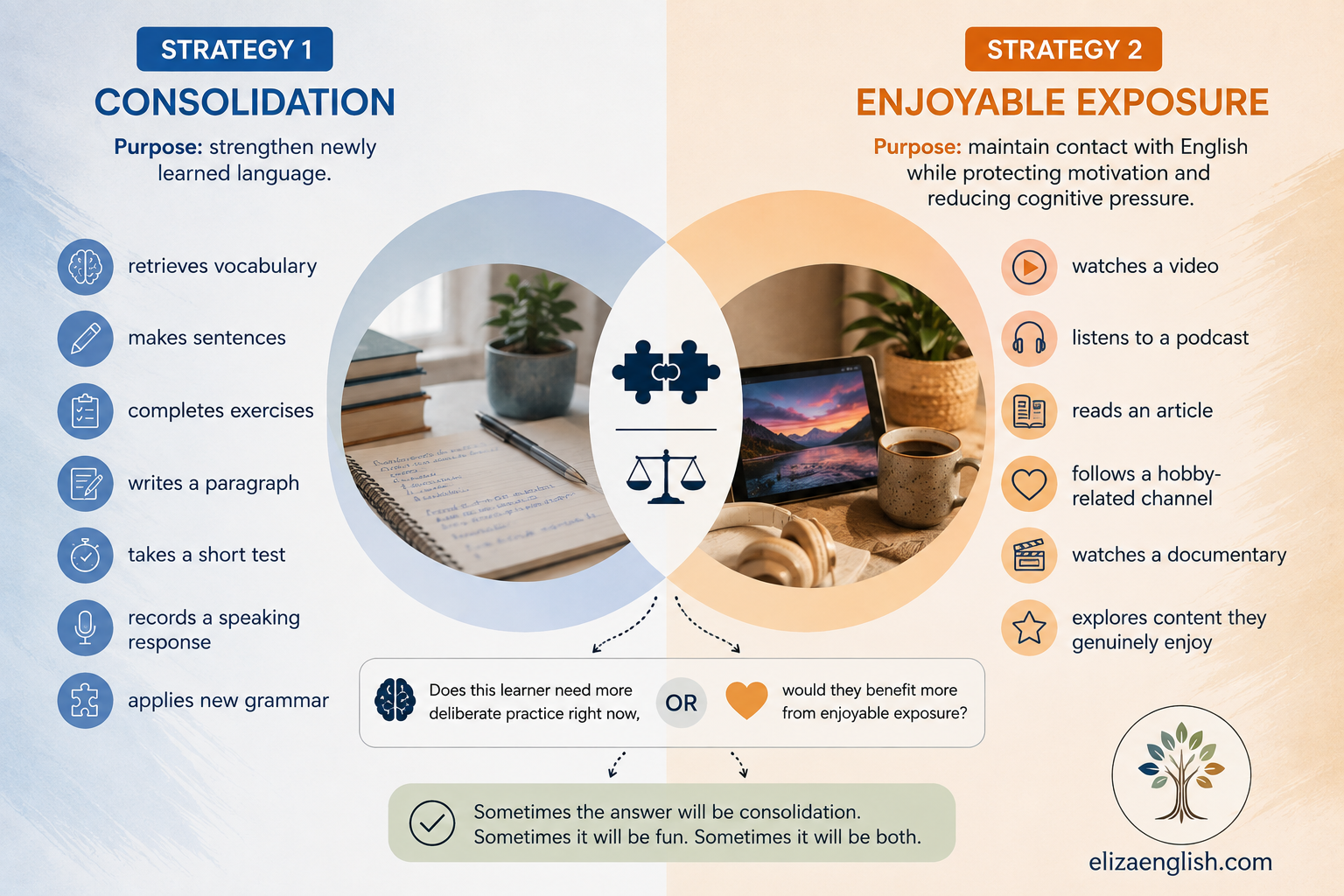
How to choose the right homework strategy
A useful rule is to consider three things:
1. What happened in the lesson?
If the lesson introduced a substantial amount of new vocabulary or grammar, active consolidation may be appropriate.
If the lesson was already cognitively demanding, a lighter task may be more beneficial.
2. What is the learner’s current workload?
An adult who has just finished a stressful working week may not benefit from another intensive assignment.
Homework should support learning, not compete with the learner’s ability to function.
3. What is the learner’s relationship with English?
Some learners genuinely enjoy grammar exercises and vocabulary challenges.
Others become demotivated by anything that resembles school.
The same homework strategy will not work equally well for both.
How EFL teachers can optimise homework for adults
Whatever strategy a teacher chooses, several principles can make homework significantly more effective.
Keep it purposeful
Every task should have a clear reason for existing.
Instead of:
Complete exercises 1 to 10.
try:
Use today’s vocabulary to describe a real problem you have experienced at work.
The second task has a communicative purpose.
Keep it manageable
Adult learners often have unpredictable schedules.
A focused 10 to 20-minute task can be more sustainable than a 60-minute assignment that constantly gets postponed.
The goal is not to maximise homework time. The goal is to maximise learning value per minute.
Make learners produce language
Whenever appropriate, move beyond recognition.
Ask learners to:
- make sentences
- answer questions
- explain an idea
- write a message
- record a response
- solve a problem
- tell a story
- express an opinion
Production forces learners to retrieve and organise language.
Recycle old language
Do not constantly introduce new vocabulary without revisiting previous material.
A homework task can deliberately combine:
new vocabulary + vocabulary from previous lessons
This creates repeated, spaced encounters with language.
Personalise the task
Adults are more likely to engage when the content relates to their lives.
Instead of:
Write ten sentences using these adjectives.
try:
Choose five adjectives and use them to describe your workplace, your city, your daily routine or a recent experience.
Offer choice
Choice can make homework feel less like an imposed school task.
For example:
Choose ONE:
A. Write a short paragraph using the new vocabulary.
B. Record a two-minute speaking response.
C. Complete the vocabulary retrieval challenge.
The learning objective remains the same, but the learner has some autonomy.
Make homework relevant to the next lesson
Homework becomes much more meaningful when learners know that it will actually be used.
If they write an email, discuss it in the next lesson.
If they record a speaking response, repeat and improve it.
If they watch a video, discuss its ideas.
If they collect useful expressions, use them in a role-play.
This creates a continuous learning cycle:
Lesson → homework → feedback → further use
Rather than:
Lesson → homework → forgotten → new lesson
10 effective English homework tasks for adult learners
Here is a practical bank of activities teachers can adapt to almost any lesson.
1. Retrieval challenge
Without looking at your notes, write down as many expressions from today’s lesson as you can remember. Then check and correct yourself.
2. Personal sentence challenge
Choose five new expressions and write one original sentence for each. At least three sentences should be genuinely relevant to your life.
3. Mini essay
Write 150 to 200 words giving your opinion on today’s topic. Use at least five expressions from the lesson.
4. Real-life writing
Write an email, message, complaint, request or workplace update that you might realistically need to write in English.
5. Voice recording
Speak for two minutes about today’s topic without reading a script. Use at least four expressions from the lesson.
6. Error correction
Look at your previous writing and identify five recurring mistakes. Rewrite the sentences correctly.
7. Vocabulary recycling
Use three expressions from today’s lesson and three expressions from an earlier lesson in a short story.
8. Authentic listening
Find a short English-language video or podcast connected to your interests. Listen for five minutes and write down three expressions you found interesting.
9. Hobby English
Spend 15 minutes enjoying English content related to one of your hobbies. No notes, no exercises and no vocabulary list required.
10. Choose your challenge
Choose one: write a short response, record a two-minute answer or complete a retrieval quiz using today’s language.
What should EFL teachers avoid?
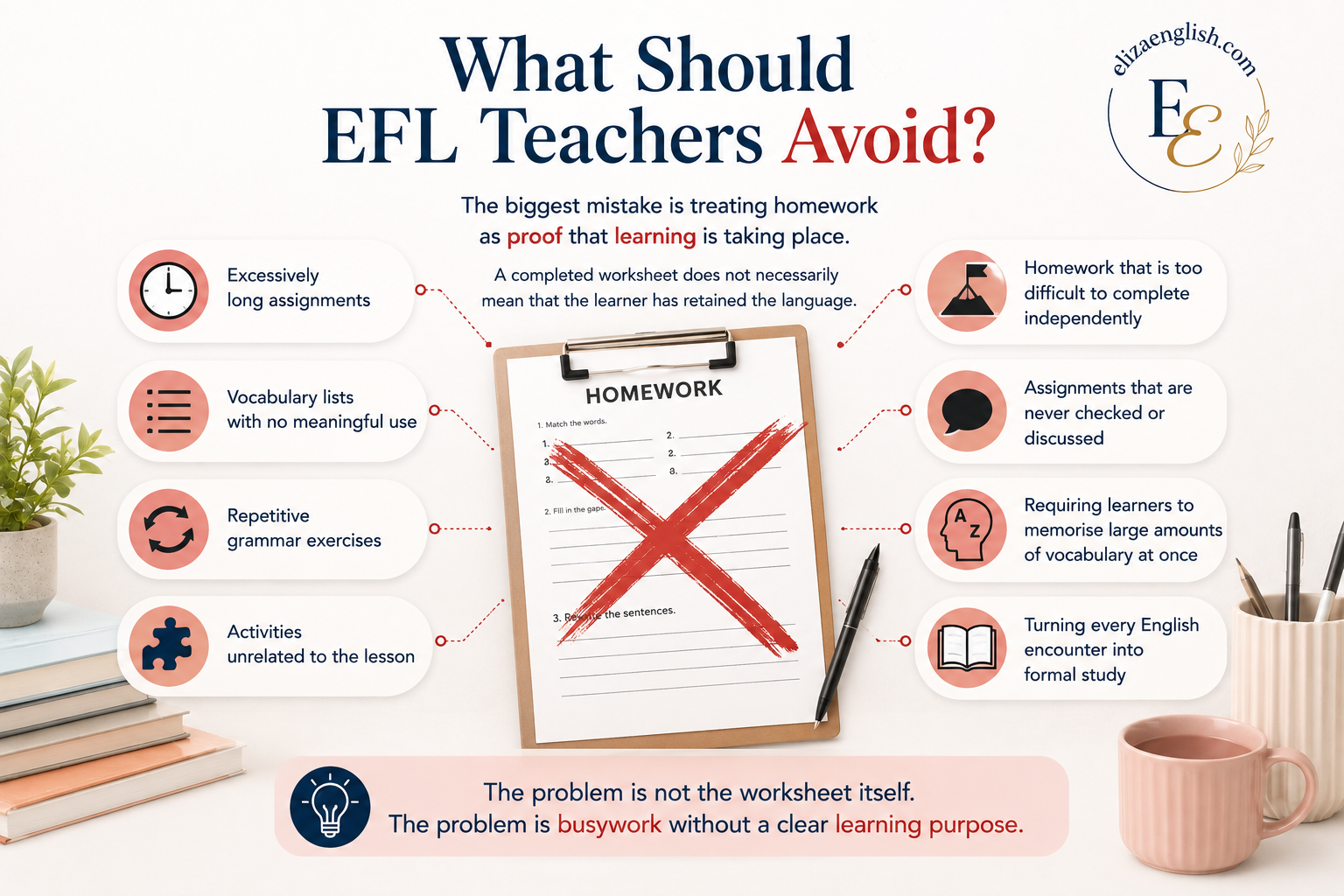
The ultimate principle: homework should make English sustainable
For adult learners, effective homework is not about giving them more work.
It is about creating the right kind of contact with English at the right time.
Sometimes that means asking the learner to retrieve new vocabulary, make sentences, write a short essay or complete a test. The purpose is consolidation: taking information encountered in class and moving it towards active, retrievable knowledge.
At other times, the smartest homework may be almost the opposite.
It may mean telling a learner to watch a YouTube video about cooking, listen to a podcast about fitness, read an article about history or watch a documentary about a topic they love, with no vocabulary list and no comprehension questions.
The purpose is not immediate consolidation. The purpose is to give the learner a break while keeping English present in their life. That distinction is especially important for adults.
A learner who spends every evening doing demanding English exercises may make progress, but they may also become exhausted and eventually disengage. A learner who occasionally gets to experience English as entertainment, curiosity and a hobby may develop a much more sustainable relationship with the language.
So, is English homework necessary for adult learners?
Yes, but not necessarily as traditional homework.
Adult learners need opportunities to consolidate what they learn, and research supports the value of retrieval and spaced practice in learning, including second-language learning. But they also need cognitive breathing space.
The best EFL teachers therefore do not ask only:
“What homework should I give?”
They ask:
“What does this learner need from English right now?”
If the answer is consolidation, give them a short, purposeful task that makes them retrieve and produce the new language.
If the answer is exposure without pressure, give them something genuinely interesting to watch, listen to or read.
And if the learner needs both, combine the two.
Ultimately, the best adult English homework does not maximise the amount of work a learner completes.
It maximises the chances that the learner will remember the language, use it confidently and continue wanting to engage with English.