B2 vs C1 English: What Is the Difference and How Do You Reach C1?
If you are at B2, you can already communicate effectively in English. You can discuss abstract topics, understand complex texts, participate in meetings and explain your opinions without constantly translating.
So why does C1 still feel so far away?
Because the jump from B2 to C1 is less about learning more English and more about gaining control over the English you already know.
The CEFR describes B2 as the ability to communicate clearly and effectively across a wide range of subjects. At C1, learners can use language more flexibly, fluently and precisely, including when dealing with complex ideas and demanding situations. (coe.int)
B2: I can communicate complex ideas.
C1: I can communicate complex ideas precisely, flexibly and spontaneously.
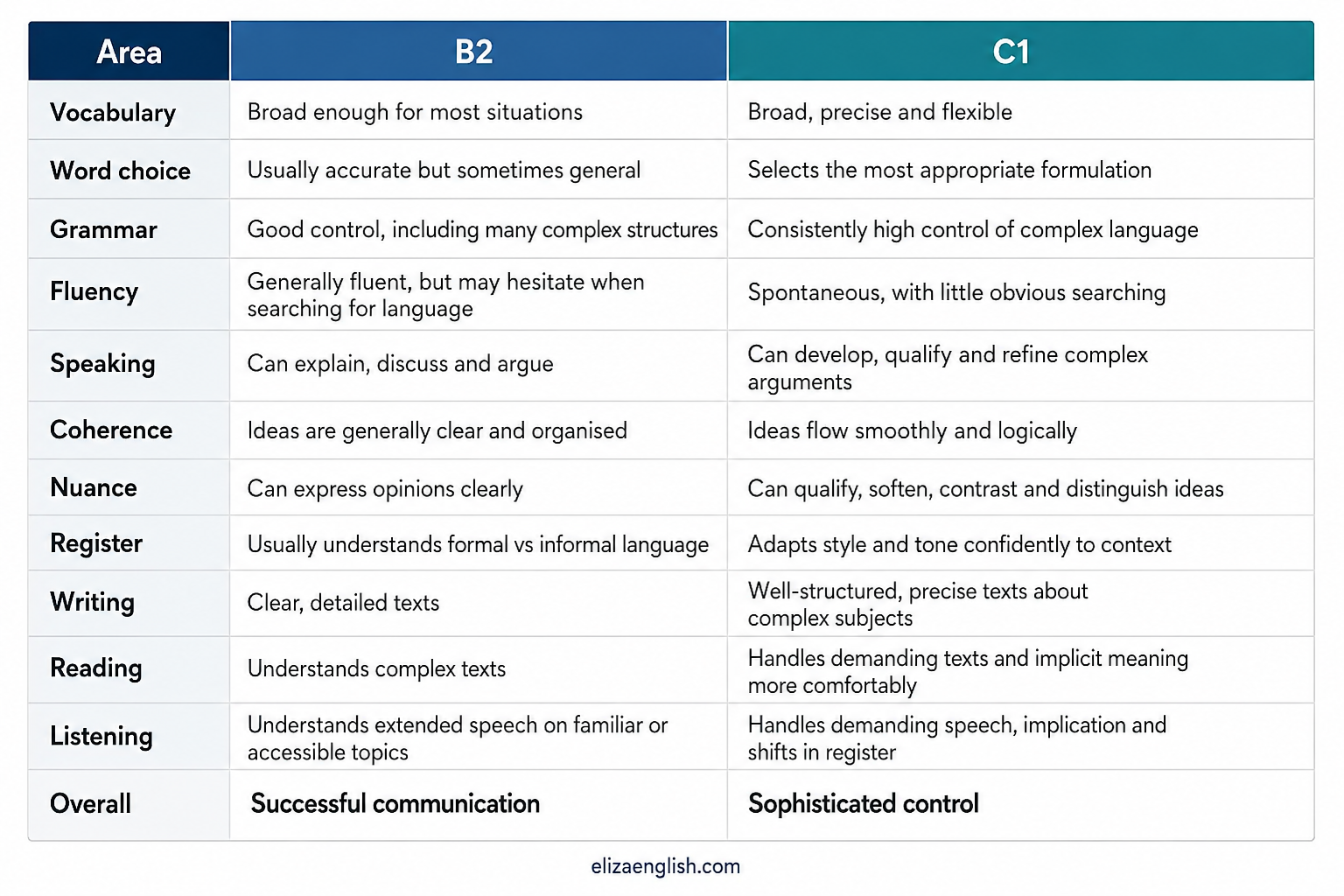
The biggest misconception: C1 ≠ more difficult vocabulary
A B2 learner might say:
The company has a lot of problems.
A C1 speaker might say:
The company is facing several structural challenges that could undermine its long-term competitiveness.
The difference is not simply vocabulary. It involves precision, collocation, grammar, specificity, register and control.
Knowing mitigate does not make you C1.
Being able to use:
mitigate the risks
mitigate the impact
measures to mitigate
significantly mitigate potential damage
is much more useful.
Quick B2 vs C1 diagnostic
This is a practical screening tool, not an official CEFR examination.
Part 1: Choose the best answer
1. The report highlights several factors that are likely to __ the company’s growth.
A. affect
B. influence on
C. impact to
D. make an influence on
2. Had the company acted earlier, it __ the financial difficulties it is facing now.
A. would avoid
B. would have avoided
C. had avoided
D. will have avoided
3. The proposal sounds attractive. __, there are several practical issues that need to be considered.
A. Whereas
B. Nevertheless
C. Despite
D. Although
4. The manager’s explanation was so __ that nobody was sure what decision had actually been made.
A. ambiguous
B. inevitable
C. coherent
D. compelling
5. We need to __ the possibility that demand may decline next year.
A. account
B. take into account
C. make allowance
D. take account
6. The research does not prove that the policy caused the decline. It merely __ a possible relationship between the two.
A. suggests
B. claims
C. assures
D. convinces
7. I wouldn’t say the project was a failure. It was, __, considerably more expensive than anticipated.
A. however
B. therefore
C. consequently
D. despite
8. The new system is expected to __ a significant improvement in productivity.
A. bring
B. make
C. do
D. take
9. The speaker avoided making a definite prediction, __ the uncertainty surrounding the economic outlook.
A. owing to
B. because
C. due
D. as a result
10. Which sentence is most precise and appropriately formal?
A. There are many things which explain why the project didn’t work.
B. There are many reasons why the project didn’t work out.
C. A number of factors help account for the project’s failure.
D. The project didn’t work because of lots of different things.
11. Which expresses a cautious academic claim?
A. This clearly proves that remote work is better.
B. This proves without doubt that remote work is better.
C. This may suggest that remote work can be beneficial under certain conditions.
D. This means remote work is definitely better.
12. Which demonstrates the greatest control of nuance?
A. The plan is good, but there are some problems.
B. The plan is generally good, although there are some problems with it.
C. While the proposal has considerable merit, its long-term feasibility remains questionable.
D. The plan has advantages and disadvantages.
Answer key
| Q |
1 |
2 |
3 |
4 |
5 |
6 |
7 |
8 |
9 |
10 |
11 |
12 |
| Answer |
A |
B |
B |
A |
B |
A |
A |
A |
A |
C |
C |
C |
Score
| Score |
Indication |
| 0–5 |
Below a secure B2 profile in these areas |
| 6–8 |
B2 |
| 9–10 |
Strong B2 / B2+ |
| 11–12 |
C1-level language control is possible |
Do not treat this score as proof of your CEFR level. Recognition is easier than spontaneous production.
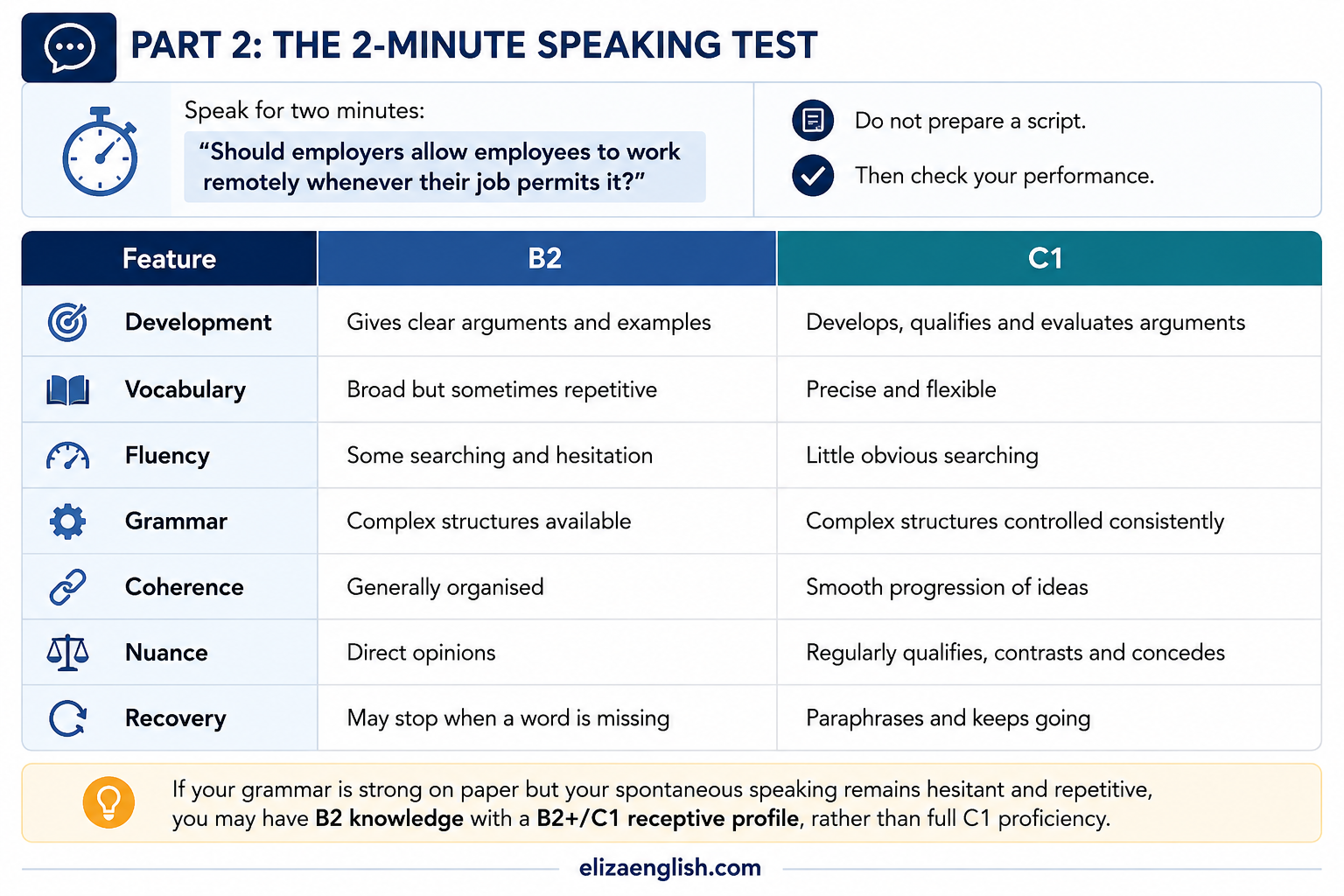
How to make the B2 → C1 leap
The most effective change is to move from learning more language to using language with greater control.
1. Learn collocations, not isolated words
Instead of:
mitigate = reduce
learn:
mitigate the risks
mitigate the impact
measures to mitigate
significantly mitigate potential damage
This makes vocabulary usable.
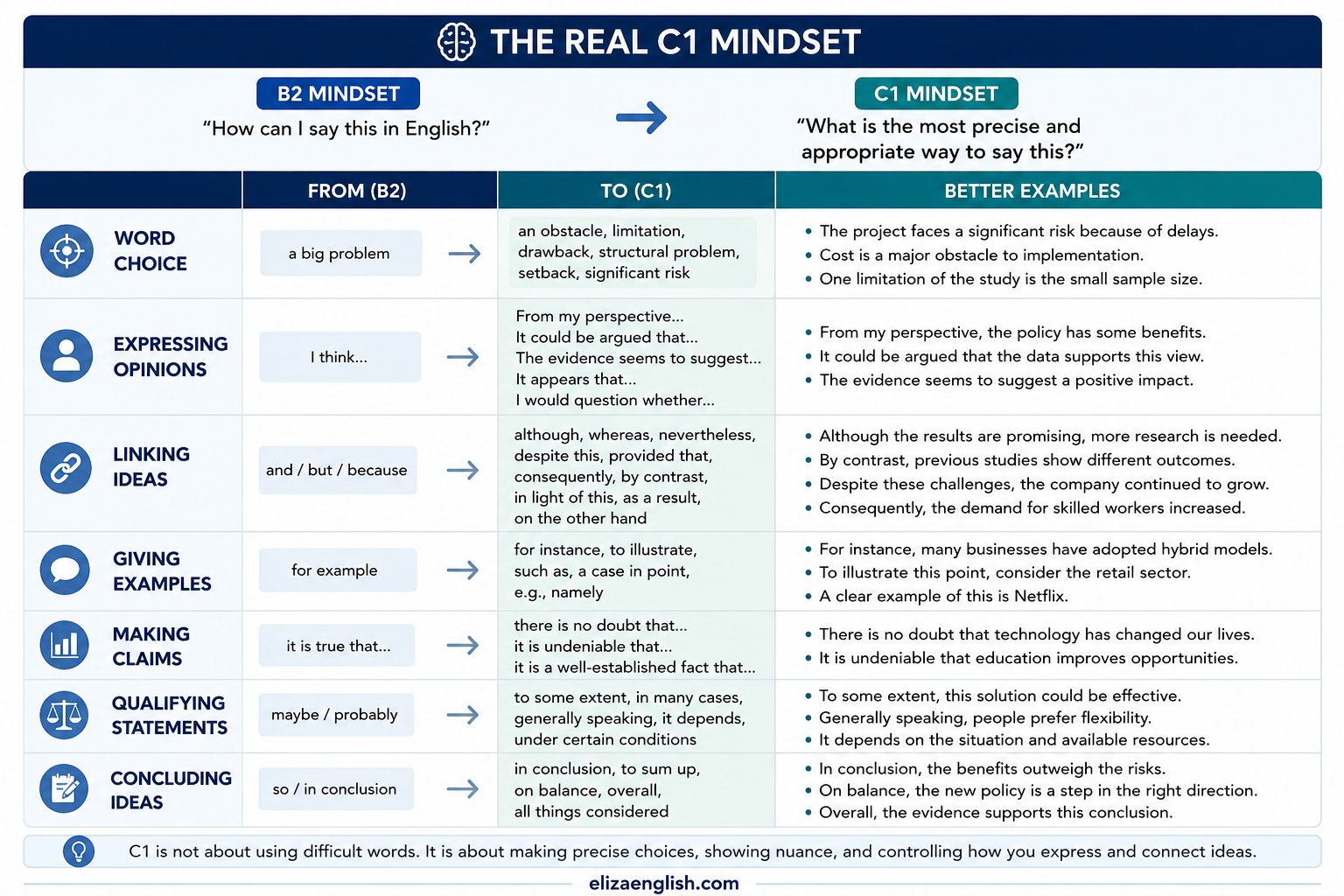
2. Replace vague language with precise language
| B2-style |
More precise |
| a big problem |
a major obstacle / significant challenge |
| a good result |
a positive outcome |
| very important |
crucial / essential |
| make better |
improve / enhance |
| make worse |
exacerbate / undermine |
| show |
demonstrate / indicate |
| say |
argue / maintain / acknowledge |
| cause |
trigger / contribute to / lead to |
| deal with |
address / tackle |
| thing |
factor / issue / aspect |
Do not replace every simple word with an advanced synonym. C1 is about choice, not complexity.
3. Practise paraphrasing
Take:
Working from home can make employees more productive.
Produce:
Working remotely can increase employee productivity.
Remote work may contribute to higher levels of productivity.
Under the right conditions, working from home can enhance productivity.
This trains flexibility in vocabulary, grammar, register and degree of certainty.
Daily drill
1 sentence
    ↓
3 reformulations
    ↓
neutral
formal
cautious / academic
4. Learn to qualify your ideas
Compare:
Social media is harmful to teenagers.
with:
Excessive social media use can have negative effects on some teenagers.
Useful language includes:
may
might
tends to
appears to
is likely to
arguably
to some extent
under certain circumstances
there is some evidence to suggest that
C1 speakers can communicate degree of certainty, rather than presenting every claim as absolute.
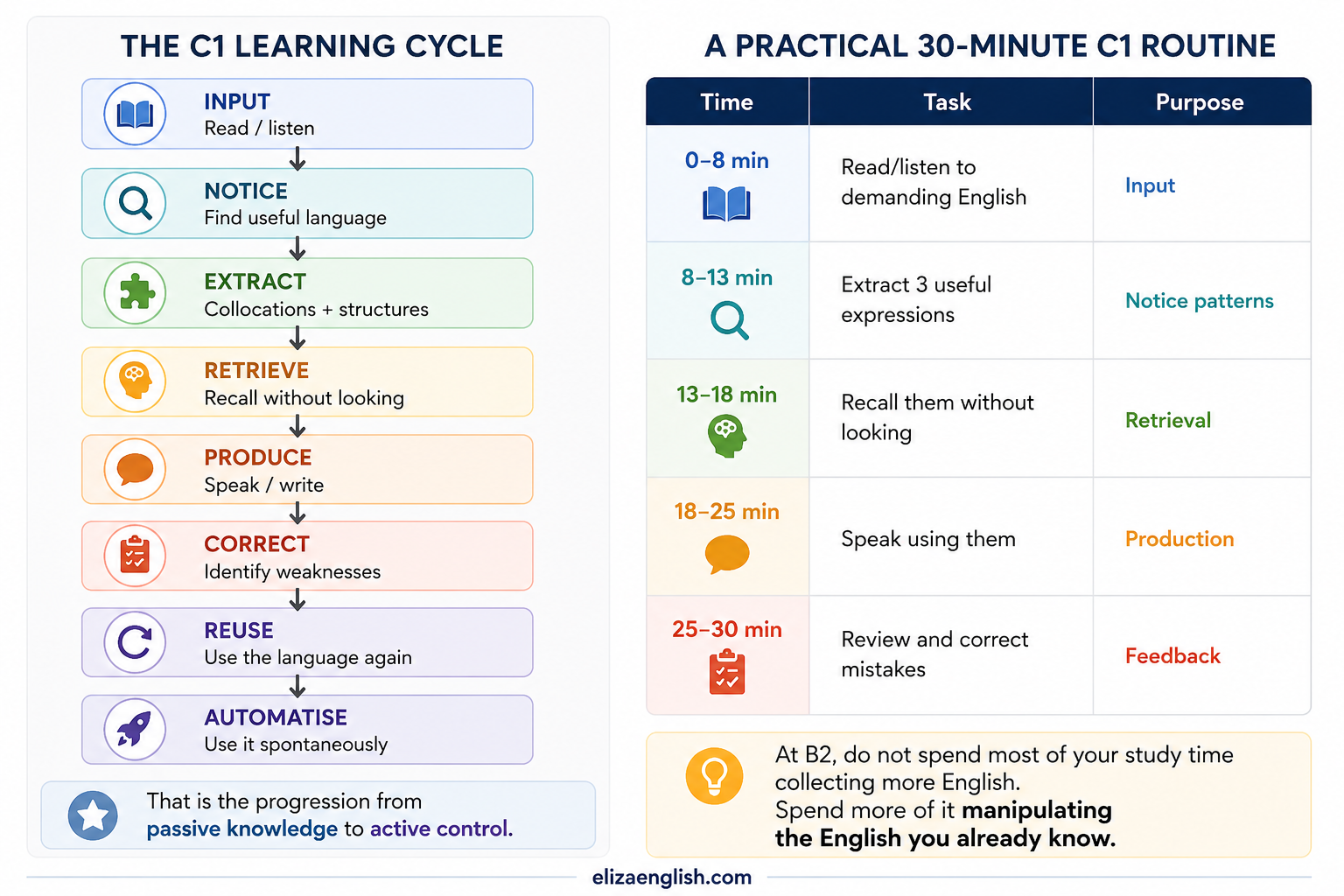
5. Turn passive vocabulary into active vocabulary
Knowing a word is not enough.
SEE
 ↓
UNDERSTAND
 ↓
RECALL
 ↓
USE
 ↓
REUSE
 ↓
USE SPONTANEOUSLY
For example:
substantial increase
substantial evidence
substantial losses
a substantial proportion
Then deliberately use substantial in your next speaking or writing task.
6. Use progressive speaking practice
Choose one question and answer it several times.
Round 1: Give your opinion.
Round 2: Add a concession.
Although X is beneficial, Y remains a concern.
Round 3: Add three target collocations.
Round 4: Qualify two claims.
Round 5: Give the answer in a more formal register.
This forces you to retrieve and manipulate language, rather than simply recognise it.
7. Record yourself
Once a week, record a two-minute response and look for:
| Problem |
What to check |
| 🔁 Repetition |
Which words do I overuse? |
| ⏸️ Pauses |
Where do I search for language? |
| 🧱 Grammar |
Which mistakes recur? |
| 🎯 Vocabulary |
Where am I too vague? |
| 🔗 Coherence |
Do my ideas flow? |
| 🔄 Recovery |
Can I paraphrase when I forget a word? |
Your recurring weaknesses are more useful than a generic list of C1 vocabulary.
What to stop doing
| ❌ Less effective |
✅ More effective |
| Memorising huge word lists |
Learn fewer words deeply |
| Endless grammar exercises |
Use grammar in production |
| Collecting rare C1 words |
Learn useful collocations |
| Only multiple-choice practice |
Add speaking and writing |
| Speaking without feedback |
Record and analyse yourself |
| Translating everything |
Build direct English processing |
| Trying to sound sophisticated |
Aim for precision |
| Studying randomly |
Track recurring weaknesses |
B2 → C1 self-check
| Can I do this spontaneously? |
Yes |
Not yet |
| Explain a complex issue for several minutes |
☐ |
☐ |
| Express the same idea in different ways |
☐ |
☐ |
| Use precise rather than vague vocabulary |
☐ |
☐ |
| Qualify claims naturally |
☐ |
☐ |
| Concede and respond to opposing views |
☐ |
☐ |
| Maintain complex grammar while speaking |
☐ |
☐ |
| Speak with little searching for expressions |
☐ |
☐ |
| Organise a long answer clearly |
☐ |
☐ |
| Adapt language to different contexts |
☐ |
☐ |
| Understand implied meaning |
☐ |
☐ |
| Use collocations naturally |
☐ |
☐ |
| Paraphrase when a word is missing |
☐ |
☐ |
| Notice and correct recurring mistakes |
☐ |
☐ |
The bottom line
B2 is already a strong level. You can communicate independently and handle a wide range of complex situations.
C1 is not simply B2 + 1,000 advanced words.
It is the ability to use English with greater:
precision + flexibility + fluency + nuance + control
If you are stuck at B2, focus less on collecting new language and more on making your existing language retrievable, adaptable and automatic.
Learn collocations. Practise paraphrasing. Record yourself. Develop discourse control. Work on register. Qualify your ideas. Get targeted feedback. Then reuse the corrected language until it becomes spontaneous.
The B2 → C1 leap is not about making your English more complicated. It is about making it more precise, flexible and controlled.
Sources
- Council of Europe, CEFR Global Scale and Common Reference Levels. (coe.int)
- Council of Europe, Qualitative Aspects of Spoken Language Use. (coe.int)
- Council of Europe, CEFR Companion Volume with New Descriptors. (coe.int)
The diagnostic quiz in this article is an original screening tool, not an official CEFR assessment.