How one unexpected lesson with a business professional led me to create a dynamic AI-powered teaching methodology that combines coaching, real-time content creation, strategic thinking, and genuine human connection.
The Day My Perfect Lesson Plan Became Obsolete
As teachers, we are often told that preparation is everything. Over the years, I have certainly embraced that philosophy, especially when working with advanced B2-C1 business professionals who expect lessons that challenge them intellectually while helping them communicate more effectively in English.
One particular lesson seemed destined for success. I had spent several hours preparing a comprehensive session on Blue Ocean Strategy versus Red Ocean Strategy, a topic that I have always enjoyed teaching because it naturally encourages discussion about innovation, competition, leadership, marketing, and business growth. For ambitious professionals, it is the kind of topic that generates meaningful conversation while providing plenty of opportunities to practise sophisticated business vocabulary and analytical thinking.
My preparation was extensive. I had carefully selected articles, gathered real-world case studies, organised several visual infographics, added relevant video resources, and compiled everything into a detailed Google document that would guide us through the lesson. By the time I finished preparing, I felt confident that I had created an engaging and valuable learning experience.
However, the lesson took an unexpected turn almost immediately.
Within the first few minutes of our conversation, I realised that my student was already exceptionally familiar with Blue Ocean Strategy. He was not merely aware of the concept. He understood the underlying principles, knew the terminology, could discuss famous examples from business history, and was comfortable analysing the framework from a strategic perspective. As he spoke, it became increasingly clear that the lesson I had spent hours preparing was unlikely to offer him anything new.
At that moment, I faced a choice that many teachers encounter but rarely discuss openly. I could continue with the original lesson simply because I had invested significant time creating it, or I could abandon my carefully designed plan and follow a direction that seemed far more relevant to my student’s needs.
Fortunately, perhaps inspired by the very topic we were discussing, I decided to embrace my own version of Blue Ocean thinking.
Instead of teaching the framework itself, I asked a simple question.
“How do you apply Blue Ocean Strategy in your own work?”
The effect was immediate.
My student worked as a Business Development Manager in the gaming industry, and within seconds the conversation became more interesting than any of the materials I had prepared. Rather than discussing textbook examples, we explored real commercial challenges, competitive pressures, market opportunities, customer acquisition strategies, and business decisions that directly affected his professional life.
As he shared his experiences, another idea occurred to me.
If we were discussing Blue Ocean Strategy in the context of the gaming industry, why not create entirely new materials that were specifically designed for his world rather than relying on generic examples that anyone could find online?
While listening carefully to his explanation, I opened ChatGPT and began creating prompts. My goal was ambitious but simple. I wanted to generate a professional infographic that would explain how a Business Development Manager working in the gaming industry could apply Blue Ocean thinking to identify new opportunities for growth.
What happened next genuinely surprised me.
By the time my student had finished explaining his perspective, ChatGPT had produced a visually impressive infographic that explored audience expansion, strategic partnerships, B2B opportunities, subscription ecosystems, geographic growth strategies, and entirely new market possibilities. The visual looked professional, relevant, and highly specific to his industry.
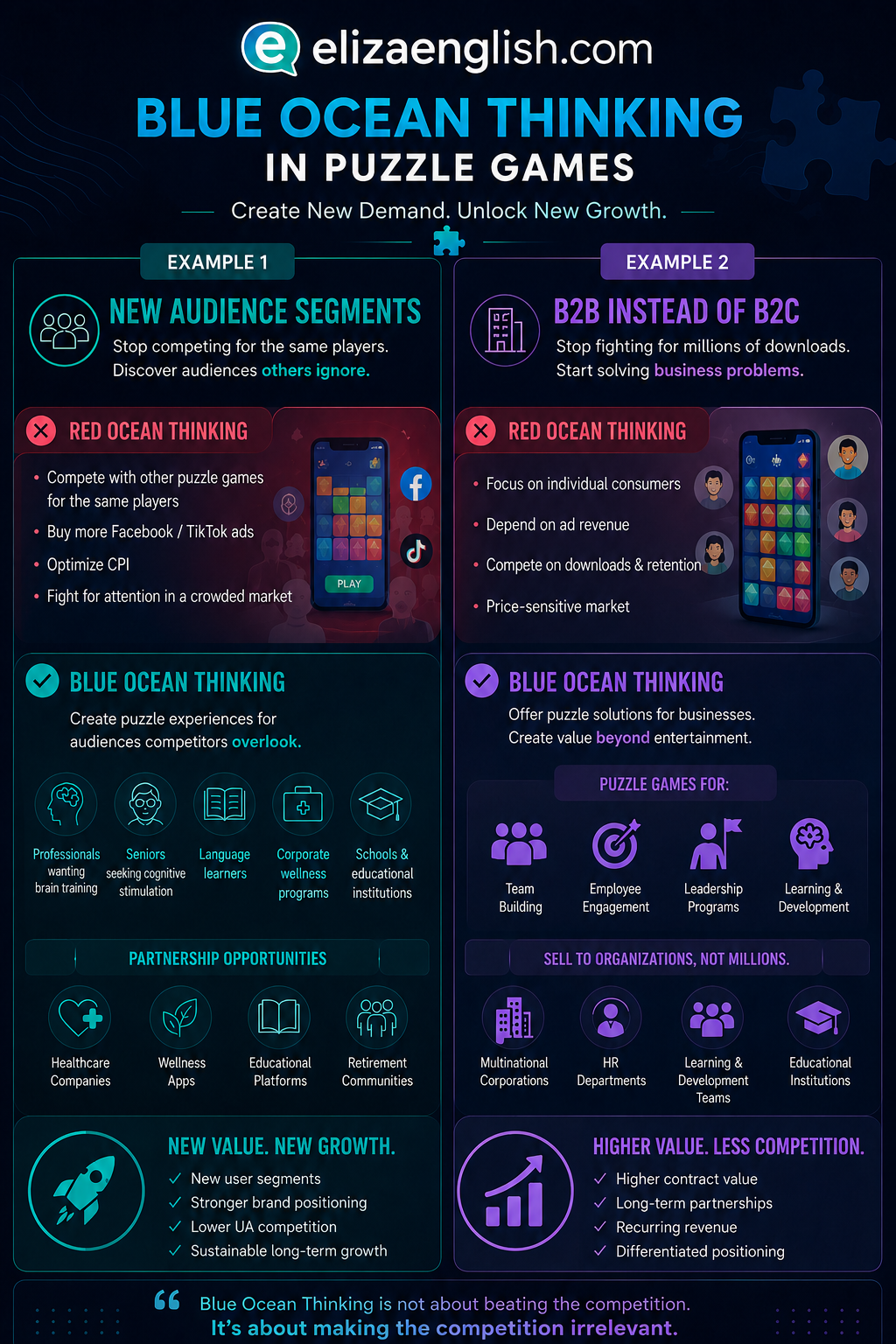
When I shared it on the screen, my student was immediately engaged.
However, what happened afterwards was even more valuable than the infographic itself.
Rather than simply reading the content, he began evaluating it critically. Together, we examined each recommendation and discussed whether it was realistic, practical, commercially viable, or overly optimistic. He challenged certain ideas, expanded on others, and connected the recommendations to his own professional experience. The discussion became an authentic business consultation conducted entirely in English.
At that moment, I realised something important.
The most valuable part of the lesson was no longer the materials I had prepared beforehand. The real value was being created in real time through the combination of human expertise, active listening, strategic questioning, AI-generated resources, and genuine professional discussion.
Without intending to, I had stumbled upon an entirely new teaching methodology.
I later gave it a name.
Vibe Teaching™.
What Is Vibe Teaching?

Vibe Teaching is a dynamic, AI-enhanced coaching methodology in which lessons evolve naturally around the learner’s professional context, interests, expertise, and emerging needs rather than following a rigid pre-planned structure.
In a traditional lesson, the teacher typically determines the content before the session begins and guides the learner through a predetermined sequence of activities. Vibe Teaching works differently. The teacher enters the lesson with resources, ideas, and objectives but remains flexible enough to adapt instantly whenever a more valuable learning opportunity emerges.
The result is a learning experience that feels highly personalised, deeply relevant, and remarkably engaging.
Instead of acting as a passive recipient of information, the student becomes an active contributor whose experiences, insights, challenges, and ideas help shape the direction of the lesson. Rather than forcing the conversation to fit the materials, the materials are created and adapted to fit the conversation.
The lesson develops organically around what matters most to the learner at that particular moment, allowing language development to occur through meaningful interaction rather than artificial exercises.
Why Vibe Teaching Is Perfect for Modern Business Professionals
Today’s professionals operate in environments characterised by constant change, increasing complexity, and continuous innovation. Markets evolve rapidly, technologies transform industries, and new challenges emerge faster than traditional educational materials can keep pace with them.
As a result, many experienced professionals find generic learning content frustrating because it often feels disconnected from their reality.
A senior manager does not necessarily need another textbook exercise about leadership. An entrepreneur may not benefit from discussing fictional business scenarios. A business development specialist is unlikely to be excited by a generic article about communication skills.
What they need is relevance.
Vibe Teaching allows every lesson to connect directly to the learner’s professional world. Current projects, workplace challenges, strategic decisions, industry developments, and business opportunities become the raw material for language development and professional growth.
This creates a level of engagement that is difficult to achieve through traditional teaching methods.

The Hidden Skills Required to Become a Vibe Teacher
Many people assume that AI does most of the work in this type of lesson. In reality, Vibe Teaching demands a higher level of expertise from the teacher than many traditional approaches.
First, a teacher must become exceptionally skilled at prompting. During a live lesson there is no time to experiment endlessly with different instructions or repeatedly edit poor outputs. Prompts must be clear, strategic, and precise enough to generate useful resources within minutes.
Second, active listening becomes absolutely essential. A teacher cannot create meaningful learning experiences in real time without paying close attention to what the learner is saying, how they think, what challenges they face, and where opportunities for deeper discussion exist.
Third, successful Vibe Teaching requires a strong relationship built on trust. The better you understand your learner’s goals, personality, professional background, and ambitions, the easier it becomes to create resources and discussions that genuinely resonate with them.
Finally, Vibe Teaching requires confidence and adaptability. Teachers must be willing to abandon carefully prepared plans whenever a better learning opportunity presents itself. Although that can feel uncomfortable initially, it is often where the most memorable and impactful learning takes place.
Why Vibe Teaching Works Especially Well for Advanced Learners
While elements of Vibe Teaching can be adapted for different levels, the methodology is particularly powerful for advanced learners because they already possess substantial knowledge, professional experience, and intellectual curiosity.
Many B2-C1 learners are no longer studying English simply to pass an exam or learn grammar rules. They want to communicate complex ideas, discuss industry trends, negotiate effectively, solve problems, present confidently, and participate fully in international professional environments.
For these learners, English becomes a tool for thinking, collaborating, and creating value rather than an isolated academic subject.
Vibe Teaching supports exactly that goal.
The Future of Language Learning
I believe that the future of education lies not in choosing between human teachers and artificial intelligence but in finding the most effective ways to combine the strengths of both.
AI can generate resources, create visuals, summarise information, design activities, and dramatically reduce preparation time. However, technology alone cannot build trust, challenge assumptions, understand emotions, recognise opportunities, or facilitate meaningful human conversations.
Those capabilities remain uniquely human.
Vibe Teaching exists at the intersection of these two worlds. It combines the creativity, empathy, adaptability, and expertise of an experienced teacher with the speed, flexibility, and content-generation capabilities of artificial intelligence.
The result is a learning experience that feels both deeply human and remarkably modern.

Learn How to Become a Vibe Teacher
If you are a teacher, coach, trainer, consultant, or language professional who wants to integrate AI into your work without losing the human element that makes great teaching possible, I now help educators develop the skills required to practise Vibe Teaching confidently and effectively.
Through personalised teacher training and coaching, I show educators how to create powerful prompts, design AI-generated learning materials, build dynamic lessons, develop stronger coaching skills, and create highly personalised learning experiences that modern learners genuinely value.
Teacher Training and AI Coaching
Learn how to:
• Create professional AI prompts quickly and accurately
• Design customised lesson materials in minutes rather than hours
• Generate visually impressive infographics and learning resources
• Build highly personalised learning experiences
• Use AI strategically without becoming dependent on it
• Develop the mindset and skills required for Vibe Teaching
Learn more by booking a teacher training class with me.
Bottom Line
Looking back, it is amusing that the lesson which inspired Vibe Teaching was centred around Blue Ocean Strategy because the experience ultimately taught me a lesson about innovation itself.
Instead of competing within the increasingly crowded red ocean of traditional language teaching, I accidentally discovered a new space where coaching, technology, conversation, business expertise, and human connection could work together in a completely different way.
That new space became my own blue ocean.
And today, I call it Vibe Teaching™.
Eliza Marabyan
Founder of Vibe Teaching™
| English Coach |
Teacher Trainer |
AI in Education Specialist |
🌐 ElizaEnglish.com
Helping professionals communicate better and helping teachers teach smarter.