If you’ve ever listened to an English podcast and thought, “I know these words, so why can’t I understand them?”, you’re not alone.
For many English learners, listening is the most frustrating skill. Reading gives you time, writing allows you to think, and speaking lets you ask for clarification. Listening, however, happens at full speed. Native speakers connect words, reduce sounds, interrupt each other, change direction halfway through a sentence, and rarely speak as clearly as textbook recordings.
The good news is that listening is a skill, not a talent. The students who achieve Band 7–9 in IELTS Listening, high TOEFL scores, or excellent results in the Duolingo English Test are not necessarily the ones with the biggest vocabulary. They are the ones who train their ears consistently and strategically.
After teaching English for over 14 years and preparing students for IELTS, TOEFL, Cambridge exams, Business English interviews, and everyday communication, I’ve noticed that only a handful of listening techniques consistently produce real progress. These are the five methods I recommend most.
Why Is English Listening So Difficult?
Most learners believe they have a vocabulary problem. In reality, they often have a listening recognition problem.
For example, you may know the words going, to, do, and it, but when a native speaker says:
“I’m gonna do it.”
your brain may hear one long unfamiliar sound instead of four familiar words.
Good listening isn’t about hearing every word. It’s about training your brain to recognise spoken English quickly and automatically.
1. Listen to Your Favourite English Songs and Read the Lyrics
This is one of the most enjoyable and surprisingly effective listening exercises you can do.
Songs expose you to natural pronunciation, connected speech, contractions, rhythm, and everyday vocabulary. Because you already enjoy the music, you’ll happily listen to the same song many times without getting bored.
Here’s how to turn music into serious listening practice.
Step 1. Choose a song you genuinely love.
The more often you’re willing to replay it, the better.
Step 2. Listen once without reading the lyrics.
Try to understand as much as possible without stopping the song.
Step 3. Find the lyrics online.
Read them carefully and highlight the words or expressions you didn’t catch.
Step 4. Listen again while following the lyrics.
Notice exactly where your ears “missed” certain sounds or connected words.
Step 5. Listen one final time without looking.
You’ll be amazed by how much more you understand.
Example
Imagine you’re listening to Someone Like You by Adele.
The first time, you might clearly hear:
“Never mind, I’ll…”
but completely miss:
“…find someone like you.”
Once you’ve read the lyrics and listened again, your brain begins connecting the sounds with the written words. The next time you hear the phrase find someone in a podcast, film, or conversation, you’ll recognise it much faster.
Bonus tip: Pause after each line and sing it yourself. Copy the singer’s pronunciation, rhythm, and intonation. This strengthens both listening and speaking because your brain learns how English sounds are actually produced.
2. Practise Active Listening Instead of Passive Listening
Many learners spend hours listening to English while cooking, cleaning, driving, or scrolling through social media. Although passive exposure has some benefits, it rarely produces rapid improvement. Active listening is much more effective because it forces your brain to process meaning.
Instead of simply playing a video or podcast, become a detective and ask yourself:
- Who is speaking?
- What is the main idea?
- What facts did they mention?
- What opinion does the speaker have?
- What will probably happen next?
Example
Suppose you’re watching a five-minute TED Talk. Pause every minute and summarise what you’ve just heard in one sentence.
This simple habit trains your brain to focus on meaning instead of individual words, which is exactly what you need in IELTS, TOEFL, and the Duolingo English Test.
3. Listen to the Same Recording Three Times (With a Different Goal Each Time)
Many students believe they should always use new listening materials. In reality, repetition is one of the fastest ways to improve because each replay trains your brain to notice something new.
First listening: Understand the main idea
Ask yourself:
“What is this mainly about?”
Don’t worry if you miss many details.
Write down:
- names / numbers / reasons / examples / opinions
Third listening: Notice the language
Pay attention to:
- useful expressions / collocations / pronunciation / linking words / reduced forms
Example
Imagine you’re listening to a podcast about healthy eating. During the first listening, you understand that the speaker is discussing nutrition.
During the second listening, you notice that they recommend eating vegetables five times a day and drinking two litres of water.
During the third listening, you discover useful expressions such as balanced diet, processed food, and maintain a healthy lifestyle.
One five-minute recording has suddenly become three different lessons.
4. Shadow Native Speakers
Shadowing is one of the techniques used by interpreters and advanced language learners because it develops listening, pronunciation, and speaking simultaneously.
The idea is simple. Listen to one sentence and repeat it immediately, copying not only the words but also the pronunciation, rhythm, stress, and intonation. Don’t worry about sounding perfect. The goal is to train your ears and your mouth together.
Example
Speaker:
“I’d rather work remotely than commute every day.”
Pause the recording and repeat the sentence exactly as you heard it. Pay attention to how the words connect naturally instead of being pronounced one by one. After just ten minutes of shadowing a day, many learners notice that fast English becomes much easier to understand because their brain starts predicting natural speech patterns.
5. Build a Listening Ladder
One of the biggest mistakes learners make is choosing materials that are far too difficult. If you understand only 20% of a podcast, your brain spends most of its energy feeling confused instead of learning. Instead, gradually increase the difficulty. Think of listening practice as climbing a ladder.
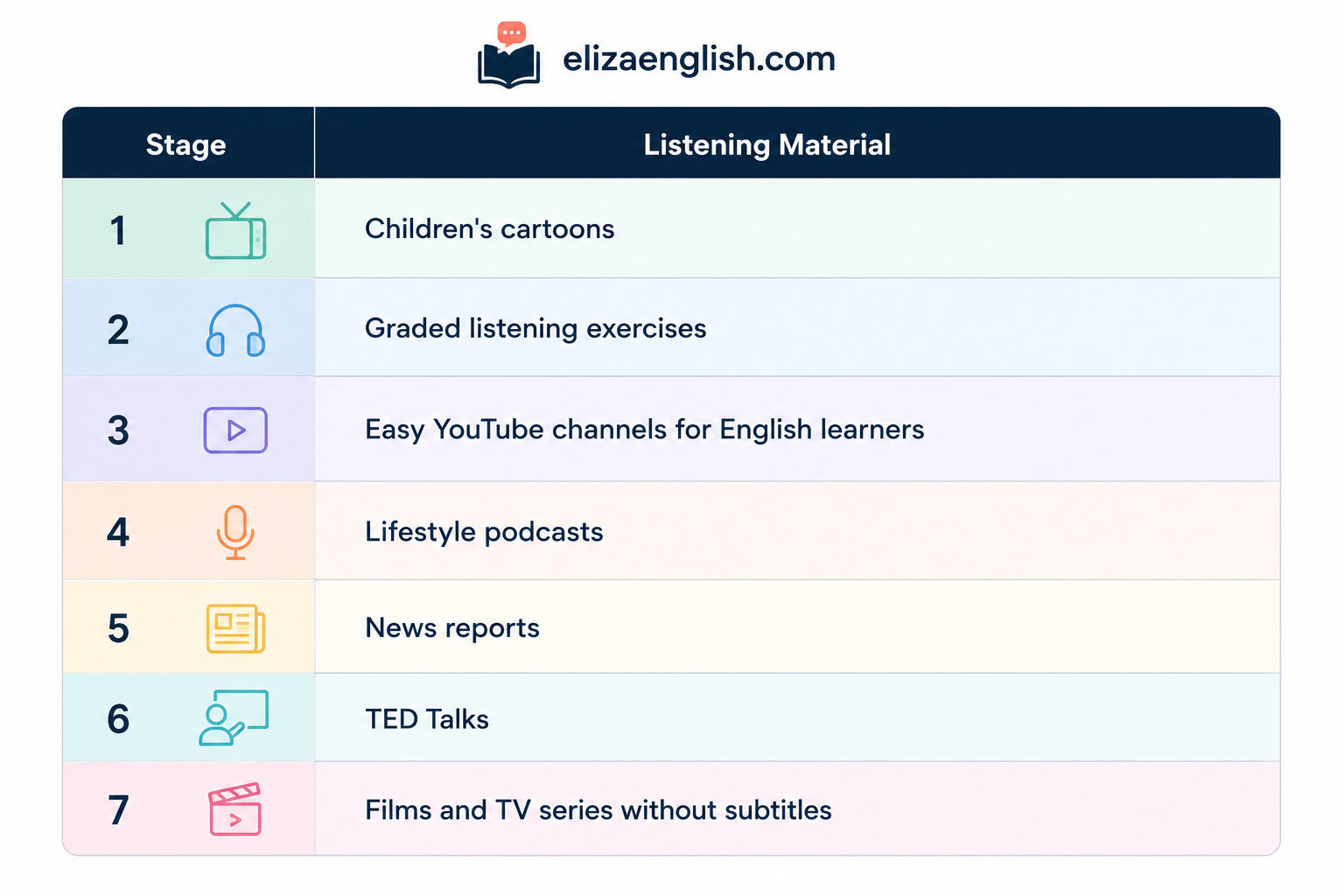
Don’t rush to the next level. When one stage starts feeling comfortable, move up to the next one. This gradual progression builds confidence while preventing frustration.
How to Practise for IELTS, TOEFL, and the Duolingo English Test
Although these exams have different formats, they all assess similar listening skills. You need to understand the main idea, identify specific details, recognise opinions and attitudes, understand the speaker’s purpose, and make logical inferences.
A simple 30-minute daily routine can prepare you for all three exams.
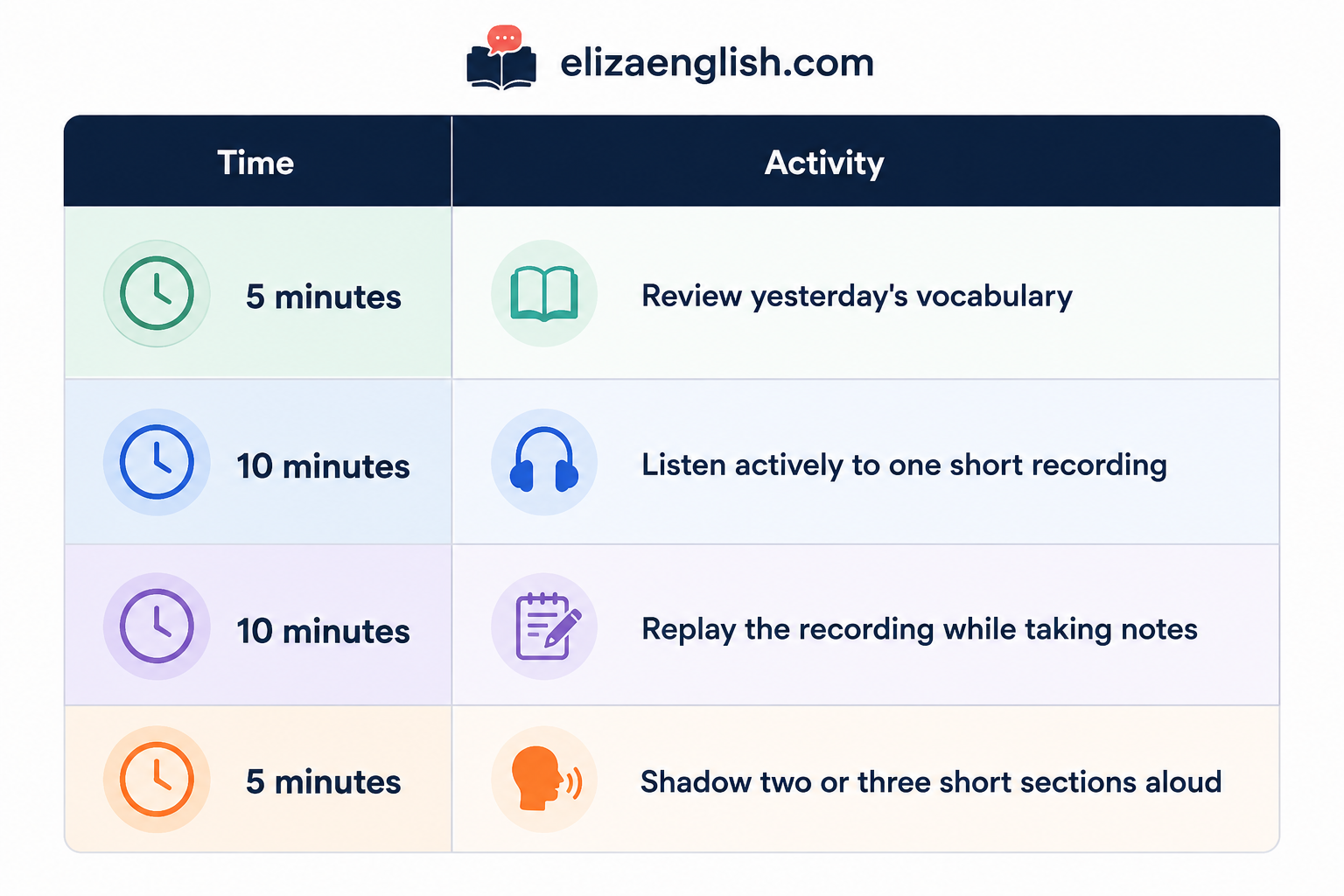
Consistency matters far more than studying for several hours once a week.
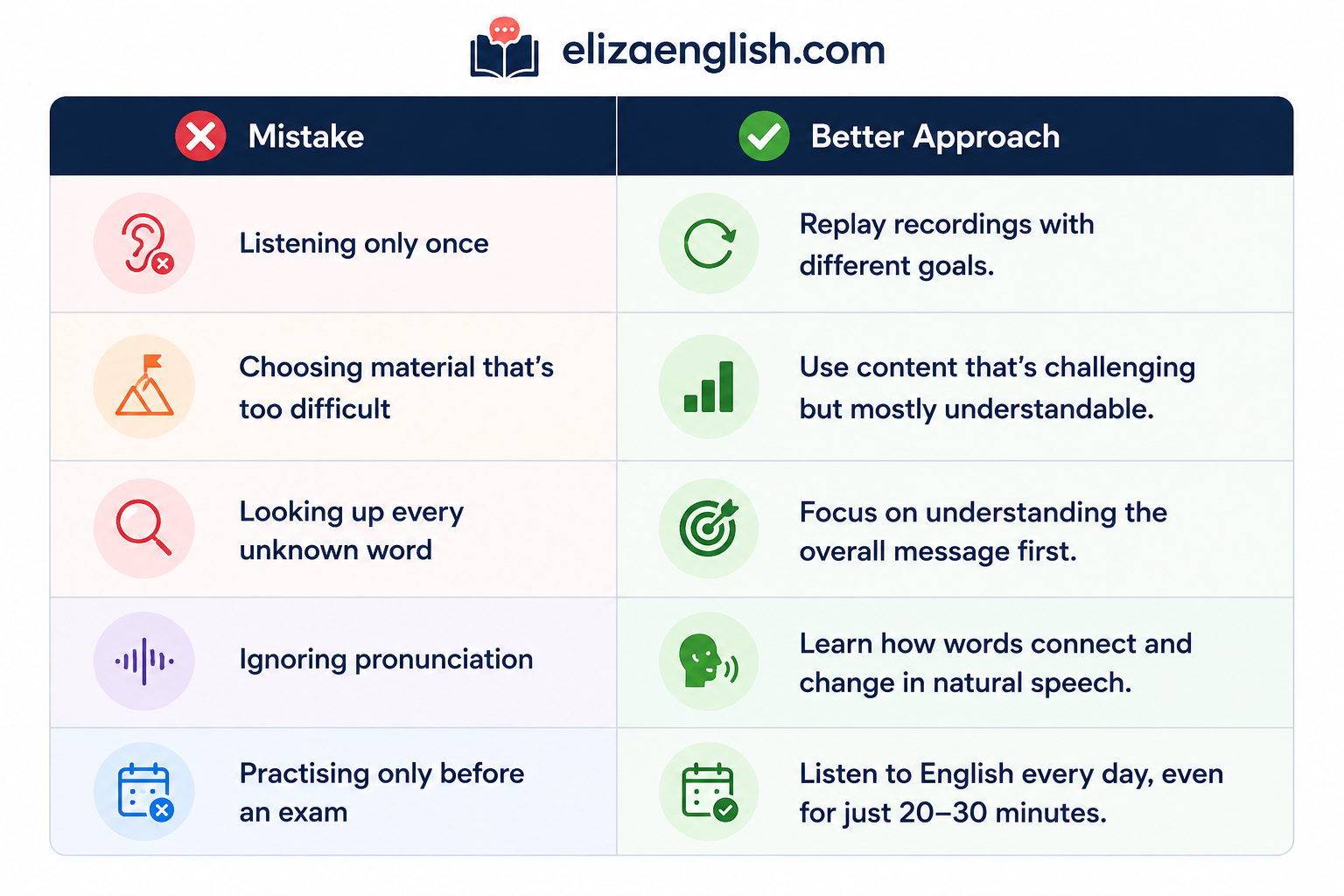
Common Listening Mistakes That Slow Down Your Progress
Many learners unknowingly make these mistakes.
Bottom Line
Improving your listening skills doesn’t require expensive courses or six-hour study sessions. It requires consistent, focused practice using techniques that mirror how the brain actually learns spoken language. Listen to songs you genuinely love and study the lyrics, replay recordings with different objectives, practise active listening instead of letting English play in the background, shadow native speakers, and gradually increase the difficulty of your listening materials.
Whether you’re preparing for IELTS, TOEFL, the Duolingo English Test, Cambridge exams, a job interview, university studies, or simply more confident conversations, these five techniques will help you understand spoken English faster and with far less frustration.
Remember that every minute of focused listening trains your brain to recognise English more automatically. At first, progress may seem slow, but one day you’ll notice something remarkable. Conversations that once felt impossibly fast will begin to sound clear, natural, and surprisingly easy. That’s the moment when you realise you haven’t just improved your listening skills. You’ve started thinking in English.