Reading is becoming a lost skill.
Not because people have become less intelligent. Quite the opposite. We consume more information than ever before. Every day we scroll through hundreds of social media posts, emails, notifications, headlines, and messages. Our brains have become excellent at switching between tasks but much worse at focusing on one.
Many people no longer read. They simply move their eyes across the page. Others force themselves to finish a chapter only to tick another box on their to-do list. Five minutes later, they cannot remember what they have just read.
Why?
Because deep reading is a low-dopamine activity. Unlike TikTok, Instagram, or YouTube Shorts, a book does not reward us every few seconds with something new. Reading requires patience, concentration, and active thinking. In today’s world of constant distractions, those qualities have become increasingly rare.
The good news is that reading is not an inborn talent. It is a skill, and like any skill, it can be improved.
Whether you’re preparing for the IELTS, TOEFL iBT, or the Duolingo English Test, or simply want to become a better learner, the strategies below will help you read faster, understand more, and remember what you read long after you’ve finished the page.
Why Reading Is One of the Best Investments You Can Make
Reading is much more than recognising words. Every time you read, your brain predicts, analyses, connects ideas, stores memories, evaluates evidence, and builds new neural pathways.
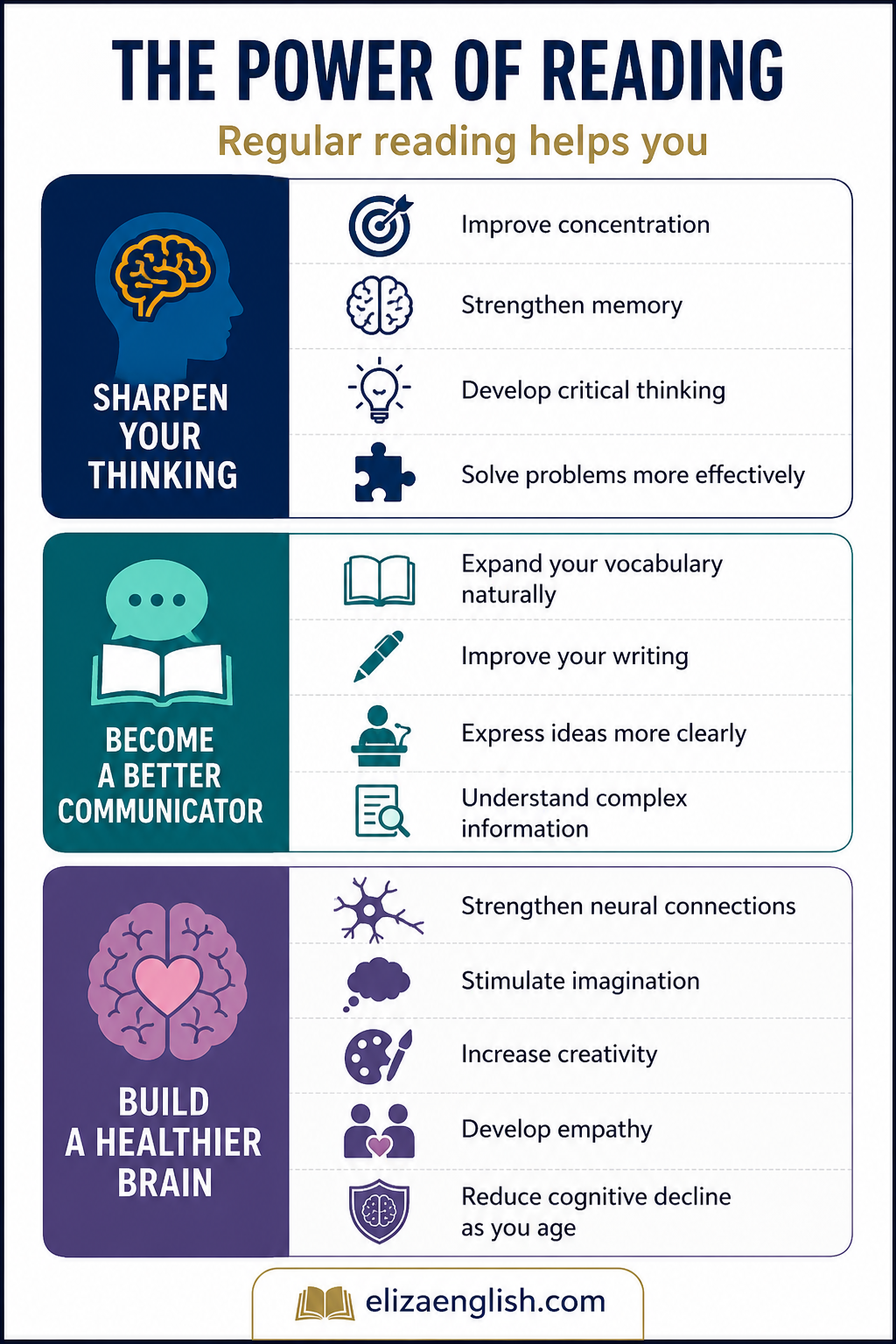
Think of every book as a workout for your brain. The more consistently you read, the stronger your mental “muscles” become.
Now let’s look at the techniques that great readers use every day.
Strategy 1. Read for Gist
One of the biggest mistakes learners make is trying to remember every detail. Strong readers first identify the main message.
This is called reading for gist.
Instead of asking:
“What does every sentence mean?”
ask yourself:
If I had to explain this page in one sentence, what would I say?
Even better, keep one question in your mind while reading:
What is the biggest takeaway I’ve learned?
At the end of every page or section, pause for ten seconds and summarise it in your own words. If you cannot explain it simply, you probably haven’t understood it deeply enough.
Useful for
| IELTS |
TOEFL |
Duolingo |
Matching Headings,
Choosing a Title
|
Main Idea,
Prose Summary
|
Interactive Reading,
Read Then Write
|
💡 Exam Tip: Don’t memorise every detail during your first reading. Understand the big picture first.
Strategy 2. Master Skimming
Many students confuse skimming with speed reading.
They are different.
Skimming means reading quickly to understand the overall message without paying attention to every detail.
When reading an article, focus on:
- the title
- headings
- the first sentence of each paragraph
- the conclusion
Within a minute or two, you should understand the topic, the author’s opinion, and how the text is organised.
Skimming gives your brain a roadmap before you start reading carefully.
Useful for
| IELTS |
TOEFL |
Duolingo |
Matching Headings,
Multiple Choice
|
Main Purpose
|
Interactive Reading
|
Strategy 3. Learn to Scan
Scanning is almost the opposite of skimming. Instead of understanding everything, you search for one specific piece of information.
Imagine the question asks:
“How many volunteers participated in the study?”
Your eyes immediately search for numbers instead of reading every sentence. Scanning saves valuable time, especially in exams where every minute counts.
Useful for
| IELTS |
TOEFL |
Duolingo |
Sentence Completion,
Note Completion,
Diagram Labelling,
Short Answer Questions
|
Factual Information Questions
|
Interactive Reading
|
Strategy 4. Read Between the Lines
Not everything is stated directly. Good readers recognise hidden meaning.
Remember these two important verbs:
- to imply = the writer suggests something indirectly
- to infer = the reader understands the hidden meaning
The writer implies. The reader infers.
Example
“Tom kept checking his watch while waiting outside the interview room.”
The author never says Tom is nervous. You infer it. This ability is essential for academic reading because writers often expect readers to connect the dots themselves.
Useful for
| IELTS |
TOEFL |
Duolingo |
True, False, Not Given,
Multiple Choice
|
Inference Questions
|
Interactive Reading,
Read Then Write
|
Strategy 5. Identify the Author’s Purpose
Every article has a purpose.
Ask yourself:
Why did the author write this?
Most texts aim to:
- inform / persuade / explain / compare / entertain / recommend / warn / criticise
Once you know the purpose, the organisation of the text becomes much easier to predict.
For example, persuasive articles usually contain arguments, evidence, and counterarguments, while explanatory texts often include definitions, causes, and examples.
💡 Pro Tip: Asking “Why did the author write this?” keeps your brain actively engaged instead of passively reading.
Strategy 6. Predict Before You Read
Your brain naturally likes making predictions. Use that to your advantage.
Before reading, spend just 20 seconds looking at:
- the title / subtitles / pictures / charts / keywords
Then ask yourself:
- What do I already know?
- What vocabulary might appear?
- What questions might the article answer?
Activating your prior knowledge makes comprehension much easier because your brain already has a framework for the new information.
Strategy 7. Learn Vocabulary from Context
Many students stop reading every time they see an unfamiliar word. That destroys both concentration and reading speed. Instead, become a language detective.
Ask yourself:
- Is the word positive or negative?
- Is it describing a person, object, or action?
- Which nearby words provide clues?
Example
“The desert was arid, receiving less than 25 millimetres of rainfall each year.”
Even if you’ve never seen the word arid, the sentence tells you it means extremely dry.
This strategy dramatically improves vocabulary acquisition because you’re learning words naturally instead of memorising isolated lists.
Useful for
| IELTS |
TOEFL |
Duolingo |
|
Vocabulary in Context
|
Vocabulary Questions
|
Interactive Reading
|
Strategy 8. Separate Facts from Opinions
Academic texts often mix facts with opinions. Strong readers can tell the difference immediately.
Fact
Water boils at 100°C under standard atmospheric pressure.
Opinion
Solar energy is the best long-term solution.
Recognising this distinction improves your critical thinking and helps you answer inference and multiple-choice questions more accurately.
Whenever you read, ask yourself:
Is this something that can be proven, or is it someone’s interpretation?
Strategy 9. Become an Active Reader
Passive readers simply move through a text. Active readers constantly think.
As you read, ask yourself:
- What surprised me?
- What is the author’s main argument?
- What evidence supports it?
- Do I agree?
- What is the biggest takeaway?
- How would I explain this idea to a friend?
These simple questions force your brain to process information instead of merely recognising words. The more actively you read, the more you remember.
Which Reading Skill Should You Use?
Which Reading Skill Should You Use?
| Goal |
Best Strategy |
| Understand the main idea |
Reading for Gist |
| Get a quick overview |
Skimming |
| Find one specific detail |
Scanning |
| Understand hidden meaning |
Inferring |
| Recognise the writer's intention |
Identifying the Author's Purpose |
| Prepare your brain before reading |
Predicting |
| Learn new vocabulary naturally |
Using Context Clues |
| Evaluate information critically |
Distinguishing Fact from Opinion |
| Remember more after reading |
Active Reading |
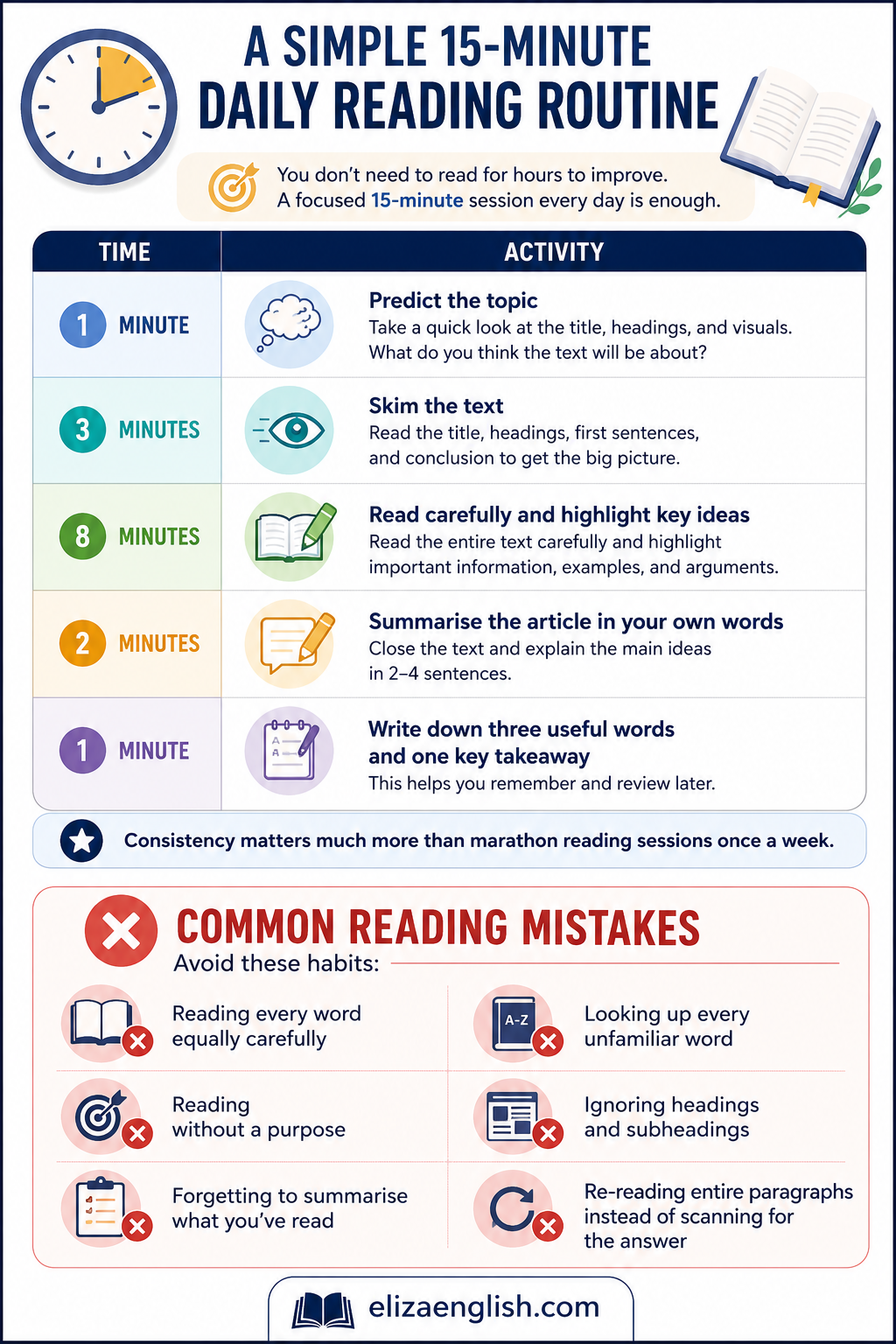
A Simple 15-Minute Daily Reading Routine
Bottom Line
Reading is not simply about finishing a book or completing an exam passage. It is one of the most valuable skills you can develop because it shapes the way you learn, think, remember, and communicate.
The strongest readers know when to skim, when to scan, when to slow down, and when to read between the lines. They actively predict, infer, question, and summarise instead of passively moving from one sentence to the next.
These are exactly the skills that help students achieve higher scores in the IELTS, TOEFL iBT, and the Duolingo English Test. More importantly, they are the same skills that will help you long after the exam is over, whether you’re reading a university textbook, analysing a business report, or simply enjoying a great novel.
The next time you open a book, don’t read just to finish it. Read with curiosity. Read with purpose.
And most importantly, finish every page by asking yourself one simple question:
What is the biggest takeaway I have learned today?
That small habit can completely transform the way you read, learn, and grow.