Why some English learners study for hundreds of hours yet struggle to speak fluently, while others make remarkable progress with less time but far better strategies.
“Tell me and I forget. Teach me and I may remember. Involve me and I learn.”
Benjamin Franklin
There is a reason this quote has survived for centuries.
The information you discover for yourself stays with you far longer than information that is simply presented to you. Every successful learner eventually realises that learning is not about collecting notes. It is about transforming information into knowledge that becomes part of who you are.
You have probably experienced this yourself.
You write ten new English words in your notebook. You glance at them for five seconds, close the notebook and think, “I’ve learned them.” The following morning, you remember only three. A week later, they have almost completely disappeared.
Now imagine another learner studying exactly the same ten words.
They write them down neatly, highlight the difficult ones, cover the page and try to recall every word from memory. Then they create sentences, invent a funny story connecting all ten words, review them the following day, notice several of them in a YouTube video later that week, and finally use them naturally during an English conversation.
Six months later, those words are still part of their active vocabulary. The difference is not intelligence. It is not talent. It is not even motivation. The difference lies in how the brain creates long-term memories.
Learning that involves searching, retrieving, connecting and applying information creates much stronger neural pathways than passive reading or highlighting. Instead of remaining superficial, knowledge becomes deeply embedded in your memory and much easier to retrieve when you need it.
In this article, you’ll discover the science behind effective self-study and learn five powerful, research-backed techniques that will help you remember English vocabulary, grammar and expressions for years instead of days.
One of the strongest findings in modern cognitive psychology is known as the Generation Effect. Decades of research show that people remember information significantly better when they generate it themselves instead of simply reading it.
When your brain has to solve a problem, recall an answer, explain an idea or complete a sentence, it works much harder than during passive reading. That extra effort strengthens memory.
Learning is not like copying files onto a hard drive.
Every learning experience physically changes your brain.
Whenever neurons fire together repeatedly, the connections between them become stronger. Over time, these pathways become coated with myelin, a fatty insulating substance that allows electrical signals to travel faster and more efficiently.
Think of it like this:
- Reading once creates a narrow footpath.
- Retrieval practice turns it into a country road.
- Repeated use widens it into a motorway.
- Authentic communication transforms it into a high-speed expressway.
The more often you actively retrieve and use information, the more myelinated and efficient these neural pathways become.
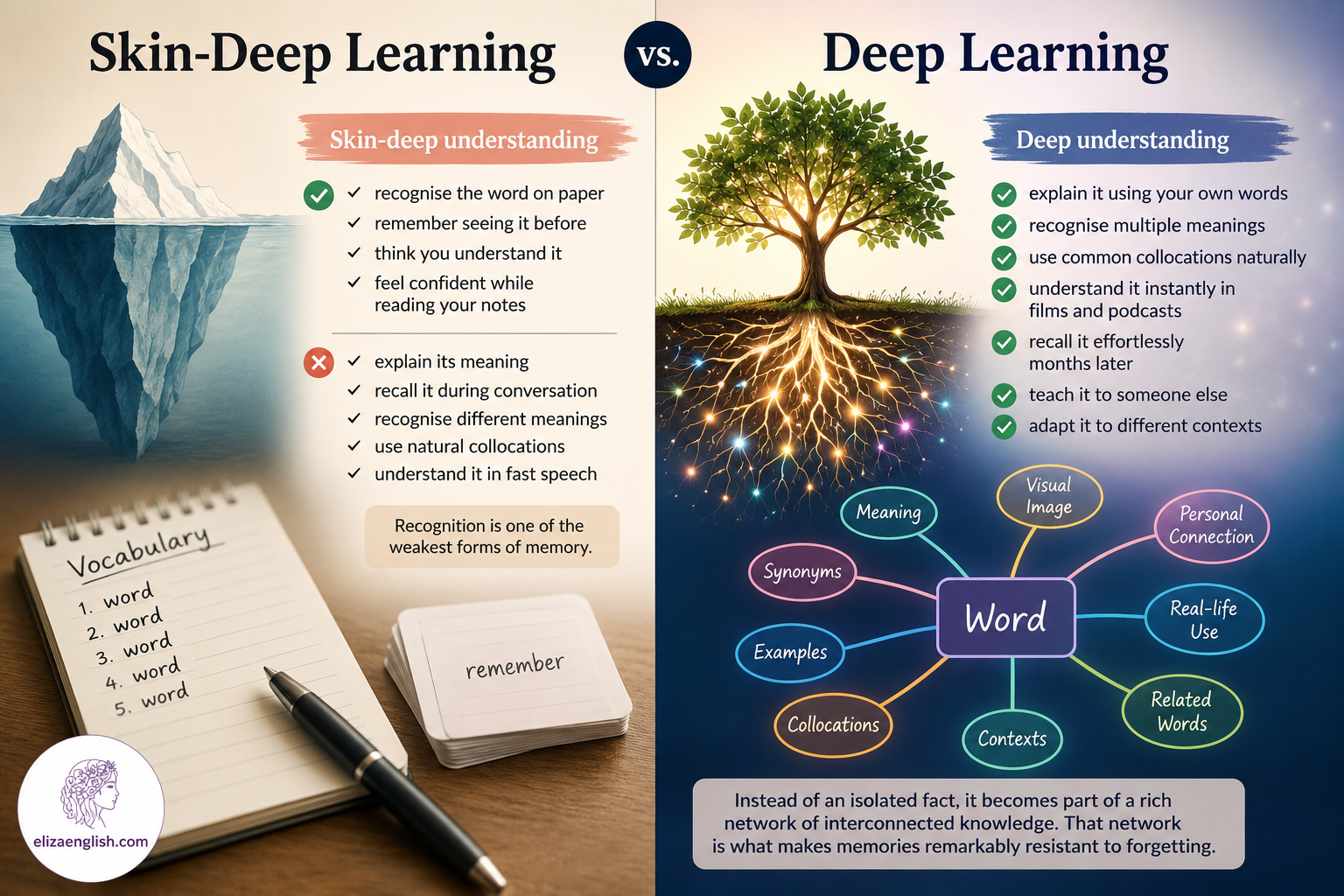
Skin-Deep Learning vs Deep Learning
Many learners mistake familiarity for mastery. Seeing a word several times creates a comforting feeling that you know it. Unfortunately, familiarity is not learning.
Psychologists call this phenomenon the illusion of competence.
“Learning is not attained by chance. It must be sought for with ardour and attended to with diligence.”
Abigail Adams
Why We Forget So Quickly
In the 1880s, German psychologist Hermann Ebbinghaus discovered what we now call the Forgetting Curve.
His experiments showed that without review, we forget much of newly learned information surprisingly quickly. Most forgetting happens within the first few days.
Modern research has confirmed this pattern many times.
Fortunately, every successful retrieval interrupts the forgetting process and strengthens the underlying memory. The goal of effective self-study is therefore not to study more. It is to forget less.
What Learning Science Tells Us
Several comprehensive reviews of educational psychology have identified a small number of learning techniques that consistently outperform traditional study methods.
Among the most effective are:
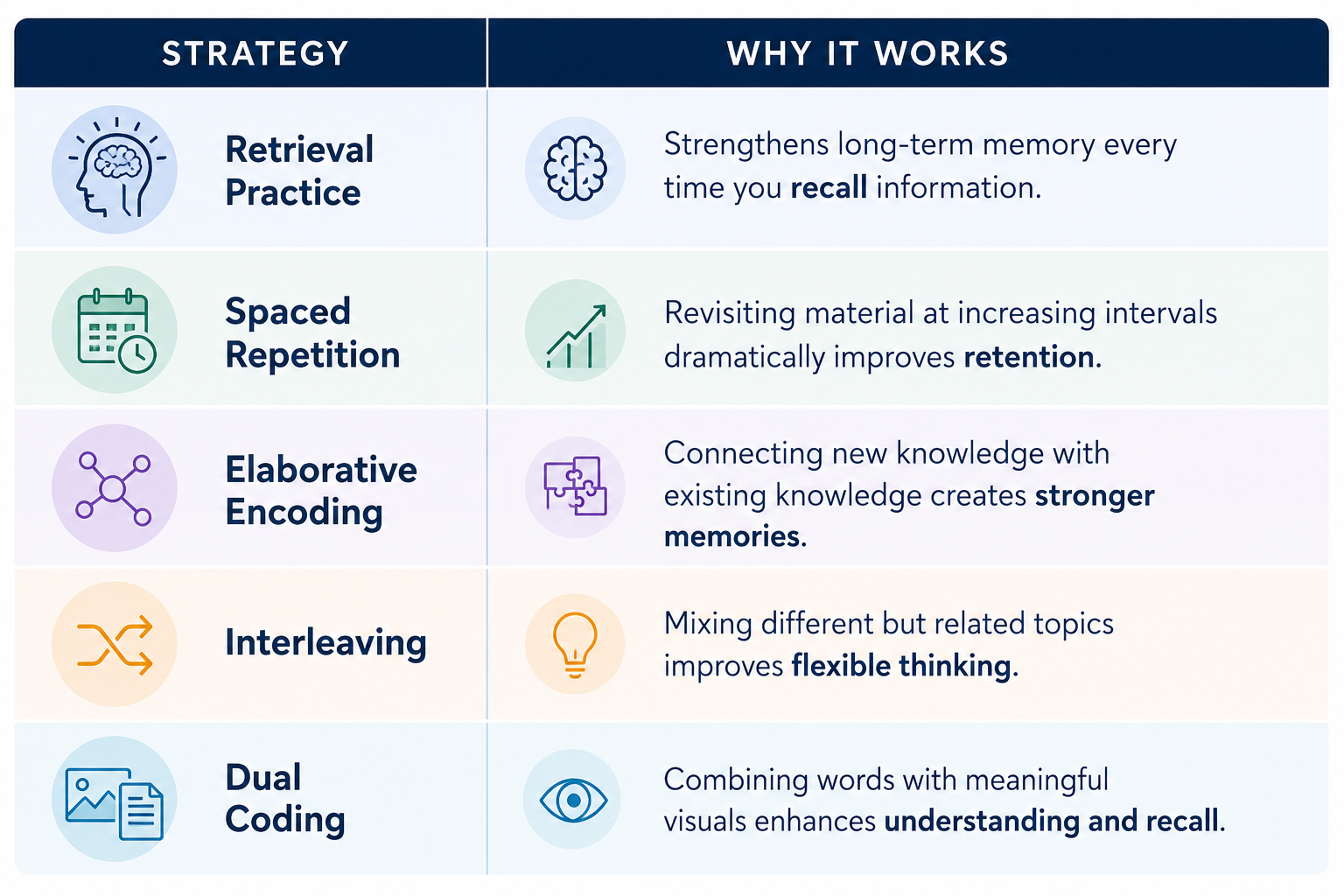
These findings have been replicated across thousands of learners by researchers including Henry Roediger III, Jeffrey Karpicke, Robert Bjork, Elizabeth Bjork and John Dunlosky.
Five Science-Backed Self-Study Techniques That Actually Work
1. Stop Collecting Words. Start Owning Them.
Many vocabulary notebooks become graveyards of forgotten words. Writing a word down is only the beginning. If you truly want to remember vocabulary, every new word should pass through several stages of processing.
For each new word:
- write a simple English definition
- note the pronunciation
- identify common collocations
- write one synonym and one antonym
- create two realistic sentences
- connect the word to your own life
- imagine a vivid mental picture
- invent a funny or emotional story
- say it aloud several times
- use it during your next lesson or conversation
For example, if you learn negotiate, don’t stop after writing the definition.
Instead, create meaningful sentences such as:
- We negotiated a better salary.
- They negotiated with the supplier.
- The company negotiated new contract terms.
Then imagine yourself negotiating your own pay rise.
Why it works
Every new connection creates another retrieval pathway. Instead of storing one isolated fact, your brain builds an entire network of associations. Neuroscientists call this elaborative encoding, and it is one of the strongest predictors of long-term retention.
2. Close the Notebook. Let Your Brain Do the Work.
Most students spend too much time looking at information. Successful learners spend far more time trying to retrieve it.
After studying for five or ten minutes:
- close the notebook
- write everything you remember
- explain today’s grammar aloud
- recreate today’s examples
- recall every new word
- identify what you forgot
- reopen your notes only to check yourself
Notice the difference. You are no longer reading. You are remembering.
Why it works
This technique is called retrieval practice, often referred to as the testing effect. Every successful recall strengthens memory far more than rereading ever could. Even struggling to remember is beneficial.
Researchers describe this as a desirable difficulty because effortful learning creates stronger and more durable memories.
“Memory is the residue of thought.”
Daniel Willingham
The more deeply you think, the more deeply you remember.
3. Build Memory Networks Instead of Memorising Lists
Your brain was never designed to remember disconnected lists.
It remembers stories, relationships and meaning.
Instead of learning isolated vocabulary, organise words into connected networks.
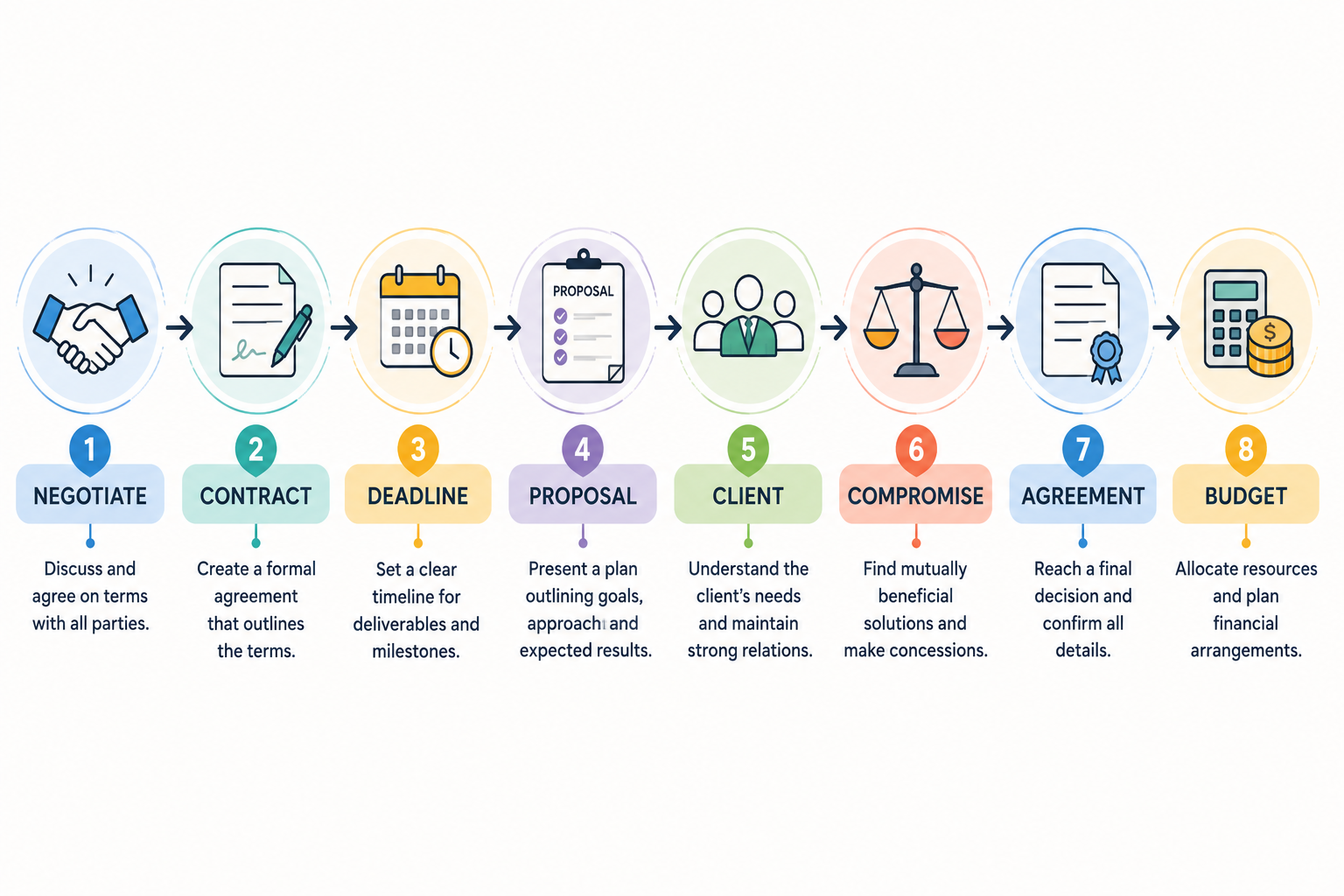
Now imagine an important business meeting using every word.
Better still:
- tell the story aloud
- write it as a short email
- role-play it with ChatGPT
- record yourself speaking
- retell the same story tomorrow without looking
Why it works
The hippocampus naturally stores memories through associations.
Activating one concept automatically activates related concepts, making retrieval faster and far more reliable.
4. Chase Your Vocabulary in the Real World
Many learners finish studying and immediately close the textbook.
That is exactly when the most valuable learning opportunity begins.
Suppose today’s vocabulary includes:
- sustainable / affordable / shortage / efficient / reliable / flexible
Now spend twenty minutes consuming authentic English. Watch YouTube. Read BBC News. Listen to a podcast. Browse LinkedIn.
Every time you notice one of today’s words:
- pause the video
- examine the sentence
- notice nearby collocations
- ask why the speaker chose that word
- repeat the sentence aloud
- imagine using it yourself tomorrow
Why it works
Psychologists call this contextual variability. Seeing the same word across multiple situations teaches your brain that the knowledge is widely useful rather than tied to a single lesson. Eventually, recognition becomes automatic. Then automatic recognition becomes spontaneous production.
5. Finish Every Study Session by Creating Something
Many learners spend hours consuming English but almost no time producing it. Reading improves recognition.
Listening improves comprehension. Speaking and writing transform knowledge into skill. Before ending every study session, create something.
For example:
- summarise today’s article
- explain today’s grammar in simple English
- record a one-minute voice message
- write a LinkedIn post
- answer an IELTS or TOEFL question
- describe your day using today’s vocabulary
- write a short dialogue
- teach the topic to an imaginary student
Why it works
Producing language forces your brain to coordinate vocabulary, grammar, pronunciation and ideas simultaneously. This activates multiple neural systems at once, creating stronger and more integrated memories. Over time, English stops feeling like something you study. It becomes something you naturally use.
A Simple Weekly Self-Study Framework
Instead of studying randomly, follow this cycle.
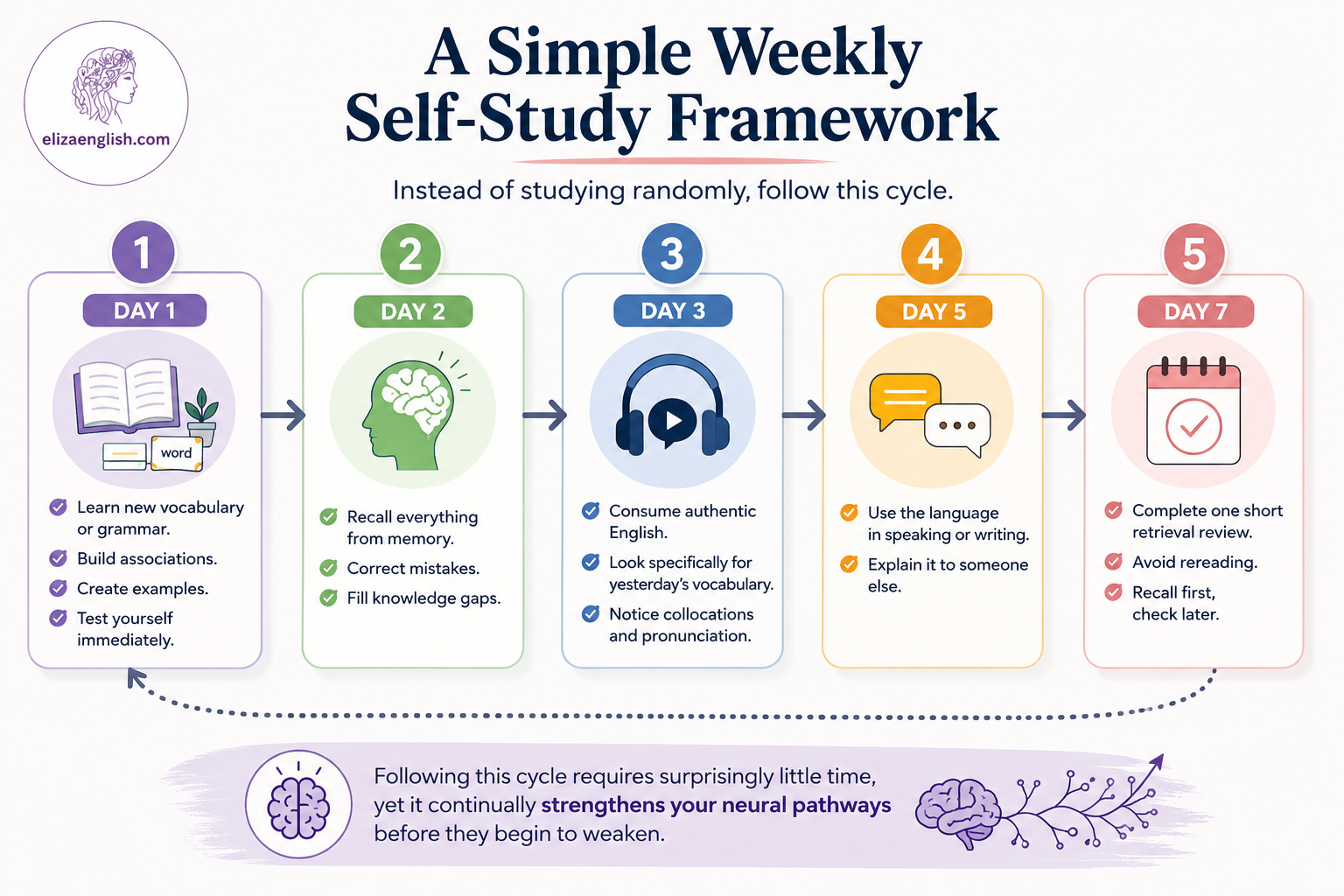
Following this cycle requires surprisingly little time, yet it continually strengthens your neural pathways before they begin to weaken.
Quality Always Beats Quantity
Many learners proudly announce,
“I studied English for three hours today.”
A much better question is:
How many times did your brain actually retrieve information?
One focused hour filled with retrieval practice, elaboration, spaced repetition and meaningful communication often produces better results than three hours spent highlighting notes.
The best learners do not necessarily study longer.
They study smarter.
“Knowledge is of no value unless you put it into practice.”
Anton Chekhov
Bottom Line
There is no perfect app, magical course or secret textbook that can replace the way your brain naturally learns.
The learners who make extraordinary progress are usually not the ones spending the most hours with their books open. They are the ones who repeatedly retrieve information, connect it with existing knowledge, revisit it before forgetting begins, and actively use it in meaningful communication.
Every successful act of remembering strengthens the neural pathways that support future learning. Every sentence you create, every conversation you have, every article you read and every new context in which you recognise today’s vocabulary makes those pathways faster, stronger and more deeply embedded.
The next time you finish writing ten new English words in your notebook, resist the temptation to close the book because you think the learning is over.
Close it because the real learning is about to begin.