Cybersecurity Isn’t Just an IT Topic Anymore
A few years ago, if someone had asked me to teach a Business English lesson on cybersecurity, I probably would have suggested another topic. Leadership? Absolutely. Negotiations? No problem. Marketing? I’ve taught those for years. Cybersecurity, however, felt like a completely different world.
Like many English teachers, I’m not an IT professional. I don’t build networks or investigate cybercrime. At first, the idea of teaching cybersecurity felt intimidating because I worried about explaining technical concepts accurately and answering questions that might go beyond my expertise.
Then something changed. Cybersecurity stopped being an IT topic and became a life skill.
Almost every week, we hear about another ransomware attack, data breach, phishing scam, AI-generated deepfake, or company losing millions because of a single human mistake. Suddenly, cybersecurity wasn’t something that only concerned software engineers. It became relevant to HR managers, accountants, marketers, lawyers, entrepreneurs, teachers, students, and anyone who uses a computer or smartphone.
Our students encounter these stories every day. They discuss them with colleagues, read about them in the news, and sometimes become victims themselves. Whether they work in finance, healthcare, education, sales, customer service, or simply use the internet, they need enough cybersecurity knowledge to understand what’s happening around them. Not because they want to become cybersecurity experts, but because they want to become informed, digitally literate professionals.
If you’d like to save hours of preparation or learn this topic independently, I’ve created a complete five-lesson Business English Cybersecurity Bundle that includes ready-to-teach lesson plans and self-study guides. You can explore it here: 👉 Business English for Cybersecurity
Let’s look at why cybersecurity deserves a permanent place in every modern Business English course.
Business English Has Changed
Business English is no longer just about meetings, presentations, negotiations, and emails.
Today’s professionals discuss artificial intelligence, digital transformation, cloud computing, remote work, data privacy, cybercrime, and online security. These topics appear in meetings, onboarding sessions, compliance training, conferences, client calls, and everyday workplace conversations.
If our learners can’t explain what phishing is, discuss a data breach, or understand why companies use multi-factor authentication, they’re missing an increasingly important part of modern business communication.
That’s why cybersecurity has become one of my favourite Business English topics. It combines practical vocabulary, fascinating real-world stories, critical thinking, authentic reading, and meaningful discussions that students genuinely enjoy.
You Don’t Need to Be an IT Expert
One of the biggest misconceptions is that English teachers need technical expertise before introducing cybersecurity.
You don’t. Your role isn’t to explain how to configure a firewall or build a secure network. Your role is to help learners understand and communicate confidently about topics they encounter in everyday life and at work.
That includes conversations about:
These aren’t computer science lectures. They’re modern workplace conversations.
I Couldn’t Find the Lessons I Wanted
When I decided to introduce cybersecurity into my Business English classes, I assumed there would be plenty of high-quality teaching materials available.
There weren’t.
Most resources fell into one of two categories. They were either highly technical articles written for IT professionals or simple vocabulary worksheets with very little opportunity for meaningful communication. Very few were designed specifically for B2-C1 Business English learners who wanted to discuss cybersecurity confidently without becoming cybersecurity engineers.
So I created my own.
What started as a single lesson gradually evolved into a complete course. Every topic naturally led to another. Students couldn’t understand cyberattacks without first understanding networks. Protecting digital assets deserved its own lesson, while the rapid development of AI, deepfakes, cloud computing, and quantum technologies made it obvious that the future of cybersecurity needed dedicated attention as well.
The result is a practical five-lesson Business English bundle that explains complex ideas in clear English while encouraging learners to think critically, discuss authentic issues, and build confidence.
Five Cybersecurity Topics Every Modern Professional Should Understand
Rather than overwhelming learners with technical jargon, I focused on the knowledge every educated professional should have, regardless of their industry.
1. Cybersecurity Fundamentals
Build a strong foundation by learning essential cybersecurity concepts, common threats, key terminology, and the vocabulary needed to understand cybersecurity news and workplace discussions.
2. Networking Basics
Understand how networks function, why they matter, and how attackers exploit weaknesses. Complex concepts are explained through simple language, diagrams, and practical examples.
3. Cyberattacks & Social Engineering
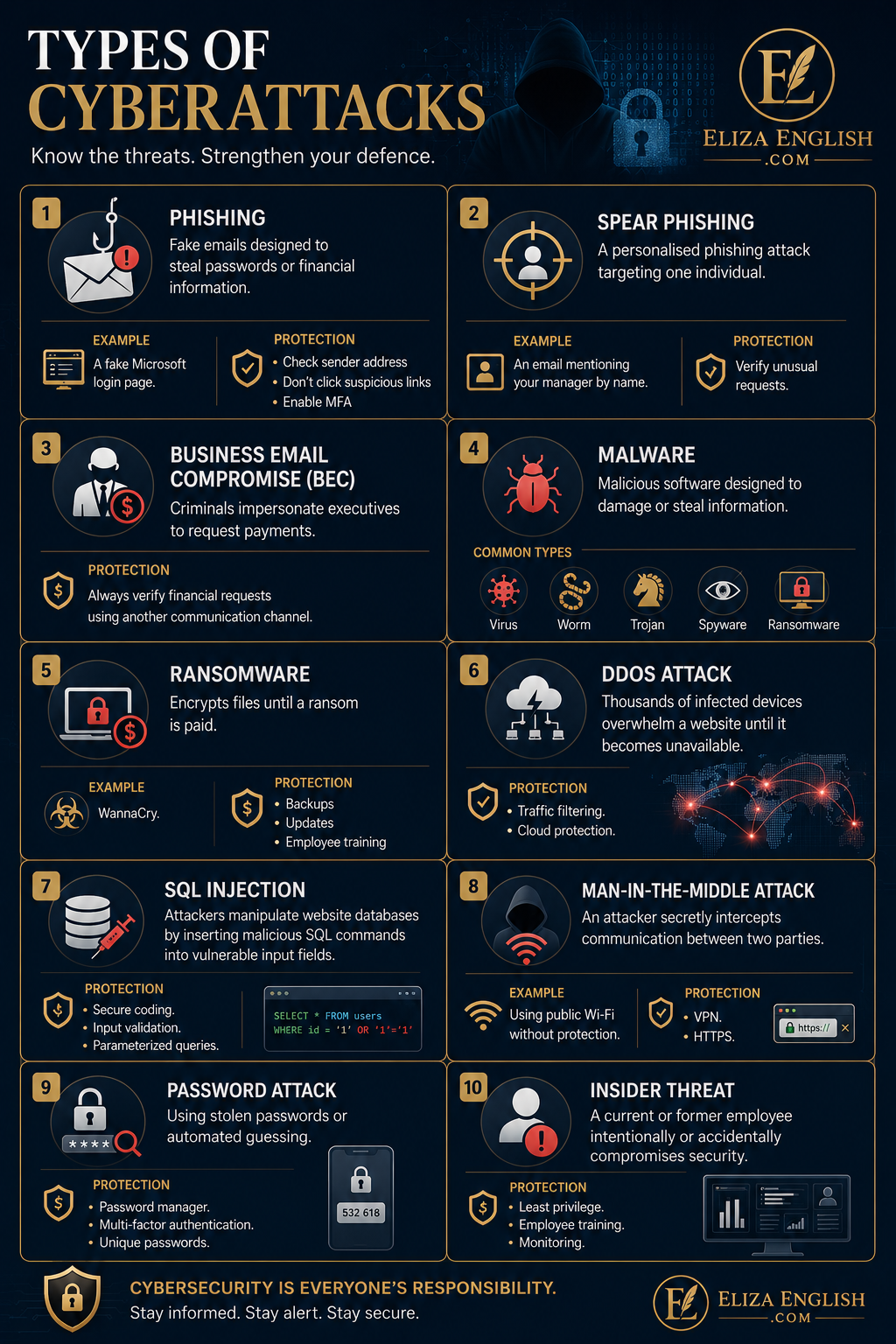
Explore phishing, ransomware, malware, hacking, and social engineering through authentic case studies, reading texts, vocabulary tasks, and engaging discussion activities.
4. Protecting Digital Assets
Learn practical ways to protect personal and company information through passwords, encryption, authentication, authorization, firewalls, antivirus software, backups, and digital risk management.
5. The Future of Cybersecurity
Discover how artificial intelligence, cloud computing, deepfakes, quantum computing, and cyber warfare are transforming digital security and changing the future of business.
Together, these five lessons provide learners with the language and confidence needed to participate in one of the most important conversations in today’s workplace.
Designed for Teachers and Independent Learners
One of my priorities was to create something useful for both audiences.
If you’re an English teacher, you’ll receive complete, ready-to-teach lesson plans that save hours of preparation. Every lesson includes structured activities, authentic reading texts, professional visuals, discussion questions, vocabulary exercises, speaking tasks, and answer keys.
If you’re an independent learner, every lesson also comes with a comprehensive self-study guide that allows you to study at your own pace. Whether you’re preparing for an international job, improving your Business English, or simply want to understand cybersecurity better, you’ll have everything you need in one place.
The same bundle works equally well in the classroom, during corporate training, or as a self-study course.
More Than Vocabulary Lists
Students don’t remember cybersecurity because they memorise twenty new words.
They remember it because they analyse real cyberattacks, discuss authentic news stories, solve workplace problems, debate ethical questions, and repeatedly use new vocabulary in meaningful contexts.
That’s exactly how these lessons have been designed.
Inside the bundle you’ll find:
-
Complete lesson plans
-
Self-study guides
-
Authentic reading texts
-
Professional infographics
-
Speaking and discussion activities
-
Vocabulary exercises
-
Critical thinking tasks
-
Real-world case studies
-
Answer keys
-
Premium classroom materials ready to use
The goal isn’t simply to teach cybersecurity vocabulary. It’s to help learners communicate confidently about one of today’s most important business topics.
Cybersecurity Literacy Is Becoming as Important as Financial Literacy
For many years, financial literacy was considered an essential life skill.
Today, digital literacy is just as important.
Every day we create online accounts, transfer money, shop online, receive suspicious emails, store confidential documents in the cloud, connect to public Wi-Fi, and share personal information across multiple platforms.
Understanding concepts such as phishing, ransomware, authentication, encryption, social engineering, and digital footprints helps us make better decisions online and reduces our chances of becoming victims of fraud.
Cybersecurity is no longer just an IT issue. It’s a business issue. It’s a personal issue. And increasingly, it’s an English language issue too. Learning this vocabulary doesn’t simply improve communication.
It helps people protect themselves, their families, their companies, and their digital assets.
Why This Bundle Saves So Much Time
Creating a lesson on cybersecurity isn’t difficult.
Creating five engaging, visually appealing, discussion-based lessons that explain complex ideas accurately while remaining accessible to English learners is another story entirely.
- Researching terminology.
- Reading cybersecurity reports.
- Finding authentic articles.
- Creating visuals.
- Designing speaking tasks.
- Writing vocabulary exercises.
- Preparing answer keys.
- It takes days.
I’ve already done that work for you. Whether you’re a teacher looking for professional, ready-to-use materials or a learner looking for a structured self-study course, everything has been organised into one complete bundle.
Bring One of Today’s Most Relevant Topics into Your Lessons
Students love discussing topics that feel useful beyond the classroom, and few topics are more relevant than cybersecurity.
If you’ve been looking for an engaging way to introduce cybersecurity into your Business English lessons without spending weeks researching technical content, this bundle was designed to make that easy.
It combines five complete lessons, ready-to-teach lesson plans, comprehensive self-study guides, authentic reading texts, professional visuals, speaking activities, discussion questions, vocabulary practice, and real-world case studies into one complete Business English course for B2-C1 learners.
Whether you’re an English teacher, corporate trainer, tutor, or independent learner, you’ll gain the language, confidence, and digital awareness needed to understand and discuss one of the defining topics of our time.
Explore the complete Business English Cybersecurity Lesson Bundle here:
👉 Business English for Cybersecurity
Spend less time preparing lessons, more time teaching, and help your students build a skill that will benefit them long after the lesson ends.