There is a common misconception about teaching English with AI.
Many teachers imagine typing a quick prompt, receiving a worksheet ten seconds later, and calling it a lesson. Others worry that AI is replacing teachers altogether. In my experience, neither is true.
After more than fourteen years of teaching English, I have discovered something far more interesting. ChatGPT is not a replacement for expertise. It is an exceptionally capable assistant that helps me build learning materials I simply could not find anywhere else.
The greatest advantage is not that it saves time. It is that I can create exactly the resource a particular student needs, even when that resource doesn’t exist.
When Google Has Nothing to Offer
A while ago, one of my C1 students wanted to master the more advanced uses of gerunds and infinitives. We had long since moved beyond the familiar exercises on remember to do versus remember doing. She wanted the grammar that appears in academic articles, quality journalism, and sophisticated business communication, where subtle differences in meaning matter.
Naturally, I started with Google. After opening page after page, I realised something frustrating. Nearly every worksheet looked the same. Most stopped at B2 level, recycled identical examples, and barely scratched the surface of the topic. None of them offered the level of challenge my student actually needed.
So I opened ChatGPT instead. Within minutes, I had generated dozens of examples targeting the precise structures I wanted. But that was only the beginning. I rewrote awkward sentences, adjusted the level, removed unnatural examples, added realistic distractors, created detailed explanations, and organised everything into a polished worksheet.
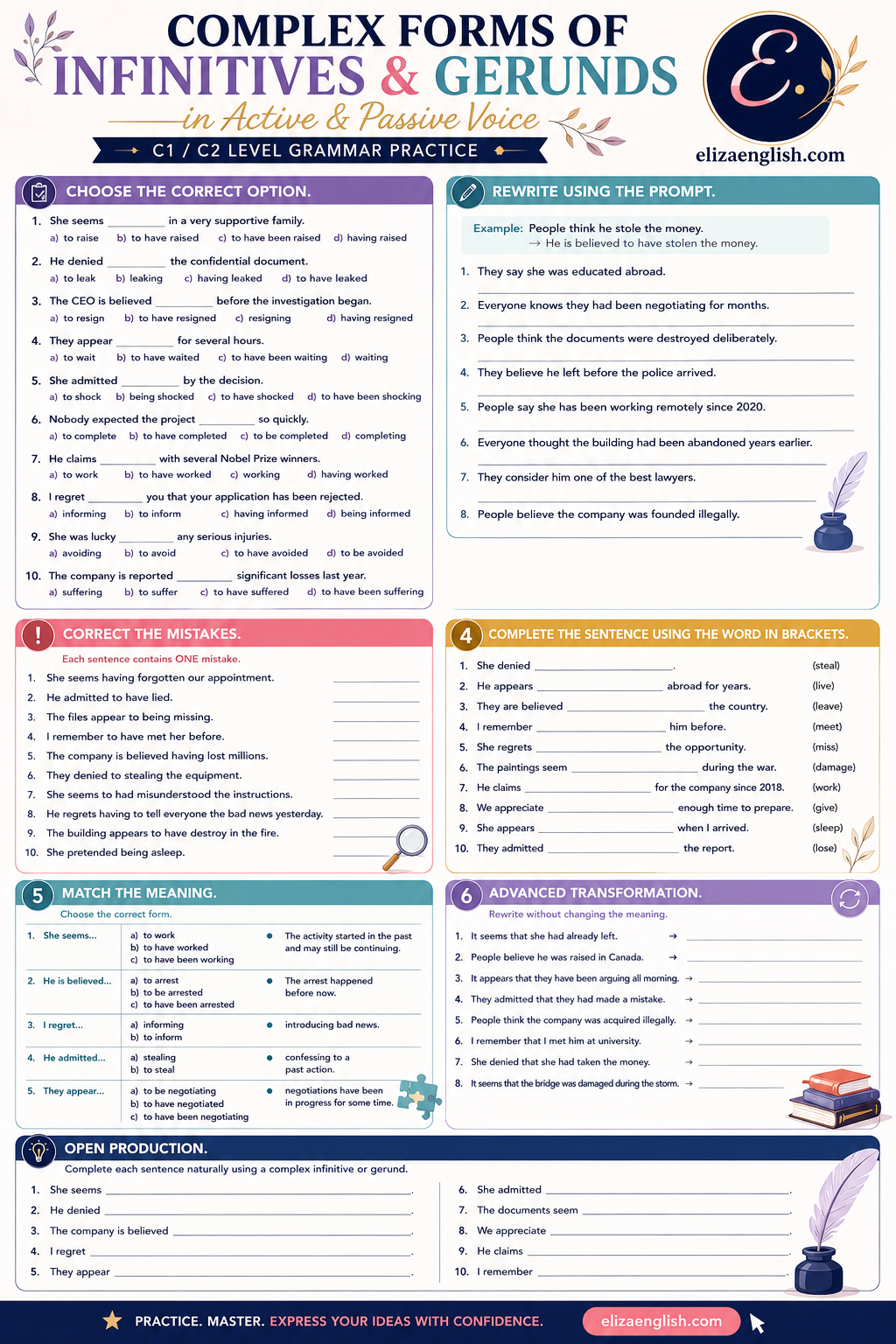
The final resource did not exist anywhere on the internet. It existed because it had been created specifically for one learner. That is where AI becomes genuinely powerful.
ChatGPT Explains Grammar Better Than Most Textbooks
Creating exercises is only half the story. One of ChatGPT’s greatest strengths is its ability to explain the same grammar point in completely different ways depending on who is learning it.
For example, I can ask it to explain the Present Perfect:
- An A2 learner receives clear explanations with simple vocabulary and familiar, everyday examples.
- A B1 learner practises the same grammar in realistic situations they are likely to encounter outside the classroom.
- A C1 learner explores subtle distinctions in meaning, register, and usage that rarely appear in traditional textbooks.
- A visual learner understands grammar through timelines, analogies, and easy-to-remember visual representations.
- A Business English learner sees grammar used naturally in meetings, negotiations, presentations, and workplace emails.
- An IELTS or TOEFL student learns through exam-focused explanations and practice that closely reflects the tasks they will face on test day.
No traditional grammar book can adapt that quickly. Of course, I never copy the explanation as it is. I refine it, improve the examples, simplify difficult sections where necessary, and make sure every explanation sounds natural. AI produces the first draft. My teaching experience transforms it into something students genuinely enjoy using.
The Student Who Changed My Thinking
One message on italki completely changed the way I think about creating learning materials.
An A2 student contacted me with an unusual request. She wasn’t looking for conversation practice or grammar drills. Instead, she wanted Business English, but at an A2 level, and she wanted to learn it almost entirely through repetition.
She explained that she struggled with traditional courses because every lesson introduced too much new language. What worked for her was seeing the same collocations repeated in different contexts until they became automatic.
Then she said something that stayed with me. She couldn’t find materials that combined A2-level English, Business English collocations, self-study activities, and enough repetition to match her learning style.
She was absolutely right. Those resources hardly existed. I immediately accepted the challenge.
Building Materials That Never Existed
Using ChatGPT as my creative partner, I started generating examples. Then I carefully selected the strongest ones, rewrote awkward phrases, simplified grammar where necessary, checked every collocation, and organised everything into a logical learning sequence.
Soon I had created an entire self-study workbook focused on one carefully chosen set of Business English collocations. But I wanted to take the idea further.
Since repetition was essential for this student, I created multiple listening resources featuring exactly the same language. Together with ChatGPT, I developed:
- A short podcast that helps learners hear the target collocations used naturally in context.
- A workplace speech that demonstrates how professionals use the expressions in presentations and meetings.
- A realistic voice message that mirrors the kind of communication employees exchange every day.
- A dialogue between colleagues that brings the vocabulary to life through authentic workplace interactions.
- Even a light-hearted joke, because humour makes new vocabulary far more memorable and enjoyable to learn.
Every resource recycled the same vocabulary while presenting it in a completely different situation. The student wasn’t memorising isolated phrases anymore. She was encountering them repeatedly in meaningful contexts, exactly the way she learned best.
The Difference Between AI Slop and Real Teaching
Many teachers have become sceptical about AI, and I understand why.
The internet is flooded with worksheets generated in seconds. They contain repetitive exercises, unnatural dialogue, awkward wording, and examples that no native speaker would ever say.
Students notice the difference. Teachers notice it too. People are becoming increasingly tired of AI-generated content that lacks thought and quality. That is why I never treat ChatGPT as the finished product.
It is my brainstorming partner, my research assistant, and my first-draft writer. Every worksheet, explanation, quiz, podcast, and lesson still goes through careful editing, rewriting, sequencing, and quality control before it reaches a student. Experience still matters. Perhaps now more than ever.
Every Learner Deserves Materials That Fit
No two learners are the same. Some need fifty examples before a grammar point becomes automatic. Others understand after three. Some love grammar rules, while others prefer stories, visuals, or listening activities.
Instead of forcing every learner into the same textbook, ChatGPT allows me to create materials around the learner. That flexibility has completely changed the way I teach.
Looking for Custom English Learning Resources?
Whether you’re an English teacher who needs professionally designed lesson materials or a learner who can’t find resources that match your goals, I can help.
If you’ve ever wished your learning materials were built around your goals instead of a generic syllabus, I’d be happy to help. I create custom grammar explanations, vocabulary practice, Business English resources, exam preparation materials, listening activities, speaking tasks, quizzes, lesson plans, and self-study worksheets designed for your level and the way you learn best.
Simply book a lesson called 🎨 Custom Resources & Educational Content Creation, tell me what you’re looking for, and I’ll create resources tailored specifically to your needs.
Sometimes the best learning materials aren’t the ones you download from a website. They’re the ones created specifically for you.