Many people have heard of Duolingo. In fact, millions use the famous green owl every day to learn vocabulary, complete lessons, and maintain impressive streaks. However, far fewer people know that Duolingo also offers a fully accredited English proficiency exam called the Duolingo English Test, or DET.
Although it is still relatively new compared to IELTS and TOEFL, the DET has rapidly gained popularity around the world. Universities appreciate its convenience, affordability, and fast results, while students value the fact that it can be taken from home in about an hour.
For today’s tech-savvy Generation Z students, preparing for the DET has never been easier. Most learners have access to countless online resources, practice tests, YouTube tutorials, and AI-powered study tools. Many students successfully prepare on their own and achieve respectable scores. However, there is often a significant gap between scoring around 100 and reaching the 120–125 range required by many prestigious universities.
After teaching the DET for quite some time, I noticed that students who improve the fastest do not necessarily have the strongest English. Instead, they understand what the exam rewards and focus on a handful of high-impact strategies that can dramatically increase their score in a short period of time.
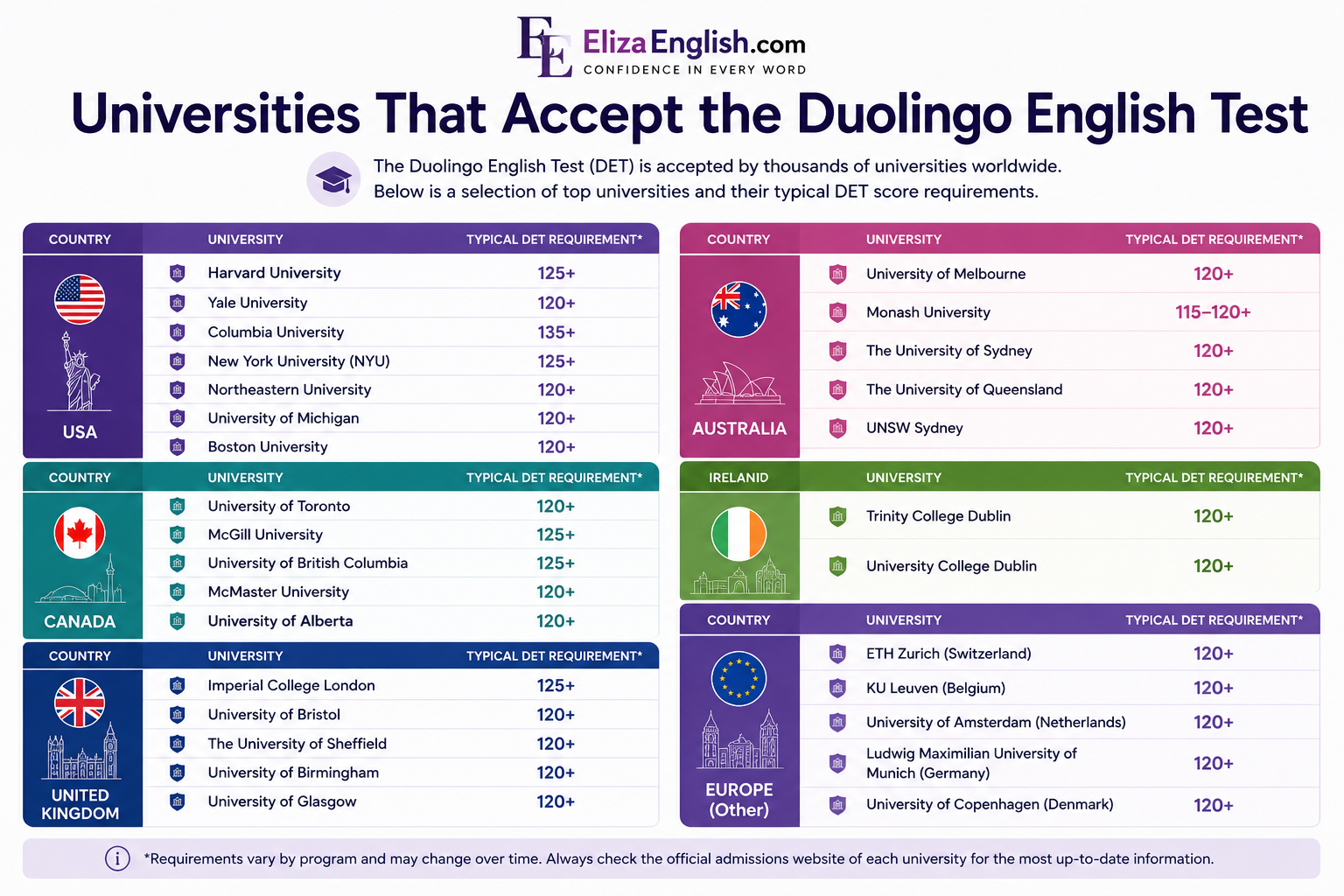
Universities That Accept the Duolingo English Test
Requirements vary by program and may change over time. Always check the official admissions website before applying.
1. Stop Describing the Obvious. Tell the Story Behind the Photo.
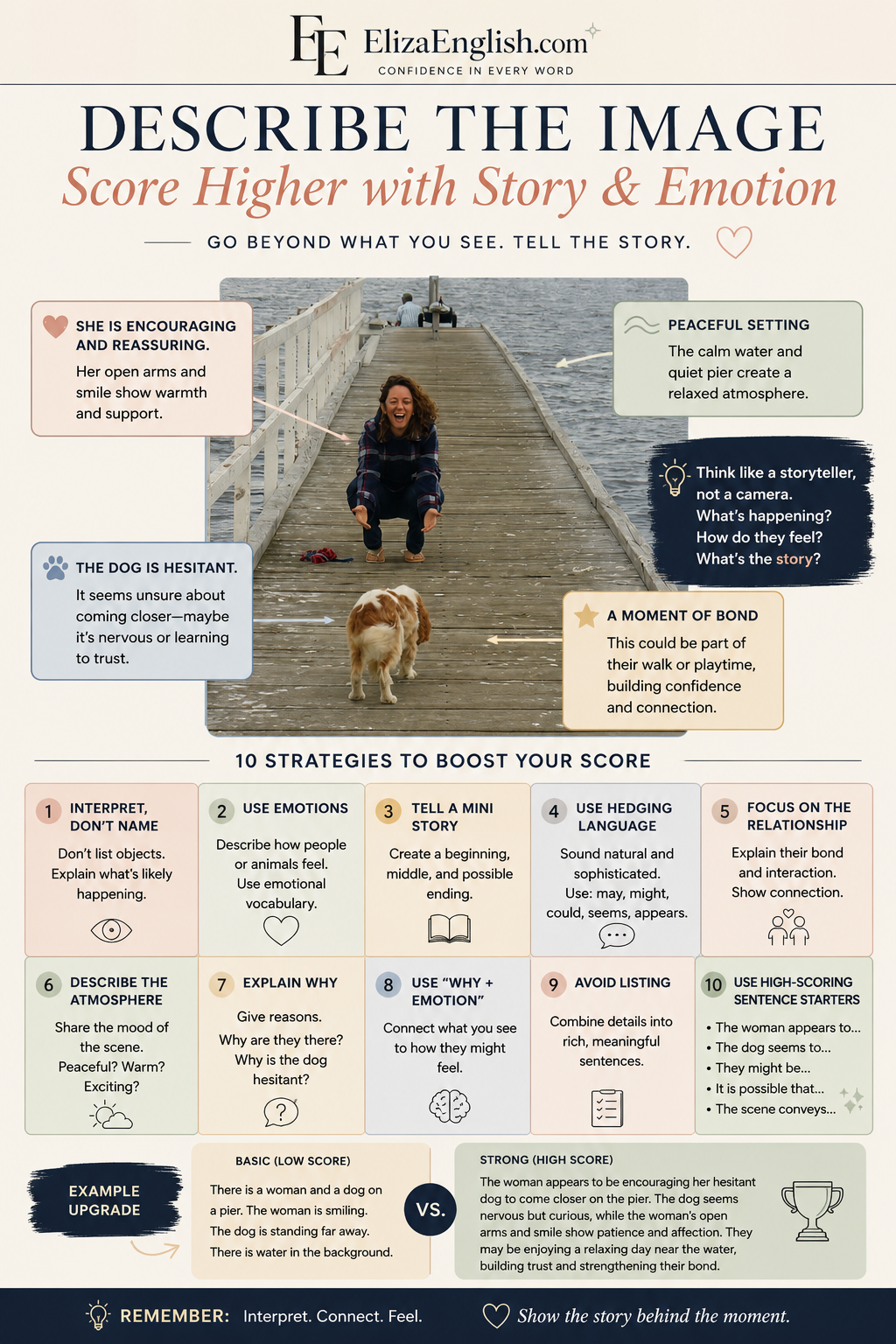
One of the biggest mistakes students make in the Describe the Image task is acting like a camera.
A weaker response sounds like this:
There is a woman. There is a dog. They are standing on a pier.
Everything is technically correct, but there is very little language sophistication.
A stronger response focuses on emotions, relationships, assumptions, and possible explanations.
Instead of simply describing the scene, ask yourself:
- What is happening?
- How do the people feel?
- Why might they be doing this?
- What happened before this moment?
- What could happen next?
For example:
She is smiling from ear to ear, so she must be enjoying herself. She appears to be encouraging the dog to come closer. The puppy may feel slightly nervous about walking along the pier, while the woman seems determined to reassure it.
Notice the use of modal verbs of deduction and speculation:
- must be
- may be
- might be
- could be
- appears to be
- seems to be
These structures immediately make your language more advanced.
2. Replace Simple Adjectives with More Sophisticated Ones
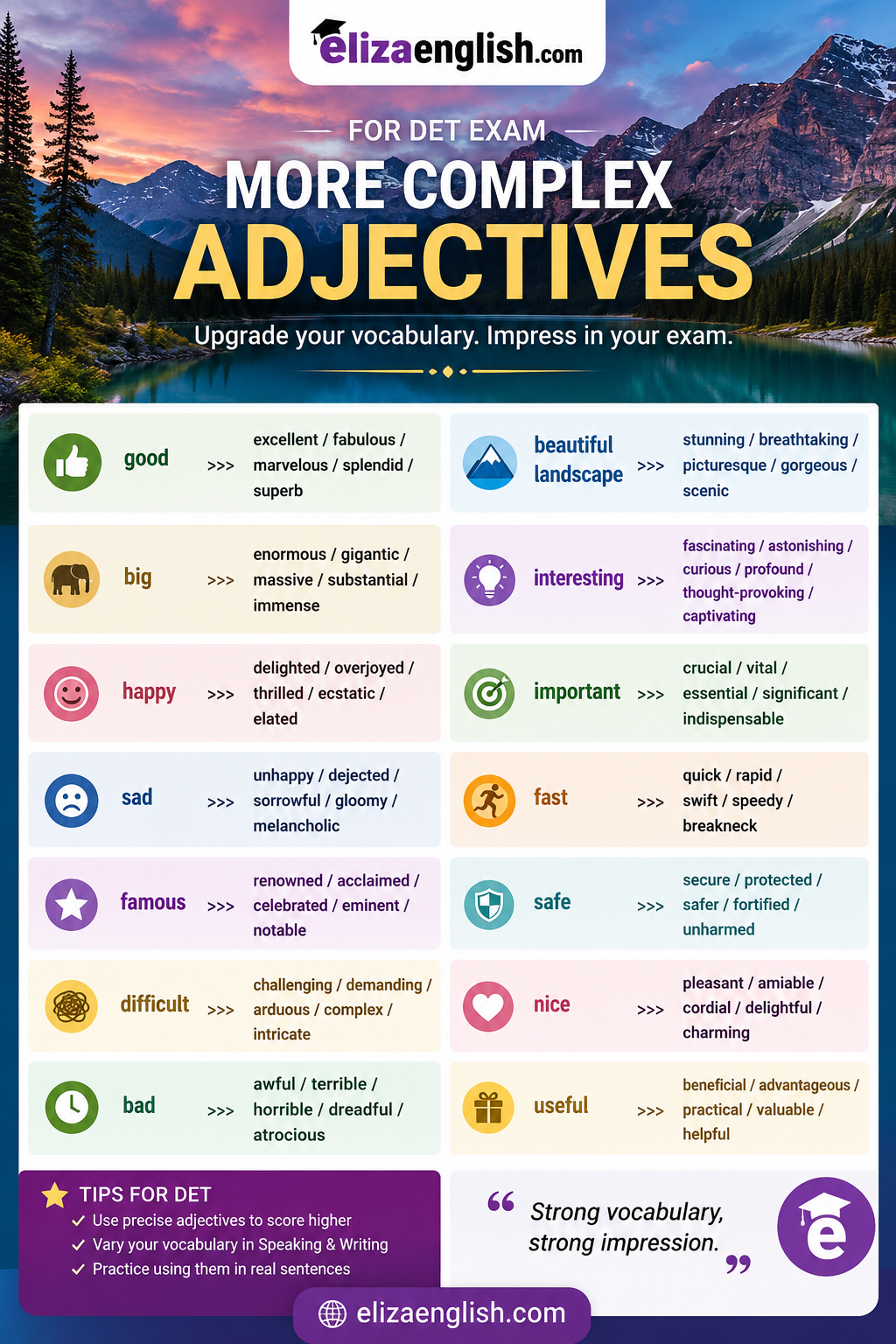
The DET rewards lexical variety.
Many students repeatedly use words such as good, bad, beautiful, interesting, and big. While these words are correct, they do not help distinguish your English from that of thousands of other candidates.
Instead of writing:
It was a beautiful landscape.
Try:
It was a breathtaking and picturesque landscape.
Instead of:
The experience was good.
Write:
The experience was rewarding and unforgettable.
Small vocabulary upgrades often have a surprisingly large impact on your overall language score.
3. Memorize a Few Advanced Grammar Structures
Many candidates try to learn dozens of grammar topics shortly before the exam. A far more effective strategy is mastering a handful of advanced structures that can be used repeatedly.
One of the most useful structures is the cleft sentence.
Examples:
What seems to be obvious is that she feels lonely.
What I can’t understand is why she is looking in that direction.
What stands out to me is the interaction between the two people.
These structures sound natural, sophisticated, and easy to apply in both speaking and writing tasks.

4. Improve Your Typing Speed
Many students underestimate how important typing speed is.
The DET is extremely fast-paced. Tasks change quickly, and time pressure is constant. Even strong English speakers sometimes lose valuable points because they simply cannot type fast enough.
For one week before the exam:
- Practice typing for 15–20 minutes daily.
- Complete timed writing exercises.
- Try to type without looking at the keyboard.
A student who types 60 words per minute has a significant advantage over someone who types 30.
This strategy alone can save many points.
Unlike traditional essays, the DET often gives you very little time to review your work.
Instead of writing an entire response and checking it afterward, use this approach:
- Write one sentence.
- Quickly reread it.
- Correct any spelling mistakes.
- Continue writing.
This prevents errors from accumulating throughout the response.
Unlike TOEFL, the Duolingo English Test does not allow note-taking.
Because of this, you need a structure that is easy to remember under pressure.
What Happened + Why It Mattered
Weak:
I explored the longest trail in the park.
Strong:
I explored the longest trail in the park, which gave me a strong sense of accomplishment.
Weak:
I attended a community event.
Strong:
I attended a community event, which helped me connect with people from different backgrounds.
This simple formula instantly adds reflection and depth.
7. Master This Writing Sample Structure
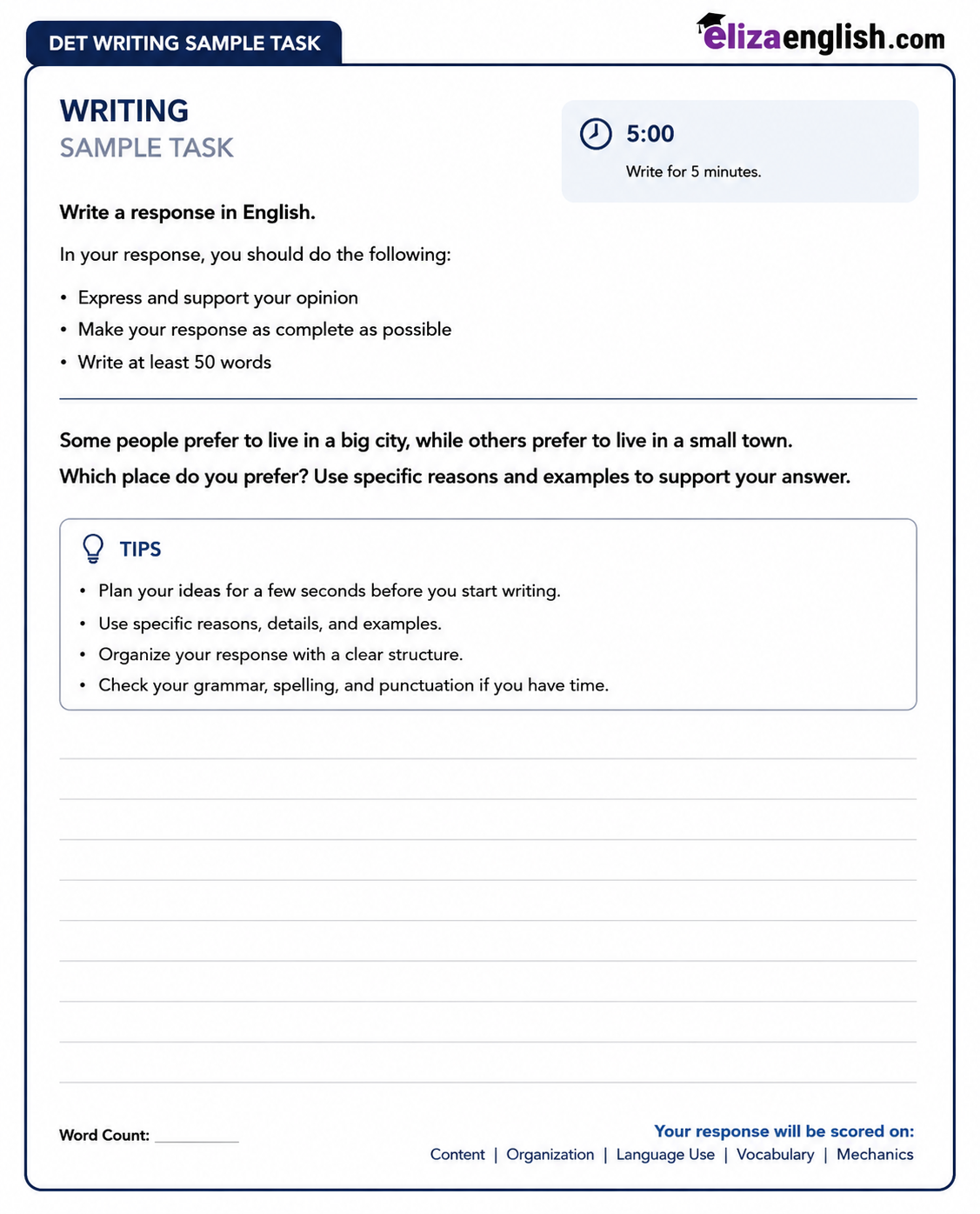
The Writing Sample is one of the most important parts of the exam because universities can see your response.
Instead of trying to invent a structure during the test, memorize this simple framework:
What happened → How you felt → What you learned → How it changed you
Example:
I visited a national park with my friends. The experience was both challenging and rewarding. It taught me the importance of perseverance and environmental conservation. Since then, I have become more appreciative of nature and more confident when facing difficult situations.
This formula is easy to remember, requires no notes, and works for a wide variety of DET Writing Sample prompts.
Bottom Line
Improving from 100 to 120+ in a week does not require learning thousands of new words or memorizing every grammar rule in English.
The fastest gains usually come from strategic changes:
- Focus on stories and emotions rather than obvious descriptions.
- Use modal verbs to make assumptions.
- Upgrade basic adjectives.
- Memorize a few advanced grammar structures.
- Increase your typing speed.
- Correct spelling immediately.
- Follow simple response formulas.
- Reflect on why experiences mattered.
The students who achieve the biggest score increases are not always the ones with the strongest English. More often, they are the ones who understand exactly what the Duolingo English Test rewards and know how to demonstrate those skills efficiently under time pressure.
If you are preparing for the Duolingo English Test and would like personalized feedback, I also offer one-to-one DET coaching on italki. During our lessons, we focus on the exact skills that influence your score, including Describe the Image, Interactive Writing, Speaking Samples, Interactive Listening, vocabulary upgrades, typing speed, and high-scoring response structures. Rather than studying generic English, you’ll learn how to approach the exam strategically, identify your weaknesses, and maximize your score in the shortest possible time. If you’re aiming for a 120+ score and want expert guidance, I’d be happy to help you create a personalized preparation plan and work with you until test day.