For years, I had one firm rule as an IELTS teacher: if a prospective student was around A2 level, I politely declined.
It wasn’t because I didn’t want to help them. Quite the opposite. I simply believed that IELTS preparation should begin only after students had reached at least a solid B1 level. Otherwise, every lesson would become a General English lesson rather than focused exam preparation.
And honestly, I still think there is some truth in that.
An A2 learner is usually not ready for authentic IELTS reading passages, academic listening recordings, complex writing tasks or fluent discussions. Throwing them straight into official IELTS materials is like asking someone who has just learned to ride a bicycle to compete in the Tour de France.
Then ChatGPT completely changed the way I teach.
Today, I no longer reject lower-level students automatically. Instead, I build what I like to call a Mini IELTS Pathway. Rather than exposing students to the full difficulty of the exam from day one, I recreate every section of the IELTS exam using language that matches their current level. Month by month, we gradually increase the complexity until the student is finally ready to tackle authentic IELTS materials.
The results have genuinely surprised me.
The Student Who Changed My Mind
Several months ago, a student contacted me asking for IELTS preparation. After assessing her level, I concluded that she was approximately A2.
A few years ago, I would have immediately explained that she first needed several months of General English before we could even think about IELTS. This time, however, I decided to experiment.
I explained one very important thing from the beginning.
“These are not real IELTS tasks. They are simplified IELTS-style activities designed specifically for your current level. Think of them as miniature versions of the real exam.”
Setting expectations was essential. Students need to understand that these activities are stepping stones rather than substitutes for official IELTS practice.
Once she understood this, we got to work.
Why ChatGPT Makes This Possible
The biggest obstacle to teaching IELTS to lower-level students has always been lesson preparation.
Finding or creating A2 versions of IELTS tasks used to take hours. A single reading lesson often meant rewriting an authentic article. A writing task had to be redesigned from scratch. Listening activities required searching for suitable recordings or creating my own.
Now I simply describe my student’s level and ask ChatGPT to generate an IELTS-style activity at exactly the right level. Within seconds, I have a lesson that would previously have taken an hour or more to prepare.
The secret is not asking ChatGPT to create “an IELTS lesson.” Instead, I ask it to imitate the structure of IELTS while adapting the language to my student’s current ability. That small difference changes everything.
Reading: Creating Mini IELTS Passages
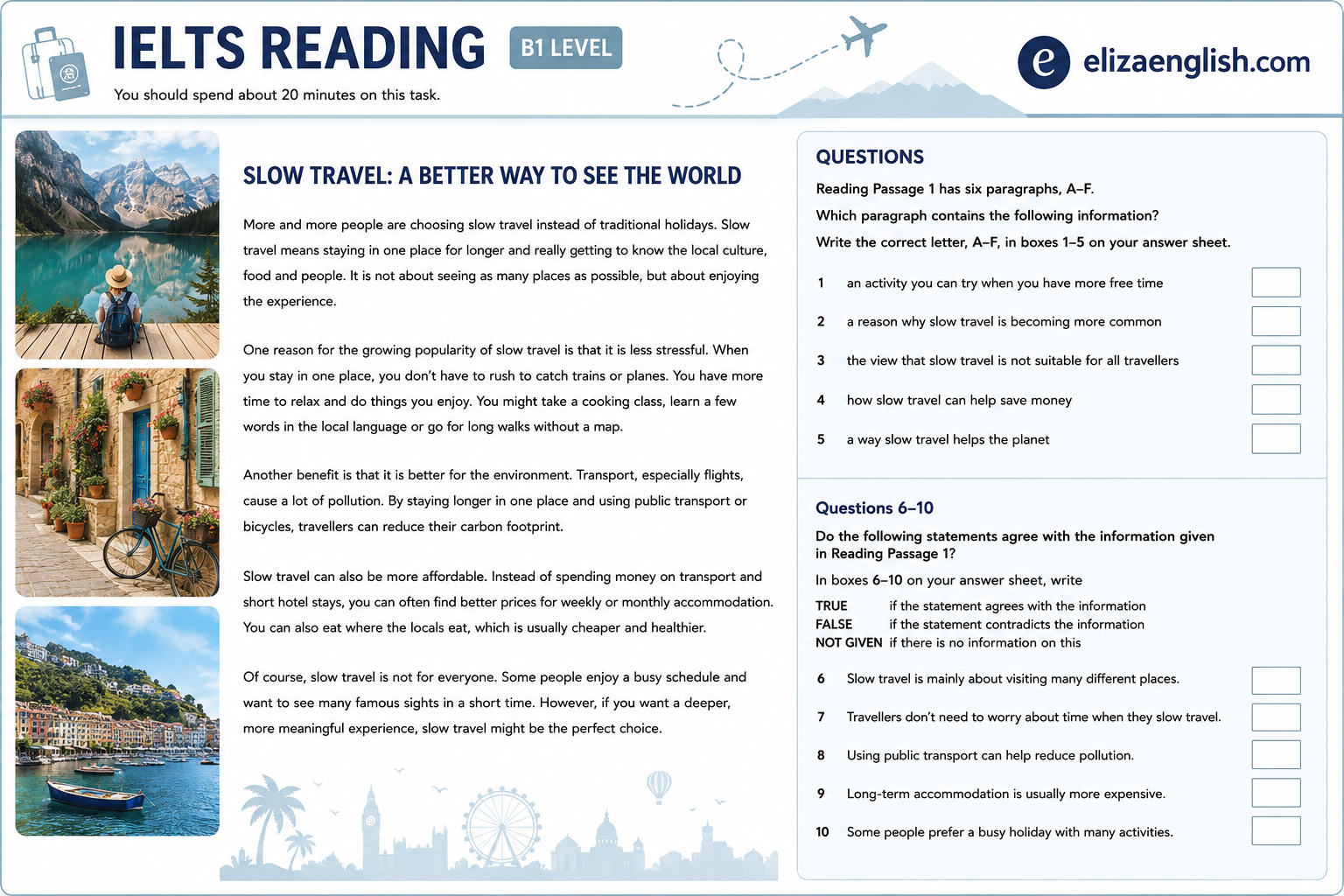
Instead of giving my A2 learner difficult academic texts filled with unfamiliar vocabulary, I asked ChatGPT to create shorter passages using A2 grammar and vocabulary while preserving authentic IELTS question types.
One of my favourite prompts is:
Prompt
Create an IELTS-style Reading task for an A2 English learner.
Topic: Healthy Lifestyle
Length: 180-220 words.
Include:
- True / False / Not Given
- Matching headings
- Multiple-choice questions
Use only A2 vocabulary but imitate the IELTS format. Present everything as a visually attractive worksheet.
After two months, I made just one small adjustment. Instead of writing A2, I changed it to B1. Nothing else. That tiny modification immediately increased the difficulty without overwhelming the student.
Other reading topics that worked particularly well included environmental issues, education, technology, travel, healthy eating, online shopping, famous inventions, festivals, wildlife and sports psychology. My student gradually became familiar with IELTS question types without struggling with impossible vocabulary.
Speaking: Building Confidence Before Complexity
Speaking is often the most intimidating section for lower-level students.
If you ask an A2 learner a genuine IELTS Part 3 question like:
“To what extent should governments regulate social media?”
the conversation is usually over before it even begins.
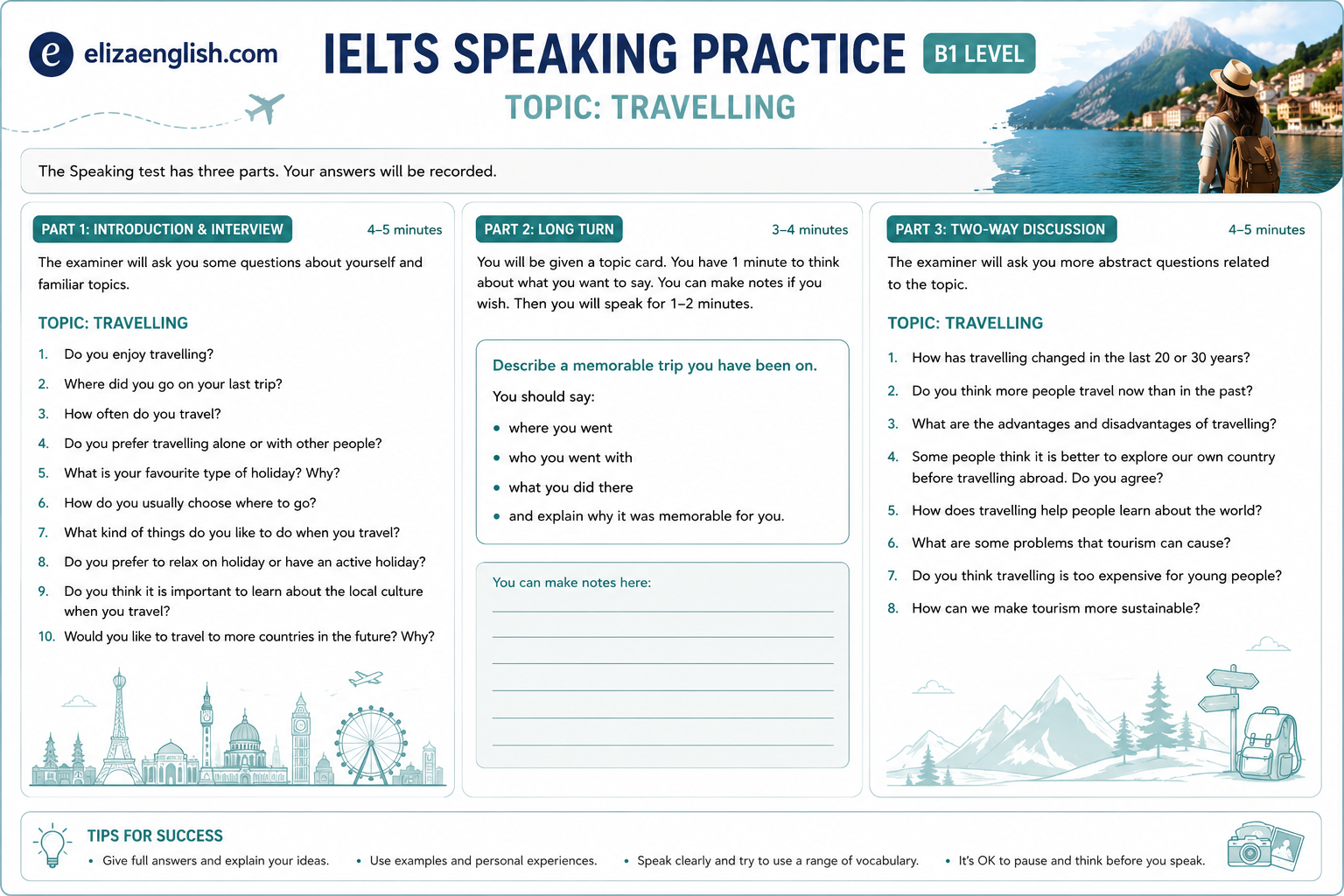
Instead, I asked ChatGPT to recreate the IELTS speaking format using language my student could actually understand.
Prompt
Create an IELTS Speaking lesson for an A2 learner.
Include:
- IELTS Part 1 style questions
- A picture description similar to Part 2
- Simplified Part 3 discussion questions
- Useful vocabulary before each section
- Follow-up questions
Format everything as a colourful worksheet.
At first, I only expected one or two sentences. Later, I encouraged three. Then five. Eventually, complete answers with reasons, examples and opinions. The format stayed familiar while the language became progressively more sophisticated.
Writing: Teaching IELTS Essays Without Writing Essays
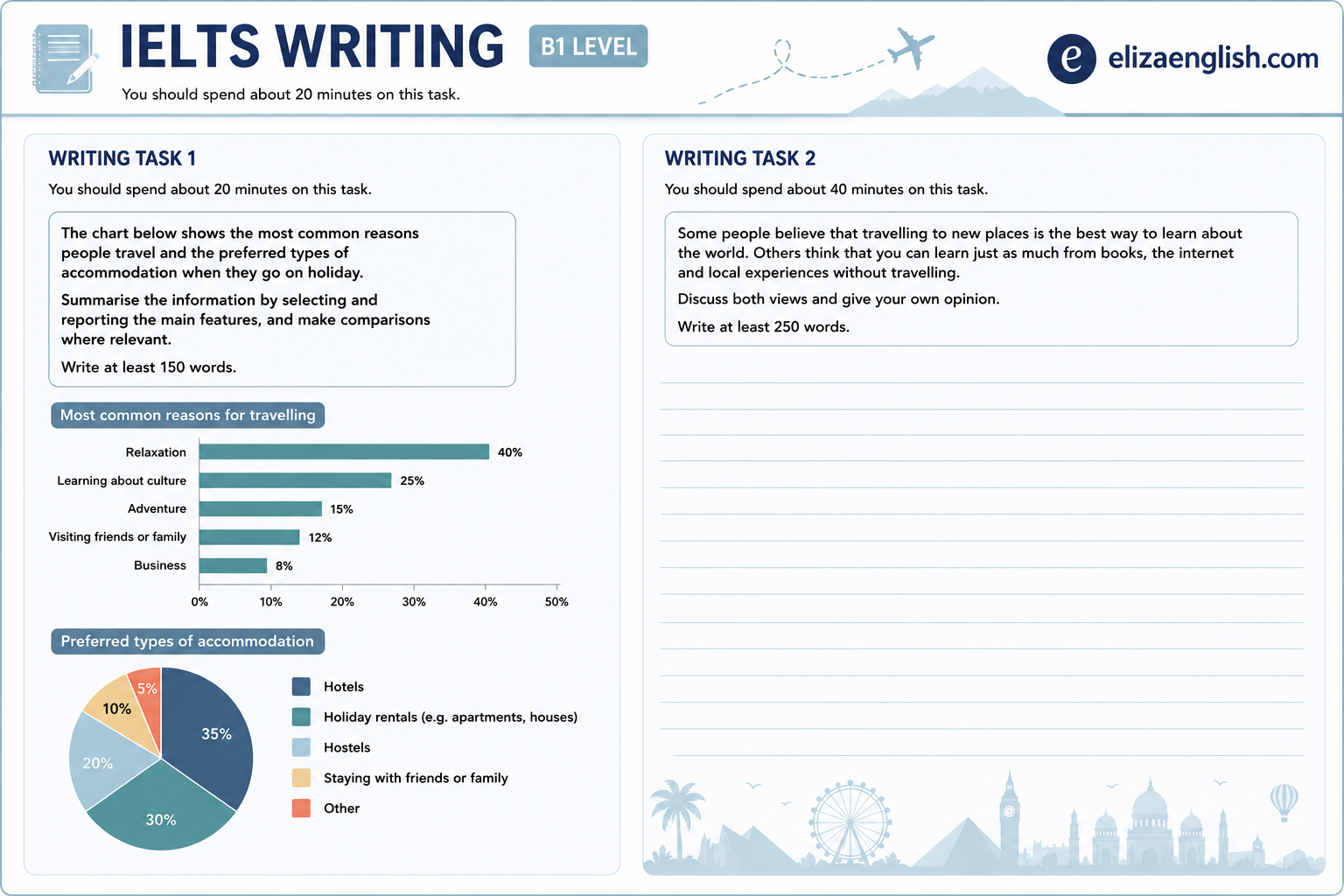
Many teachers postpone IELTS writing until students become intermediate. I decided to try something different. Instead of asking my student to produce a 250-word essay, I created simplified versions of IELTS tasks.
For example, instead of discussing both views, she initially wrote six sentences expressing a simple opinion.
Six sentences became ten. Ten became one paragraph. One paragraph became two. Eventually, she was producing structured responses with introductions, supporting ideas and conclusions.
One of my favourite prompts was:
Create an IELTS-inspired opinion writing task for an A2 learner.
Maximum 100 words.
Include useful vocabulary, sentence starters, planning ideas and a model answer.
Later, I switched to:
Rewrite this IELTS Task 2 question for a B1 learner while preserving the original argument. Include a Band 5 model answer and explain why it deserves that score.
This approach allowed my student to master IELTS structure long before worrying about advanced grammar.
Listening Without Audio Files
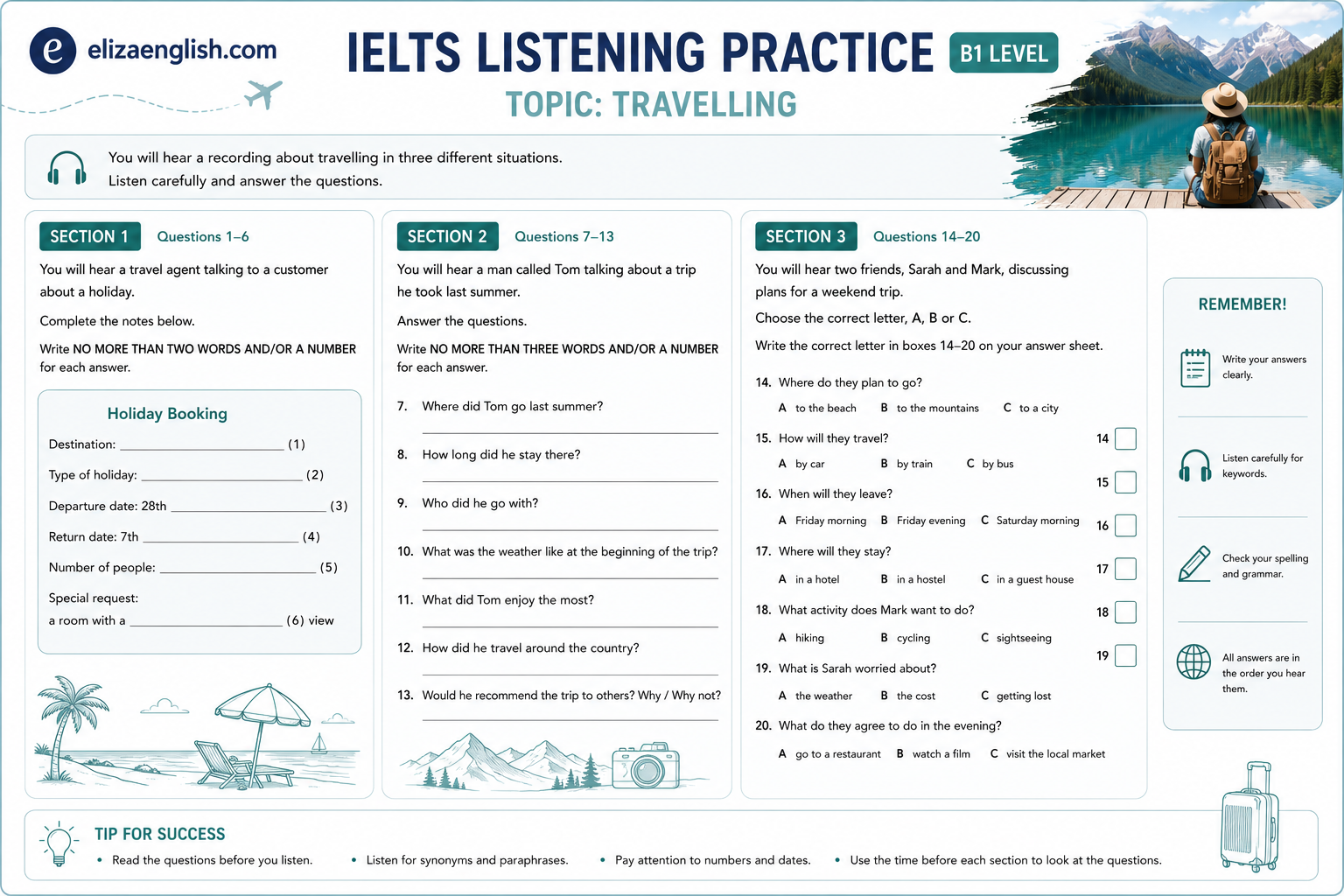
Listening was probably my biggest breakthrough. Authentic IELTS recordings were simply too difficult, so I found another solution. I asked ChatGPT to generate IELTS-style listening scripts. Then I became the speaker.
This gave me complete control over the speed, pronunciation and repetition. If necessary, I slowed down. Sometimes I repeated difficult expressions or emphasised key words. As my student’s listening improved, I gradually increased my reading speed until it sounded like natural conversation.
My prompt looked like this:
Create two IELTS-style listening exercises for an A2 learner.
Include:
- A complete script
- Gap-fill questions
- Multiple-choice questions
- Short-answer questions
- Natural distractors
Highlight the key information naturally without making it obvious.
This simple technique proved far more effective than struggling through recordings that were well above her level.
Turning Every Lesson into a Professional Worksheet
Another feature I use constantly is asking ChatGPT to create visually appealing materials. Instead of receiving plain text, I finish many prompts with:
Present everything as a modern, colourful worksheet with clear headings, icons, tables, boxes and plenty of white space suitable for printing.
Students immediately respond more positively when lesson materials look polished and professional.
Increasing the Difficulty Month by Month
One mistake many teachers make is increasing the difficulty too quickly. For the first two months, almost everything remained at A2 level.
Once my student felt comfortable, I switched nearly every prompt from A2 to B1. Later, I introduced longer reading passages, more academic vocabulary, increasingly complex writing tasks and more challenging speaking questions.
Only after building confidence did we begin working with authentic IELTS materials. The transition felt natural rather than overwhelming.
My Favourite ChatGPT Prompts for Lower-Level IELTS Students
Here are some prompts that have become permanent parts of my teaching workflow.
Vocabulary Builder
Create 25 IELTS-related vocabulary words on the topic of education for a B1 learner. Include pronunciation, definitions, collocations, example sentences and a gap-fill exercise.
Grammar Focus
Design an IELTS grammar lesson on relative clauses for B1 students. Include explanation, controlled practice, communicative activities and homework.
Reading Upgrade
Rewrite this authentic IELTS reading passage at B1 level while keeping the same question types and overall structure.
Speaking Extension
Create 20 follow-up questions based on my student’s answers. Increase the level of difficulty gradually and encourage longer responses.
Pronunciation Practice
Design an IELTS pronunciation lesson focusing on word stress, sentence stress and connected speech using common IELTS vocabulary.
Listening Practice
Write an IELTS-style dialogue about university life suitable for B1 learners. Include distractors similar to those used in the real exam.
Essay Expansion
Expand these six simple sentences into a Band 6 IELTS Task 2 essay. Explain every improvement step by step.
Error Correction
Correct my student’s IELTS essay. Explain every grammar mistake, suggest stronger vocabulary, estimate the band score and provide an improved version.
Paraphrasing Practice
Generate ten paraphrasing exercises using common IELTS Task 2 vocabulary. Start at B1 level and gradually increase the complexity.
Vocabulary Recycling
Create ten speaking questions that naturally recycle the following IELTS vocabulary without making the questions sound artificial.
More Creative ChatGPT Activities for A2 and B1 IELTS Learners
Beyond the four exam skills, ChatGPT has helped me create engaging activities that simply didn’t exist before.
Picture-to-Essay Challenge
Upload a picture and ask:
Create an IELTS-style writing lesson based on this image for a B1 learner. Include vocabulary, brainstorming questions, useful phrases and a model answer.
Band Upgrade Race
Provide a Band 4 essay and ask ChatGPT to improve it to Band 6, explaining every change. Students quickly notice patterns in vocabulary, grammar and organisation.
IELTS Detective
Ask ChatGPT to hide ten grammar mistakes inside a Band 5 essay. Students work together to identify and correct them.
Question Generator
Paste a reading passage and ask ChatGPT to generate additional True/False/Not Given, Matching Headings and Multiple Choice questions.
Vocabulary Ladder
Ask ChatGPT to replace every A2 word with a B1 alternative, then every B1 word with a B2 alternative. Students instantly see how vocabulary becomes more academic.
Role Play Interviews
Create examiner-candidate role plays based on familiar IELTS topics such as travel, hobbies, education or technology. Students practise fluency without feeling intimidated.
What Happened After Two Months?
The improvement was impossible to ignore. My student no longer panicked when she saw reading passages. She recognised IELTS question types, understood how writing tasks were organised and produced much longer speaking answers.
Most importantly, she stopped seeing IELTS as something impossible. That psychological transformation was just as valuable as the language improvement itself.
The Biggest Lesson I’ve Learned
ChatGPT did not replace my expertise. It amplified it.
I still assess my students, decide what comes next, explain grammar, correct mistakes, teach strategies and provide feedback. What ChatGPT has changed is the amount of time I spend creating personalised materials.
Instead of manually adapting every worksheet, I can now generate level-appropriate lessons in minutes. That has allowed me to say “yes” to students I would once have turned away.
Would I recommend preparing a complete beginner for IELTS? Probably not. Students still need realistic expectations, and there is no shortcut to reaching the language level required by the exam.
However, if you adapt the format carefully, gradually increase the complexity and focus on building confidence first, lower-level learners can begin their IELTS journey much earlier than many teachers believe.
Bottom Line
One of the biggest misconceptions about AI is that it simply produces lesson plans more quickly. In reality, its greatest strength is personalisation. Every learner can receive materials designed specifically for their current level instead of struggling through resources intended for someone far more advanced. That is exactly what happened with my A2 student.
Instead of waiting months before introducing IELTS, we built a bridge towards it. Two months later, she was confidently working with B1-level IELTS-style tasks, and each lesson brought her one step closer to authentic exam materials.
As teachers, we often say that we should meet students where they are. With ChatGPT, doing exactly that has never been easier.
Want to Learn How I Use AI in My IELTS Lessons?
If you’re preparing for the IELTS exam and would like personalised IELTS coaching, I’d love to help. I work with adult learners from around the world, combining proven IELTS strategies with carefully customised AI-powered materials that match each student’s current level and learning style. Whether you’re aiming for your target band score or you’re just beginning your IELTS journey, every lesson is tailored to help you make steady, measurable progress.
I’m also passionate about helping fellow English teachers save time and teach more effectively with AI. Through my teacher training, blog and practical resources, I share real classroom workflows, ChatGPT prompts and lesson ideas that you can start using immediately. If you’d like to work with me or explore more AI-powered teaching resources, you’ll find plenty more on elizaenglish.com.