The Smart Student’s Guide to Scoring Higher on the Digital SAT
If you’re planning to apply to a university in the United States or at an increasing number of universities around the world, chances are you’ve come across the SAT. For many students, it is one of the most important exams they’ll ever take. The good news is that a high SAT score isn’t reserved for geniuses. With the right strategy, focused practice and a solid understanding of how the test works, you can dramatically improve your results.
This guide will show you practical techniques that successful students use to maximize their SAT scores.
What is the SAT?
The SAT (Scholastic Assessment Test) is a standardized exam developed by the College Board and used by thousands of colleges and universities as part of the admissions process. Since 2024, the SAT has been fully digital and adaptive. This means your performance in the first module of each section influences the difficulty of the second module.
The Digital SAT consists of just two sections:
Reading and Writing
Math
Your total score ranges from 400 to 1600.
Each section contributes 200 to 800 points toward your final score.
How does the SAT compare with IELTS, TOEFL, PTE and Duolingo?
Students often confuse these exams, but they serve different purposes.
The SAT measures academic readiness for university studies and includes both language and mathematics.
IELTS, TOEFL, PTE Academic and the Duolingo English Test assess your English proficiency. They are typically required for international students whose first language is not English.
Think of it this way:
- SAT asks: Are you academically prepared for university?
- IELTS, TOEFL, PTE and Duolingo ask: Is your English good enough to study at university?
Many universities require international applicants to submit both an SAT score and an English proficiency test.
As an English teacher with over 14 years of experience, I now prepare students not only for IELTS, TOEFL and the Duolingo English Test, but also for PTE Academic and the Digital SAT, helping learners develop the language and academic reasoning skills needed to succeed in today’s competitive admissions process.
Reading and Writing Cheat Codes
The Reading and Writing section is often misunderstood. Students think they simply need excellent English. In reality, the SAT rewards precision, logical thinking and attention to detail.
1. Master transition words
One of the easiest ways to gain extra points is to become comfortable with transition words. The SAT frequently asks you to choose the connector that best expresses the relationship between ideas.
Here are some of the most common categories.
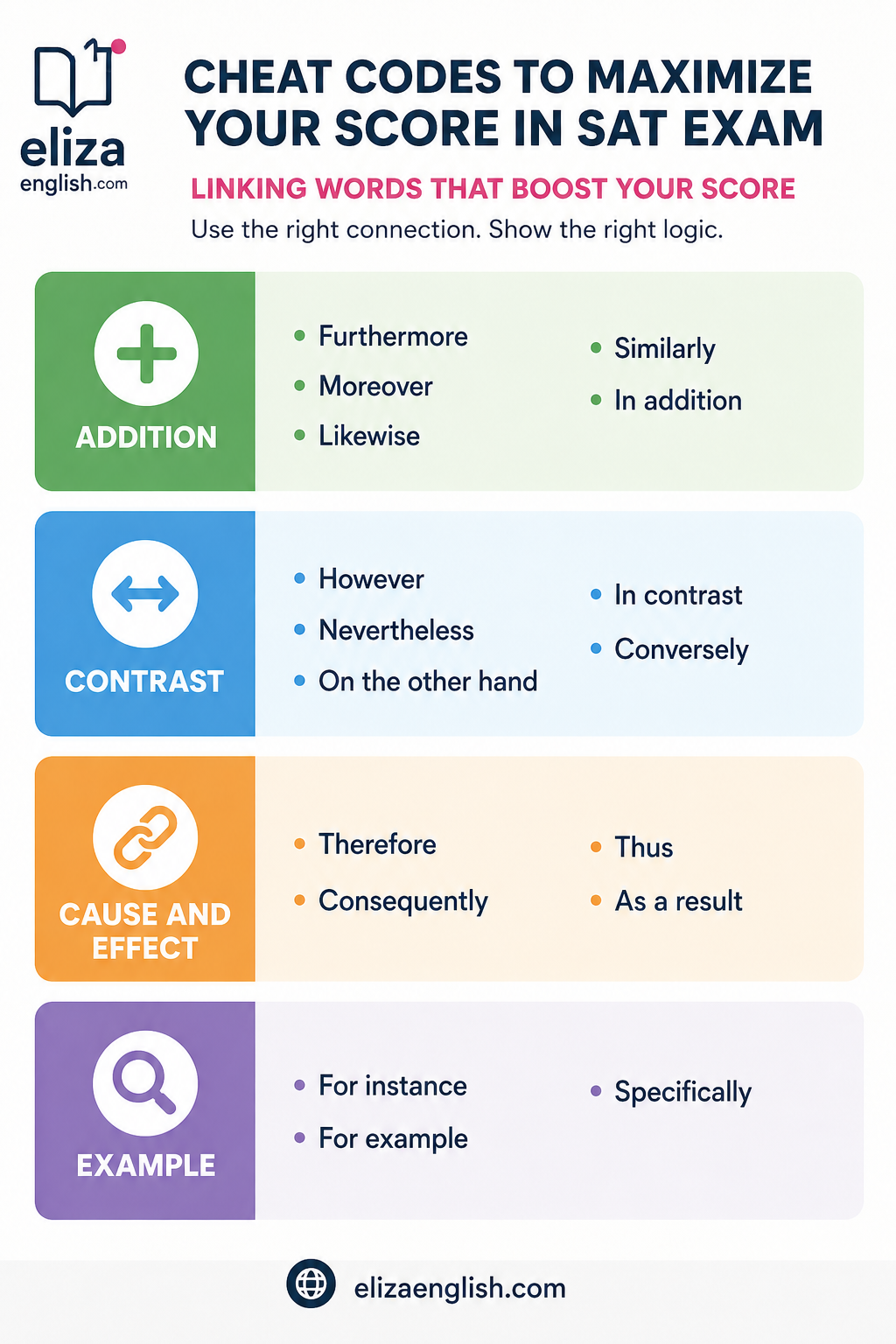
Mini example
The experiment produced promising results. ________, further research is still necessary.
A) Similarly
B) However
C) Therefore
D) For example
Correct answer: B
The second sentence introduces contrast.
2. Never underestimate punctuation
Many SAT questions test basic grammar rather than difficult vocabulary.
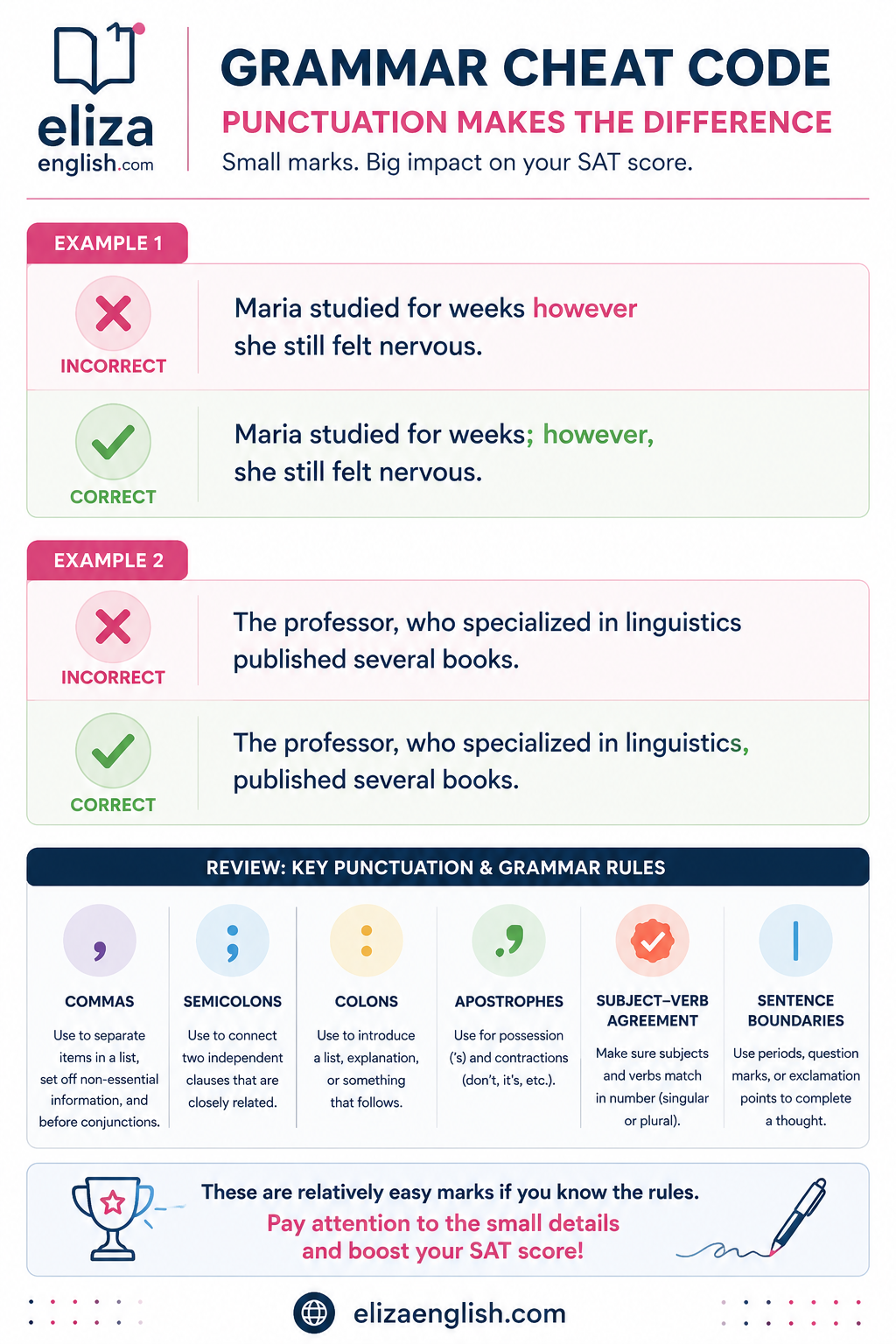
These are relatively easy marks if you know the rules.
3. Build an academic vocabulary
The SAT no longer focuses on obscure dictionary words. Instead, it rewards students who understand sophisticated academic vocabulary in context.
Here are expressions worth learning.
- to leave an indelible mark on society
- to foster innovation
- to challenge conventional wisdom
- to gain widespread recognition
- to play a pivotal role
- to provide compelling evidence
- to pose a significant challenge
- to shed light on an issue
- to reach a consensus
- to pave the way for future discoveries
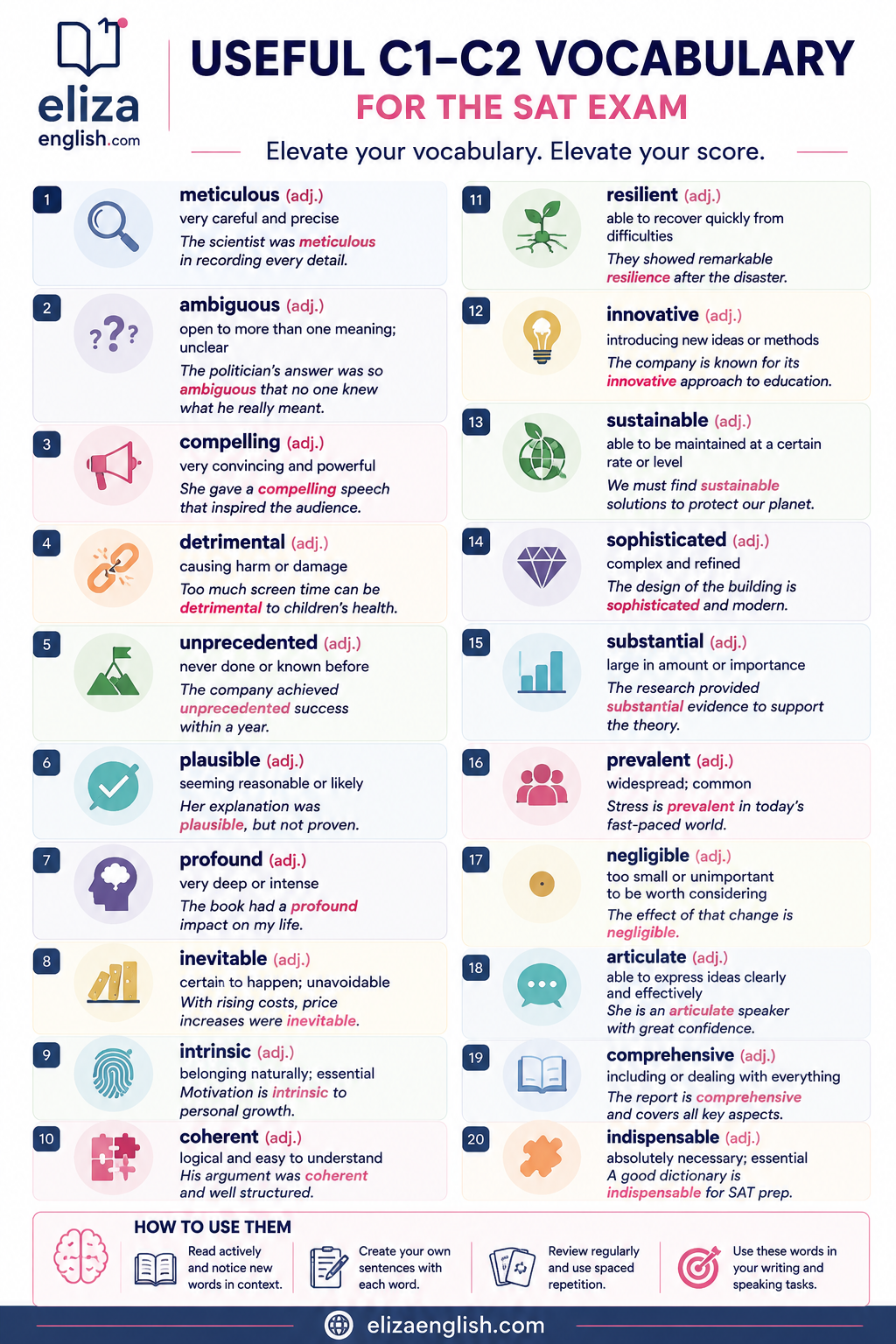
When reading articles or books, don’t simply translate unfamiliar words. Create your own example sentences. Active vocabulary grows much faster than passive vocabulary.
4. Read the question before the passage
Because SAT passages are short, reading the question first tells your brain exactly what information to look for.
This simple strategy saves valuable time.
5. Eliminate wrong answers first
Many students search immediately for the correct option.
A better approach is to eliminate obviously incorrect answers.
Reducing four choices to two dramatically increases your chances of selecting the correct answer.
6. Read quality English every day
Spend fifteen to twenty minutes reading articles from respected publications, scientific magazines or historical essays.
The SAT loves academic writing.
The more you expose yourself to sophisticated English, the more natural the exam becomes.
Math Cheat Codes
Many students believe SAT Math contains hundreds of unrelated question types.
It doesn’t.
After teaching and analysing SAT questions, I’ve noticed that they fall into recurring problem archetypes. Once you recognise the pattern, solving the question becomes much easier.
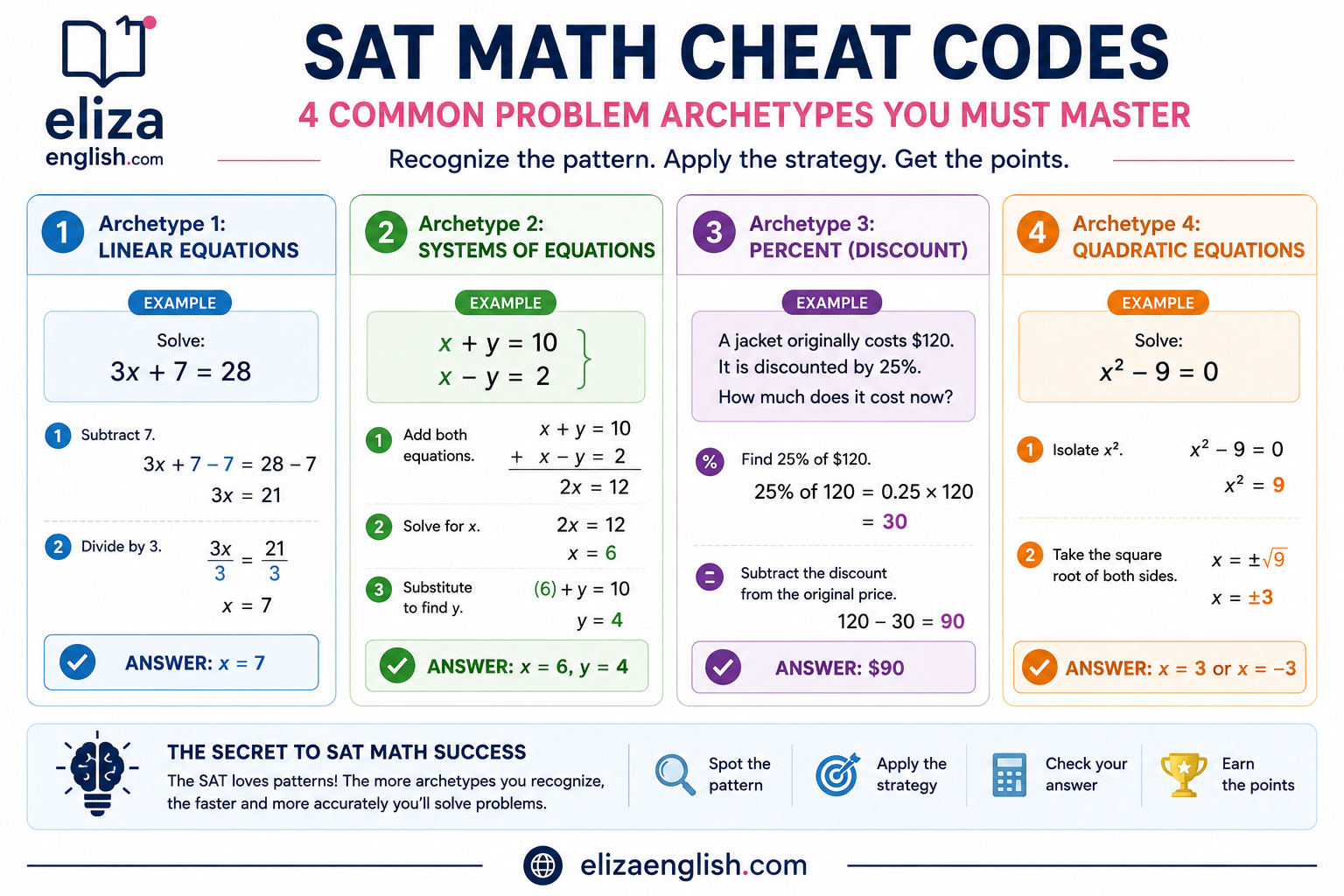
Narrative-style math problems
Personally, I find narrative problems easier because there is a story to follow. Of course, this is simply my own preference. Some students prefer equations immediately.
Example
Emma drives at 60 km/h for 2 hours before stopping for lunch. She then continues driving at 80 km/h for another 3 hours.
How far does she travel altogether?
First part:
60 × 2 = 120 km
Second part:
80 × 3 = 240 km
Total distance:
120 + 240 = 360 km
Whenever you see a story problem, underline the numbers, identify what the question is asking and translate the story into simple mathematical operations.
SAT Math Topics You Should Review
Before sitting the exam, make sure you’re comfortable with:
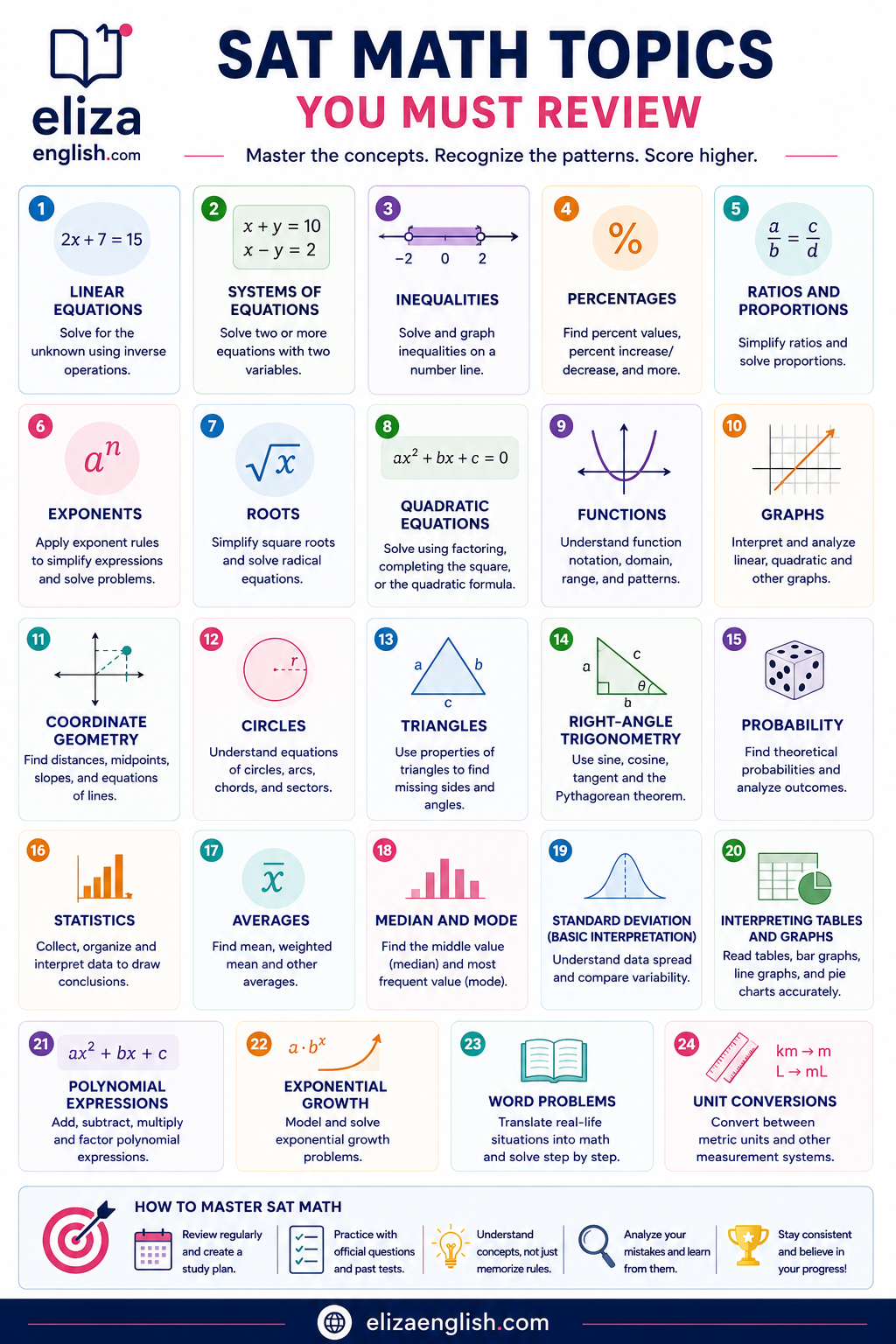
Treat this list as your revision checklist.
Final Cheat Codes
Here are a few final pieces of advice that can add valuable points to your score.
Practice using the official Digital SAT interface so that the exam feels familiar on test day.
Don’t leave questions unanswered. There is no penalty for guessing, so an educated guess is always better than a blank response.
Take several full-length timed practice tests. Knowledge alone isn’t enough. Stamina, pacing and confidence are just as important.
Review every mistake you make. Incorrect answers are your greatest teachers.
Finally, remember that the SAT is not an IQ test. It is a highly predictable exam that rewards preparation, pattern recognition and strategic thinking.
If you’re preparing for the Digital SAT and would like personalised guidance, I’d be delighted to help. Alongside IELTS, TOEFL, PTE Academic and the Duolingo English Test, I now offer one-to-one SAT preparation tailored to your current level, target score and university goals.
A great SAT score can open doors to outstanding universities. With smart preparation and the right strategies, that goal is far closer than you might think.