A few years ago, I regularly received requests to proofread academic papers, university essays, dissertations, and research projects. Students would send me hundreds of pages, often at the last minute, and universities were full of international learners looking for help refining their writing. It was a reliable source of income and, at the time, it seemed like there would always be demand for it.
Today, that market has largely disappeared.
Most people can paste their text into ChatGPT and receive a polished version within seconds. Is the result always perfect? No. Is it often good enough? Absolutely.
The same thing happened with translation work. About two years ago, I completed my last major translation project. It was substantial, well-paid, and time-consuming. Since then, requests have become increasingly rare. For many clients, AI-generated translations are accurate enough to justify not hiring a professional translator.
I can also understand the concerns of writers, copywriters, journalists, editors, and content creators. Many tasks that once required specialist expertise can now be completed by a non-specialist using AI tools. Even in education, the landscape is changing. Highly motivated learners can now prepare for IELTS, TOEFL, Duolingo English Test, and PTE largely on their own. AI provides explanations, personalised study plans, writing feedback, speaking practice, and vocabulary support. As a result, teachers who specialise exclusively in exam preparation may notice fewer enquiries than they did a few years ago.
If you’re a freelancer and you’ve noticed a decline in demand for some of your services, you’re probably not imagining it.
But here’s the important part: this is not the first time this has happened in history. And it certainly won’t be the last.
Skills Have Always Become Obsolete. The Difference Is Speed.
Throughout history, technology has continuously replaced certain skills while creating demand for new ones. The only thing that has changed is the speed.
A century ago, a profession could remain largely unchanged for generations. Thirty years ago, a skill could remain commercially valuable for decades. Today, a skill can become partially obsolete within just a few years.
That feels unsettling because many of us were taught that expertise alone would guarantee long-term security. Unfortunately, that’s no longer true. The modern freelancer isn’t paid simply for what they learned once. They’re paid for how quickly they can continue learning, adapting, and applying new knowledge.
The people who thrive in today’s economy aren’t necessarily the smartest or most talented. They’re the people who adapt fastest.
Why You Shouldn’t Fear AI
Many people assume that when technology becomes more efficient, there will be less work available. History repeatedly shows the opposite.
This phenomenon is often explained through Jevons Paradox.
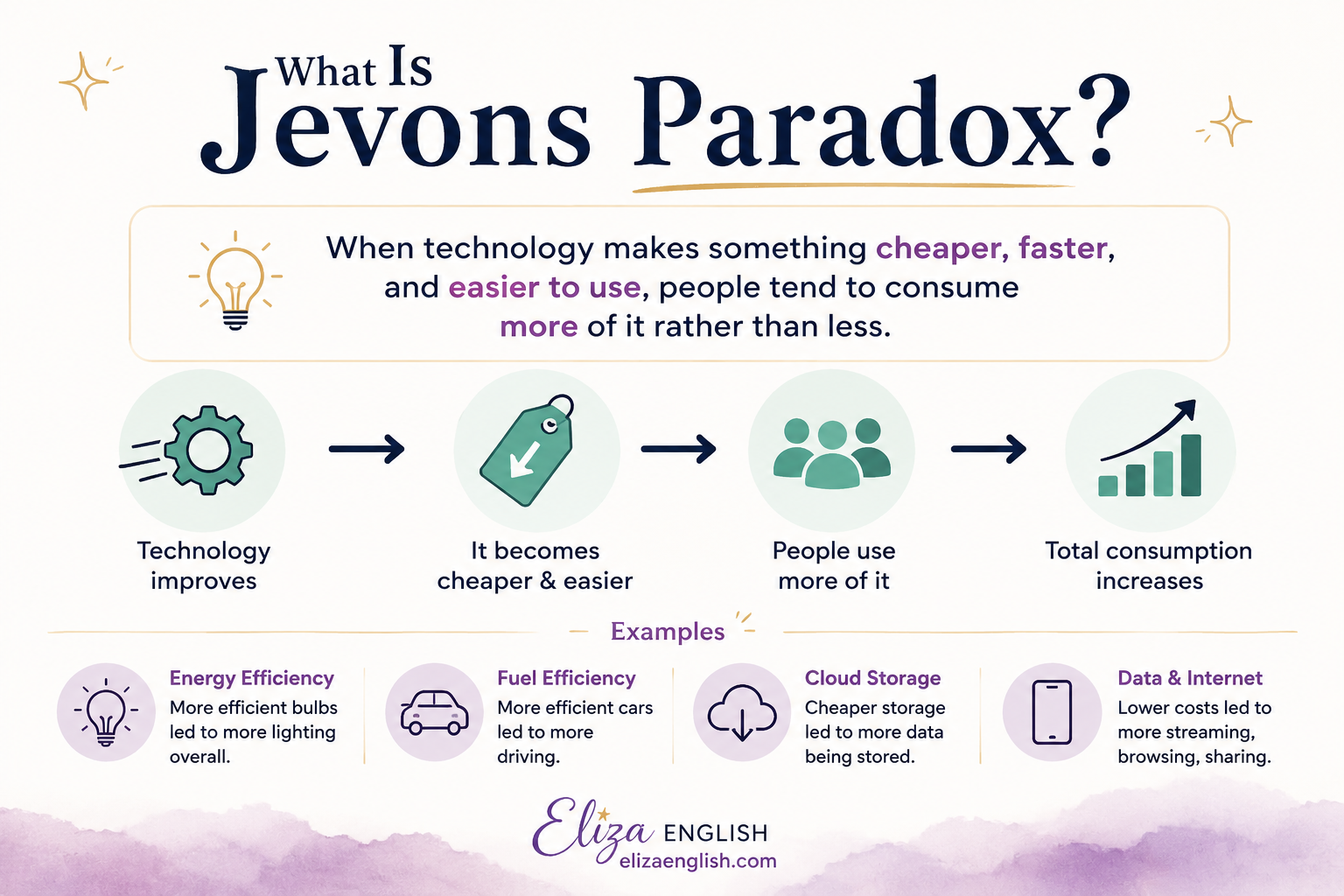
Think about content creation. AI has dramatically reduced the time required to create articles, videos, graphics, presentations, and marketing materials. Has the amount of content online decreased? Quite the opposite. The internet is producing more content than ever before.
The same pattern has appeared throughout history:
• Calculators didn’t eliminate accountants.
• Spreadsheets didn’t eliminate finance professionals.
• Canva didn’t eliminate designers.
• Email didn’t eliminate communication specialists.
• AI coding tools haven’t eliminated software developers.
Technology rarely eliminates work entirely. What it does is change the type of work that gets rewarded. Routine tasks become less valuable while strategic thinking, creativity, judgement, communication, trust, and relationship-building become more valuable.
The challenge isn’t that there’s less work. The challenge is that the work is different.
For years, freelancers operated according to a relatively simple model:
Expertise → Clients → Income
Today, that formula looks very different:
Expertise + AI + Visibility + Audience → Clients → Income
This is one of the biggest shifts taking place right now. Expertise alone is no longer enough. Many highly skilled professionals remain invisible because nobody knows they exist. Meanwhile, less experienced people with strong personal brands are attracting opportunities simply because they’re visible.
The freelancers who thrive over the next decade will combine expertise with technology and audience-building.
One of the biggest mistakes freelancers make is chasing every new tool. Every week a new AI platform appears, promising revolutionary productivity gains. Most freelancers don’t need another subscription. They need to learn how to use their existing tools properly.
For many freelancers, the paid version of ChatGPT is already enough.
Use AI aggressively to eliminate low-value work:
• Reduce lesson preparation time.
• Generate first drafts.
• Create marketing content.
• Brainstorm ideas.
• Analyse competitors.
• Conduct research.
• Build study materials.
• Create social media content.
• Automate repetitive administrative tasks.
• Learn new skills faster.
Personally, I use AI as a tutor almost every day. When I’m learning something new, I ask questions, request explanations, create learning plans, generate exercises, and test my understanding. Instead of replacing me, AI helps me acquire new skills much faster than I could previously.
The goal isn’t to compete with AI.
The goal is to become someone who uses AI exceptionally well.
Strategy #2: Expand Into Adjacent Skills
You don’t always need to reinvent yourself completely. Sometimes you simply need to expand your existing expertise. Think of your skills as a circle. What valuable services sit just outside that circle? That’s often where the opportunity lies.
For example, after years of teaching English, I’ve recently expanded into pronunciation and accent coaching. The demand is growing, the competition is smaller, and the value for professionals is significant.
At the same time, I’m learning how to teach the PTE (Pearson Test of English). Adding another exam to my portfolio allows me to serve a broader group of learners and access new markets.
The same principle applies across industries:
• Translators can become localisation consultants.
• Writers can become content strategists.
• Designers can move into UX.
• Language teachers can add interview coaching.
• Tutors can expand into communication coaching.
• Coaches can offer workshops or corporate training.
You don’t necessarily need a completely new identity. You may simply need a broader one.
Strategy #3: Build a Skill Stack
Sometimes the best opportunity isn’t adjacent to your current expertise at all. Many freelancers benefit from learning skills that complement their primary profession, such as:
• Website creation.
• SEO.
• Digital marketing.
• Email marketing.
• Sales.
• Video editing.
• Automation.
• Business development.
• Content creation.
The learning curve can feel intimidating, especially when you’re already an expert in another field. However, some of the most successful freelancers aren’t specialists in a single area. They’re people who combine several commercially valuable skills.
A teacher who understands marketing becomes more valuable. A writer who understands SEO becomes more valuable. A consultant who understands automation becomes more valuable. A coach who understands content creation becomes more valuable. The future belongs to people who build skill stacks rather than relying on a single speciality.
In my own business, teaching English eventually expanded into exam preparation, pronunciation coaching, teacher training, course creation, content marketing, and more recently AI-assisted learning. None of these areas existed in isolation. Each new skill created additional opportunities and made the overall business more resilient.
Strategy #4: Become More Human
This may sound counterintuitive, but one of the best responses to AI is becoming more human. As information becomes increasingly abundant, qualities such as trust, judgement, empathy, accountability, communication, and relationship-building become more valuable.
Students don’t hire me simply because I know English. They hire me because they want:
• Personalised feedback.
• Accountability.
• Structure.
• Encouragement.
• Confidence.
• A clear roadmap.
Similarly, business owners don’t hire consultants merely for information. Information is everywhere. They hire people who help them make decisions. The more AI handles information, the more valuable human connection becomes. Don’t become a cheaper version of AI. Become a better version of a human.
Why Most Side Hustle Advice Is Missing the Point
Let’s address something that rarely gets discussed. A lot of side hustle advice is incomplete. You’ve probably seen articles telling you to start a blog, create a course, launch a newsletter, build a website, write an ebook, become a consultant, or sell digital products. None of these suggestions are inherently bad. The problem is that most of these guides focus on creating the thing while largely ignoring the hardest part:
Finding clients.
- Creating a website is relatively easy. Getting people to visit it is hard.
- Creating a course is relatively easy. Selling it is hard.
- Building a product is relatively easy. Convincing people to buy it is hard.
know this from personal experience. Over the years, I’ve created educational resources, online products, and courses, including my own Udemy course for English teachers. Creating the course itself wasn’t the biggest challenge. The harder part was attracting the right audience, building trust, and consistently putting the course in front of people who could genuinely benefit from it. That’s why I always tell freelancers that creating something valuable is only half the battle. Distribution matters just as much.
Many coaches and consultants make a living selling advice, which reminds me of the Gold Rush. During the Gold Rush, the people who consistently made money weren’t necessarily the ones searching for gold. They were often the ones selling shovels, buckets, and equipment to the prospectors.
Today’s online business world works in much the same way. Plenty of experts sell advice while overlooking the biggest challenge freelancers face: client acquisition. And client acquisition remains the hardest part of the game.
The Real Secret: Visibility
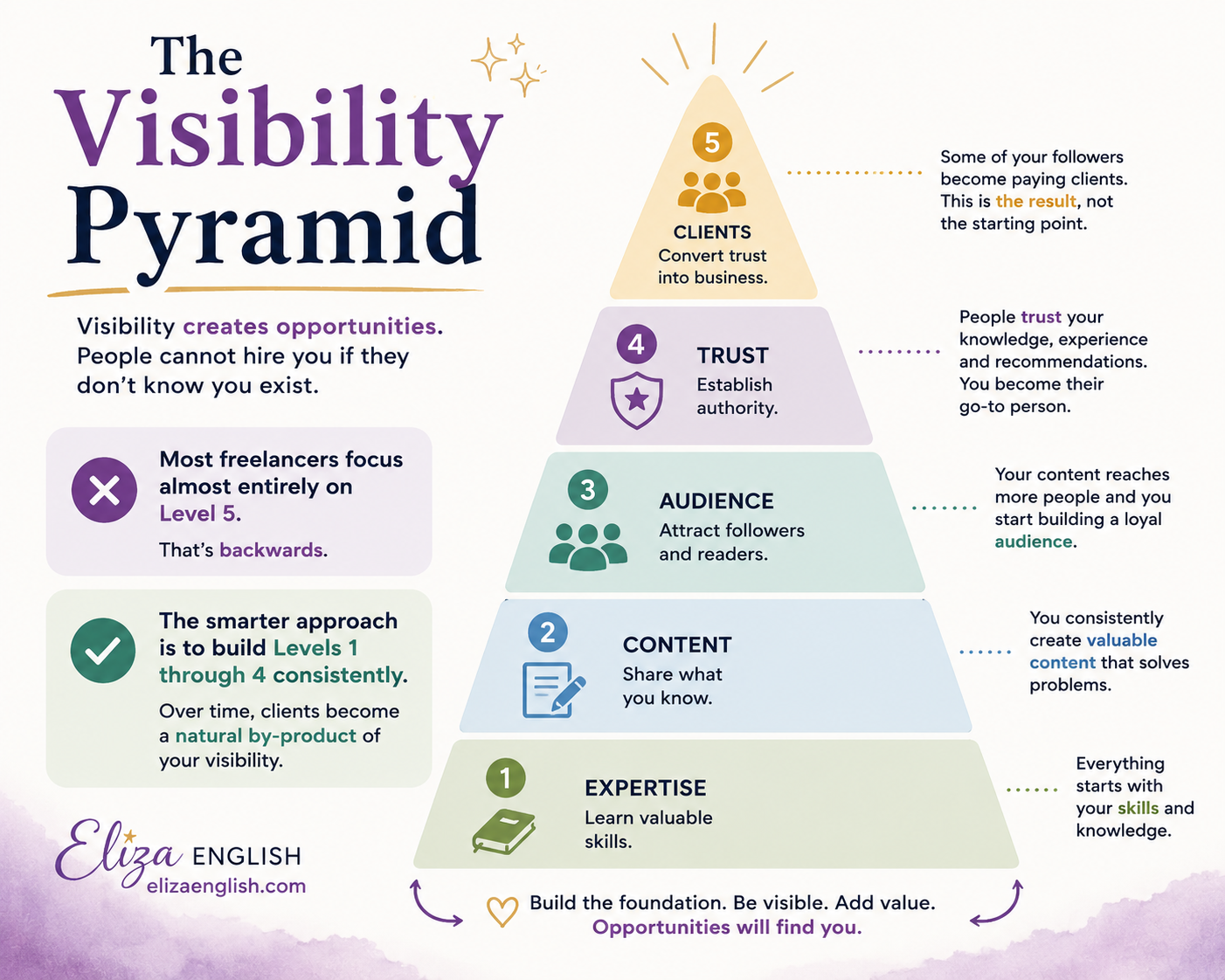
People cannot hire you if they don’t know you exist. Nobody wakes up thinking about your services.
Nobody is actively searching for you specifically. Nobody cares how talented you are if they’ve never heard of you. This sounds harsh, but it’s actually liberating because visibility is a skill. And like any skill, it can be learned.
Build Your Own Ecosystem
Choose one or two platforms you genuinely enjoy using. That might be YouTube, LinkedIn, X, Instagram, a newsletter, or your own website. Then start publishing useful content consistently. You don’t need to become an influencer. You simply need to become visible.
Share insights. Solve problems. Answer questions. Tell stories. Document your journey. Teach people something valuable.
Create:
• Articles • Videos • Newsletters • Tutorials. • Case studies • Social media posts • Short-form videos.
Every piece of content becomes a digital asset working on your behalf. One article can attract readers for years. One useful LinkedIn post can generate enquiries. One YouTube video can build trust at scale.
For example, articles on my website, social media content, educational resources, courses, and coaching services all support one another. Someone may discover my content through a blog post, later join one of my courses, attend a workshop, book a consultation, or reach out for personalised coaching. That’s the power of building an ecosystem rather than relying on a single source of clients.
This process is slow. Sometimes frustratingly slow. But it works. Visibility compounds.
Consider Getting Help to Accelerate the Process
One lesson I’ve learned over the years is that trying to figure everything out alone can be expensive. Sometimes a single conversation with the right mentor can save months of trial and error.
If you’re an English teacher, freelancer, coach, tutor, or language professional trying to adapt to a changing market, consider investing in your own professional development. Whether that’s through books, courses, communities, workshops, teacher training programmes, or one-to-one coaching, the return on investment can be substantial.
Many of the opportunities I’ve pursued over the years were inspired by conversations with professionals who had already solved the problems I was facing. Learning from people who are a few steps ahead can dramatically shorten the learning curve.
That’s one of the reasons I now offer teacher training and career development coaching for language professionals. The goal isn’t simply to improve teaching skills. It’s to help teachers build sustainable, future-proof careers, identify new opportunities, develop valuable services, and adapt confidently to the realities of today’s market.
What I’d Do If I Were Starting Again Today
If I suddenly lost 80% of my clients tomorrow, here’s exactly what I’d focus on:
- Master one AI tool.
- Add one adjacent service.
- Publish valuable content three times per week.
- Build an email list from day one.
- Learn one commercially valuable skill every year.
- Spend at least as much time on visibility as on client delivery.
- Network with professionals in my industry.
- Experiment constantly and adapt quickly.
Most freelancers spend almost all of their time serving today’s clients and very little time attracting tomorrow’s clients. That imbalance becomes dangerous when markets change.
Bottom Line
The uncomfortable truth is that some freelance services may never return to their previous levels of demand.
Translation work will probably never look the way it did in 2020. Proofreading will probably never look the way it did in 2020. Many forms of routine writing may never command the same fees again. But that doesn’t mean your earning potential has disappeared. It simply means the market is asking a different question.
Not, “What can you do?”
But, “What can you do now?”
The freelancers who continue learning, experimenting, adapting, and increasing their visibility will be just fine. In fact, many will earn more than they ever did before because they’ll be operating at the intersection of expertise, technology, and audience-building.
Some of your old skills may be losing value. That’s reality. The good news is that your ability to learn, adapt, build relationships, create opportunities, and reinvent yourself hasn’t become obsolete.
In fact, those may be the most valuable skills of all. If you’re currently navigating career changes, looking to expand your services, build a stronger personal brand, create digital products, future-proof your teaching business, or explore new income streams, remember that you don’t have to figure everything out alone. Learn from others, invest in your development, and keep moving forward. The future belongs to freelancers who stay curious, stay visible, and never stop learning.