Why some freelancers constantly chase new clients while others build waiting lists and enjoy years of repeat business.
Acquiring a new client feels exciting. Keeping that client for three, five, or even ten years is what builds a truly sustainable freelance business.
After more than a decade of working with students and professionals from around the world, I’ve realised something surprising. Client retention has very little to do with clever sales techniques. It has almost everything to do with psychology, trust, perceived value and genuine human relationships.
People often ask me why many of my students stay with me for years. The answer isn’t because I’m the cheapest teacher. Quite the opposite. It isn’t because I have the most impressive website, and it certainly isn’t because I persuade people to stay. They stay because every lesson makes their lives easier, their careers better and their goals feel more achievable.
Nobody is a fool, especially when it comes to spending their own money. People naturally evaluate whether every purchase is worth it. Every subscription, lesson, consultation and service competes for attention in an increasingly crowded marketplace. If your clients continue paying you month after month, they are silently answering one question:
“Is this one of the best investments I make?”
Your job is to make that answer an effortless yes.
Retention Starts Long Before the First Invoice
Many freelancers believe retention begins after onboarding. In reality, it begins long before the client even hires you.
People buy confidence before they buy competence. When someone feels that you genuinely understand their problem better than anyone else, trust starts forming before money changes hands.
This is one reason storytelling is so powerful.
Instead of saying,
“I teach Business English.”
say something like,
“One of my students had excellent English but froze every time she had to present in front of senior management. Six months later she confidently delivered a presentation to more than 200 colleagues and received a promotion.”
Stories activate emotion. Emotion creates memory, and memory influences decisions. Our brains remember vivid stories far better than abstract facts.
Nobody Buys Lessons. People Buy Transformation
This is one of the biggest mindset shifts any freelancer can make.
Clients rarely care about your process. They care about the outcome.
- An English teacher isn’t selling grammar.
- A fitness coach isn’t selling workouts.
- A photographer isn’t selling photos.
- A consultant isn’t selling meetings.
People buy confidence, peace of mind, career opportunities, status, time, relief and hope. The clearer you connect your service with these emotional outcomes, the stronger your client loyalty becomes.
Build an Economic Moat Instead of Competing on Price
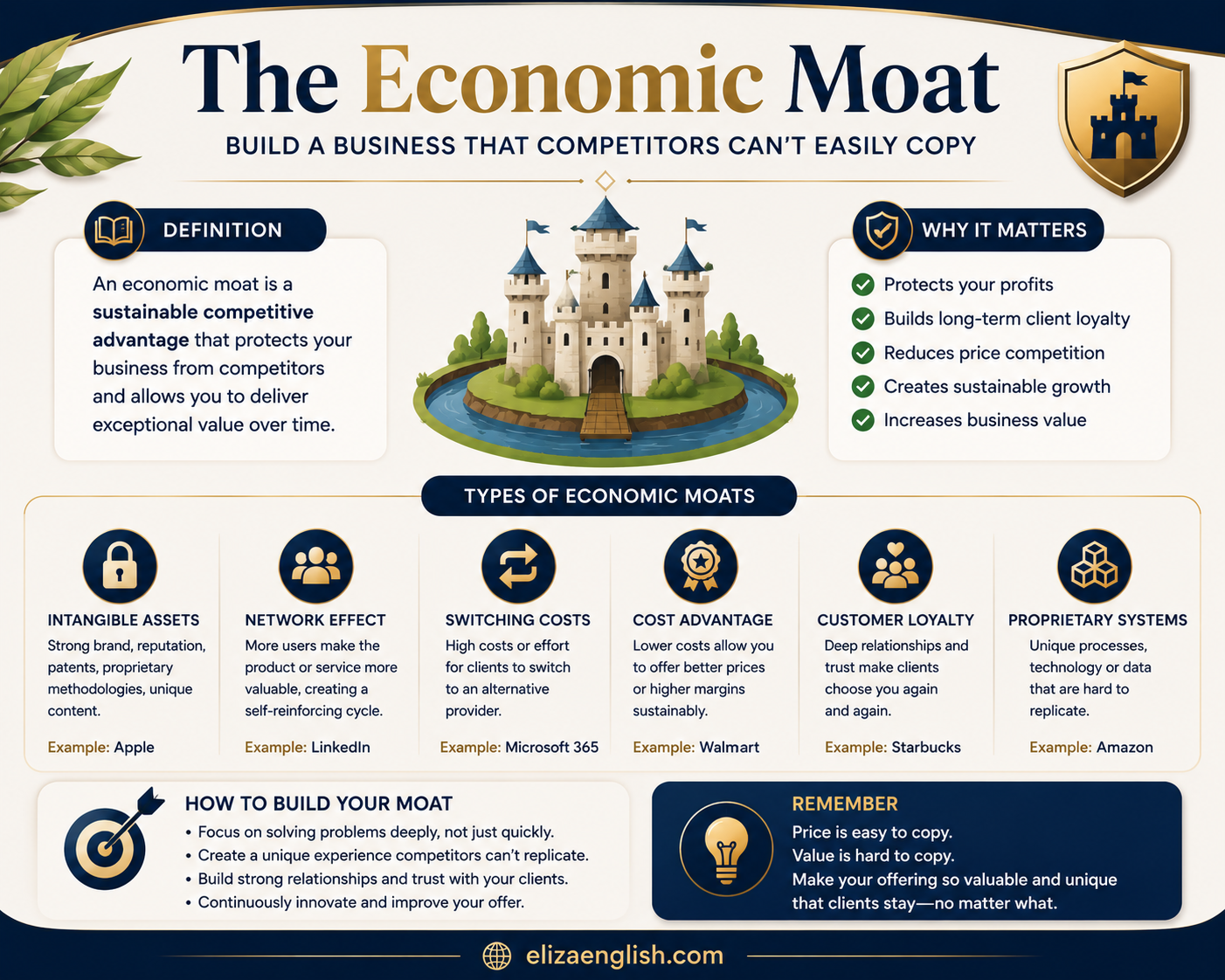
One of my favourite concepts comes from Warren Buffett, who often talks about businesses having an economic moat.
Imagine a medieval castle surrounded by a wide moat. The moat protects the castle from competitors. Your freelance business needs exactly the same protection.
If another freelancer can copy everything you do within a week, your moat is dangerously shallow.
Instead of asking,
“How can I become cheaper?”
ask,
“How can I become impossible to replace?”
That single question changes everything.
Nobody Is a Fool. Clients Expect Outstanding Value
Many freelancers mistakenly believe lower prices create loyalty. In reality, they often attract price-sensitive clients who will happily leave as soon as they find someone cheaper.
People are remarkably rational when spending their own money. They constantly compare what they pay with what they receive in return. If your service consistently delivers outstanding value, clients rarely obsess over small price differences.
Your goal should never be to become the cheapest option. Your goal is to become the option that offers the greatest overall value.
Think about everything you could include that your competitors don’t.
Perhaps you provide personalised AI-generated homework, detailed lesson notes after every session, career coaching, interview preparation, pronunciation analysis, neuroscience-based learning techniques, progress reports, customised vocabulary revision systems and personalised feedback videos.
None of these features is revolutionary on its own. However, when combined into one seamless experience, they create something extremely difficult to replicate.
That is exactly what a strong economic moat looks like.
Apply Blue Ocean Strategy
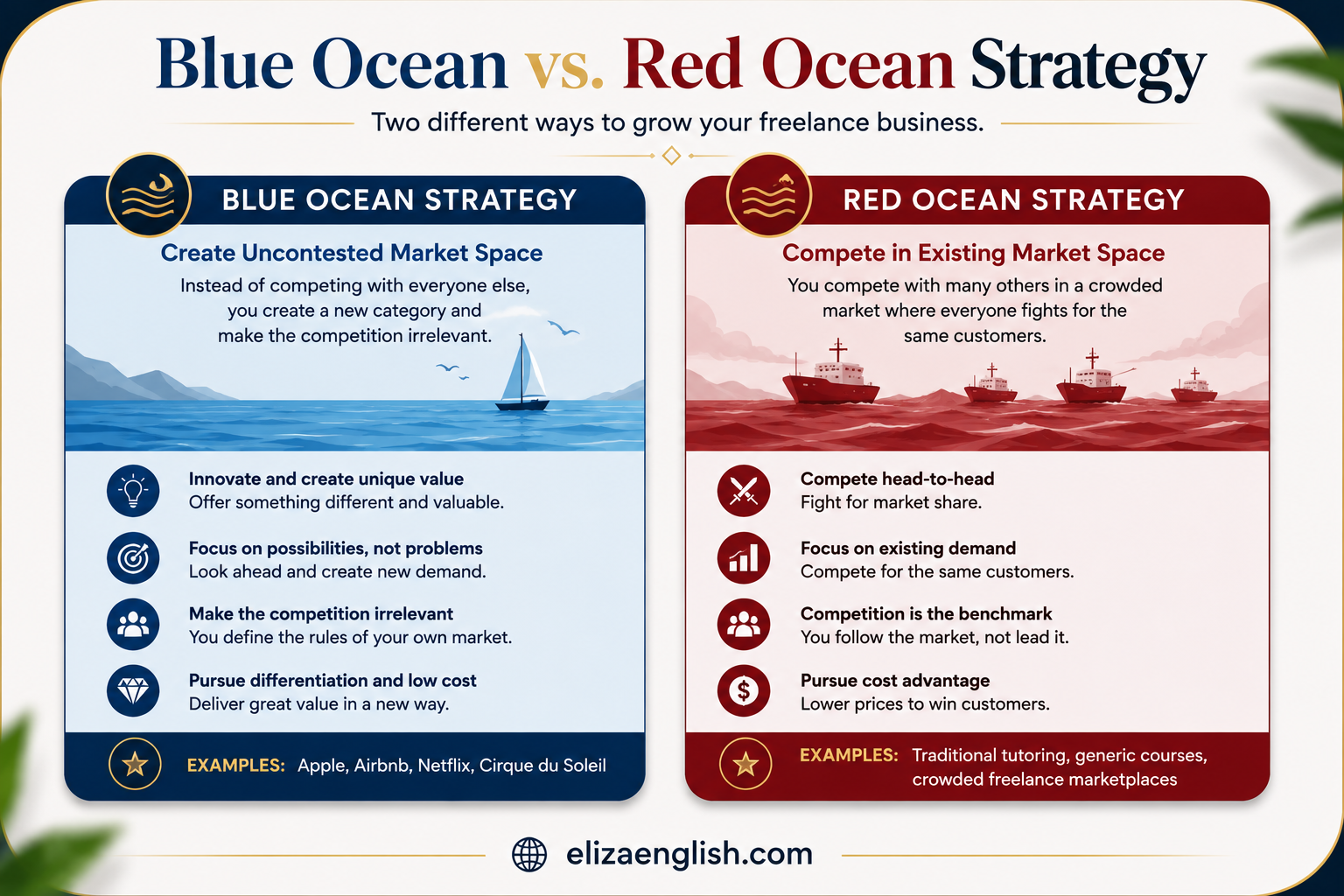
One of the most influential business books I’ve ever read is Blue Ocean Strategy by W. Chan Kim and Renée Mauborgne.
Most businesses compete inside crowded “red oceans” where everyone offers nearly identical products and fights over price.
The smartest businesses create entirely new categories instead.
- Apple didn’t simply build another smartphone. It created an ecosystem.
- Netflix stopped competing with DVD rental stores and reinvented entertainment.
- Airbnb didn’t build hotels. It unlocked millions of existing homes.
- Cirque du Soleil didn’t compete with traditional circuses. It combined theatre, music, storytelling and world-class acrobatics to create an entirely new form of entertainment.
Freelancers can do exactly the same thing.
Instead of becoming another English teacher, become an English communication strategist who combines Business English, confidence coaching, interview preparation, AI productivity systems and psychology-based learning.
Now you’re no longer competing with thousands of tutors charging by the hour. You’ve created your own category.
Enthusiasm Is Surprisingly Rare
One lesson I’ve learned over the years is that enthusiasm cannot be faked for very long.
Clients notice it.
Psychologists often talk about emotional contagion. We naturally absorb the emotions of the people around us. If you’re genuinely curious, passionate and excited about your work, your clients will often leave your sessions feeling energised as well.
That emotional experience becomes part of your service.
People may forget individual exercises, but they’ll always remember how you made them feel.
Celebrate small victories. Get excited when your client lands a promotion, passes an exam or finally masters a difficult pronunciation pattern. Genuine enthusiasm creates emotional momentum, and emotional momentum keeps people coming back.
As Tony Robbins wisely said,
“People are rewarded in public for what they practise in private.”
Remember the Person, Not Just the Client
This may be the single most powerful client retention strategy I have ever discovered, and interestingly, it has very little to do with business.
Every client has a life outside your sessions. They have families, careers, ambitions, disappointments, celebrations and worries. Yet many freelancers never look beyond the project itself. They deliver excellent work, send an invoice and move on.
The freelancers who build lifelong relationships do something very different.
They remember people.
Remember your client’s spouse’s name. Remember where they travelled for their holiday. Remember that they were preparing for a promotion, buying their first house or training for a marathon. If they mentioned their daughter’s birthday party, ask how it went. If they were nervous about an important presentation, follow up the following week. If they were interviewing for their dream job, celebrate the outcome with genuine enthusiasm.
Those conversations may only take a minute, but they communicate something incredibly powerful:
“You matter to me as a person, not simply as a source of income.”
This is one of the fundamental human needs identified by psychologists. People want to feel seen, recognised and understood. In an increasingly automated world where algorithms personalise advertisements but few people genuinely listen, authentic attention has become surprisingly rare and incredibly valuable.
One practical habit that has transformed my own client relationships is keeping confidential notes after every lesson. Before the next session, I spend sixty seconds reviewing them. That tiny investment completely changes the quality of the conversation.
For example, I might note:
-
upcoming job interview
-
conference presentation next month
-
daughter starting university
-
holiday in Japan
-
promotion to team leader
-
learning to play tennis
-
recovering from surgery
-
preparing for IELTS in October
When clients realise that you remember details they casually mentioned weeks or even months ago, they often feel genuinely surprised. Most people are used to repeating the same information to different service providers over and over again. Being remembered creates an emotional connection that no discount or promotional offer can replicate.
People rarely remain loyal to businesses.
They remain loyal to people who consistently make them feel valued.
As leadership expert Maya Angelou famously said,
“People will forget what you said, people will forget what you did, but people will never forget how you made them feel.”
That quote captures client retention better than almost any marketing textbook.
Be Flexible When Life Happens
Life rarely follows a perfectly organised calendar.
Clients become ill. Flights get cancelled. Children get sick. Parents require emergency care. Important business meetings appear without warning. Sometimes people simply have a terrible week.
Many freelancers immediately reach for their cancellation policy. While boundaries are essential and your time deserves respect, excessive rigidity can quietly damage relationships that have taken years to build.
Flexibility should never mean allowing clients to take advantage of you. Instead, it means recognising the difference between a genuine emergency and repeated disrespect for your time.
The most successful freelancers understand that long-term relationships are built on trust rather than strict rules.
Whenever possible, show clients that you understand their circumstances.
You might:
-
reschedule a lesson without unnecessary guilt
-
offer a shorter session that week
-
send independent study materials instead
-
record a short personalised video explaining what they missed
-
allow one complimentary emergency cancellation every few months
-
extend a deadline when circumstances genuinely justify it
These small acts communicate empathy rather than weakness.
Ironically, clients often become more respectful of your time after you’ve shown them kindness during a difficult period. They appreciate that you treated them like a human being rather than another appointment in your calendar.
Psychologists call this the norm of reciprocity. When someone receives understanding and generosity, they naturally feel motivated to respond with loyalty, appreciation and consideration.
The goal is not to become endlessly available.
The goal is to become deeply trusted.
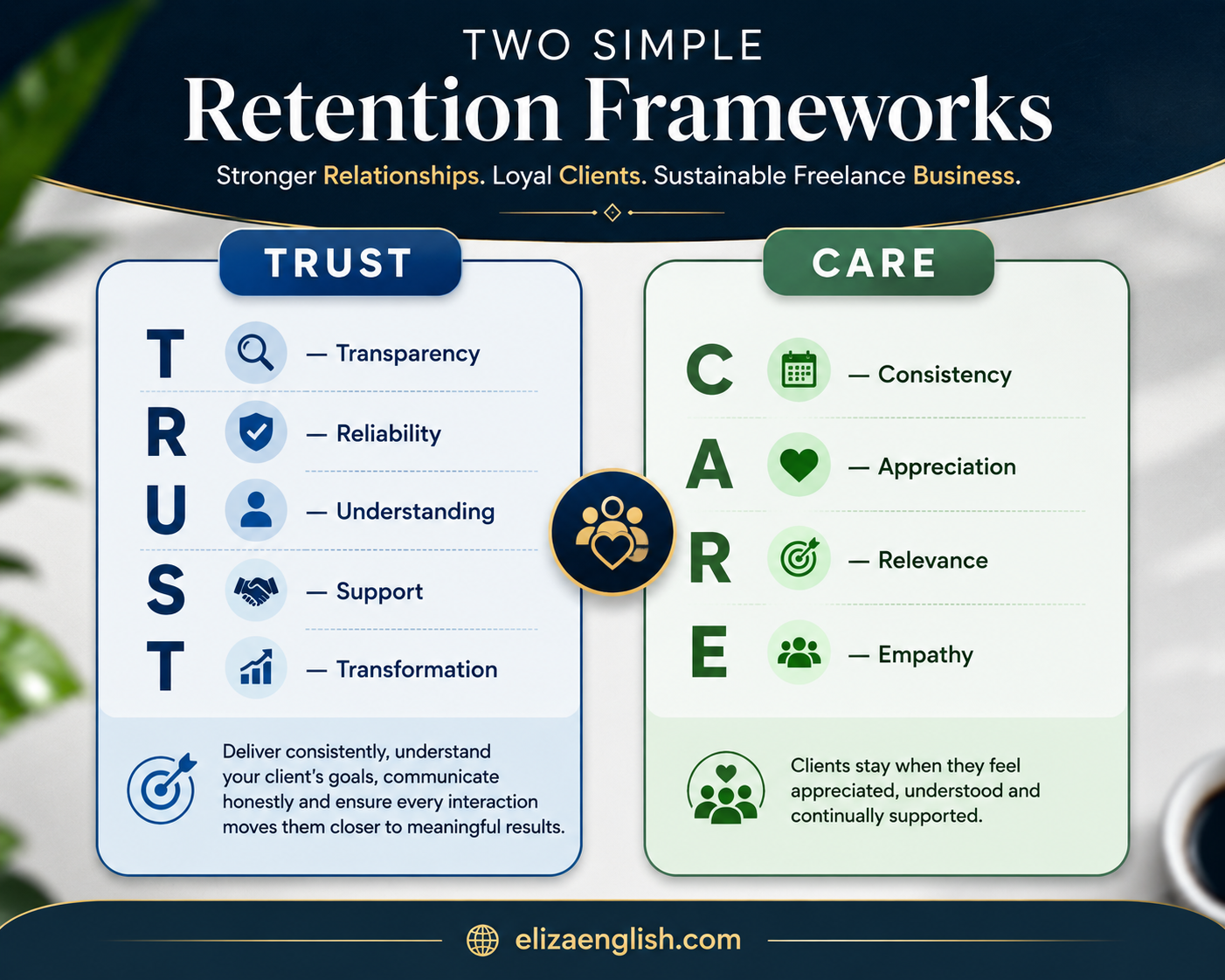
One of the biggest mistakes freelancers make is believing that loyalty comes from delivering the core service well.
Excellent service is simply the starting point.
Loyalty is often built through dozens of unexpected moments that clients never anticipated.
Behavioural scientists have repeatedly shown that unexpected positive experiences create much stronger emotional memories than expected ones. These moments become what psychologists sometimes describe as emotional peaks. Long after clients forget the details of individual lessons or meetings, they remember how those moments made them feel.
Think about the small things you could do that require very little effort but leave a lasting impression.
For example:
-
send an article related to something your client mentioned
-
record a personalised pronunciation video
-
congratulate them after receiving a promotion
-
recommend a podcast before an important business trip
-
send a useful AI prompt that saves them time
-
celebrate exam results with a handwritten message
-
remember birthdays or professional anniversaries
-
recommend a book that matches their interests
-
create a customised vocabulary list based on their industry
-
occasionally give them something valuable that they weren’t expecting
These gestures rarely take more than five minutes.
Yet together they create something priceless.
Clients begin thinking,
“My freelancer genuinely cares about my success.”
That perception is incredibly difficult for competitors to copy.
Anyone can lower their prices.
Very few people consistently create memorable experiences.
Disney calls these moments “magic moments.”
Luxury hotels refer to them as “delighting the customer.”
Whatever you call them, they become part of your competitive advantage.
Your Reputation Is Built Between Sessions
Many freelancers spend almost all of their energy thinking about what happens during the session.
Ironically, your reputation is often built in everything that happens outside it.
Clients remember the thoughtful follow-up email you sent after an interview. They remember that you checked in before an important presentation. They remember the useful article you shared on LinkedIn because it perfectly matched a conversation you had two weeks earlier.
Relationships grow in the spaces between transactions.
Consider creating a simple client experience rather than a series of isolated meetings.
That experience might include:
-
a personalised follow-up after every session
-
progress summaries every month
-
congratulations when clients reach important milestones
-
useful articles and podcasts relevant to their goals
-
occasional surprise resources
-
LinkedIn recommendations
-
birthday messages
-
quarterly progress reviews
-
personalised learning roadmaps
-
celebrating achievements publicly when appropriate
Notice that none of these actions requires expensive software or a large marketing budget.
What they require is intentionality.
People remember consistency far more than intensity.
One extraordinary lesson followed by months of silence rarely builds loyalty.
Hundreds of thoughtful interactions accumulated over time do.
This is exactly why relationship marketing consistently outperforms transactional marketing. Clients don’t simply remember the quality of your work.
They remember the quality of the relationship.
Years from now, they may not recall every lesson you taught or every piece of advice you gave.
But they’ll remember that you believed in them before they believed in themselves.
And that is what keeps clients returning, referring their friends and enthusiastically recommending your services long after the original project has ended.
Bottom Line
Client retention isn’t about manipulation. It’s about creating so much authentic value that leaving becomes difficult to justify.
The freelancers with the highest retention rates rarely rely on clever sales scripts. Instead, they combine exceptional expertise with psychology, empathy, strategic positioning and genuine human connection.
They create an offer that’s difficult to compare, impossible to commoditise and deeply rewarding to experience.
When you consistently improve another person’s life, career or confidence, price becomes only one part of the conversation.
Relationships become your greatest competitive advantage.
And in a world increasingly shaped by artificial intelligence, authentic human connection may become the strongest economic moat of all.