Every English teacher has heard the same sentence at least once:
“I know I should study more, but I just can’t stay consistent.”
The truth is that most students do not fail because they lack intelligence or motivation. They struggle because they have never built a sustainable study habit.
One of the most influential books on habit formation, Atomic Habits by James Clear, explains that remarkable results rarely come from dramatic changes. Instead, they come from small actions repeated consistently over time. According to Clear, consistency beats intensity. Even if you practise something for only five or ten minutes a day, doing it every single day creates what is known as the compounding effect. Tiny improvements accumulate until they become significant progress.
The same principle applies perfectly to learning English. A student who studies vocabulary for just ten minutes every day will almost always outperform someone who studies for four hours once every two weeks. Daily practice gradually becomes automatic, while irregular study sessions require enormous willpower every single time.
The hardest part is rarely studying itself. The real challenge is getting started. That is exactly where gamification becomes incredibly powerful.
Instead of relying on motivation alone, you create systems that make students genuinely want to return every day. Over the years, especially while preparing students for IELTS, TOEFL, Cambridge exams and the Duolingo English Test, I have experimented with simple gamification techniques that dramatically improve consistency. None of them require expensive apps or complicated technology. They simply make studying more engaging, rewarding and satisfying.
Here are seven practical ideas that have worked exceptionally well with my students.
1. The Daily Exam Checklist
This is probably my most successful strategy, particularly with exam preparation students.
Instead of telling students to “study English,” I give them a visual checklist containing every skill they should practise that day.
A typical checklist might include:
- □ Read one article
- □ Describe one picture
- □ Complete one Writing Sample
- □ Learn 10 new words
- □ Listen to one podcast episode
- □ Speak English for 10 minutes
- □ Complete one Interactive Listening task
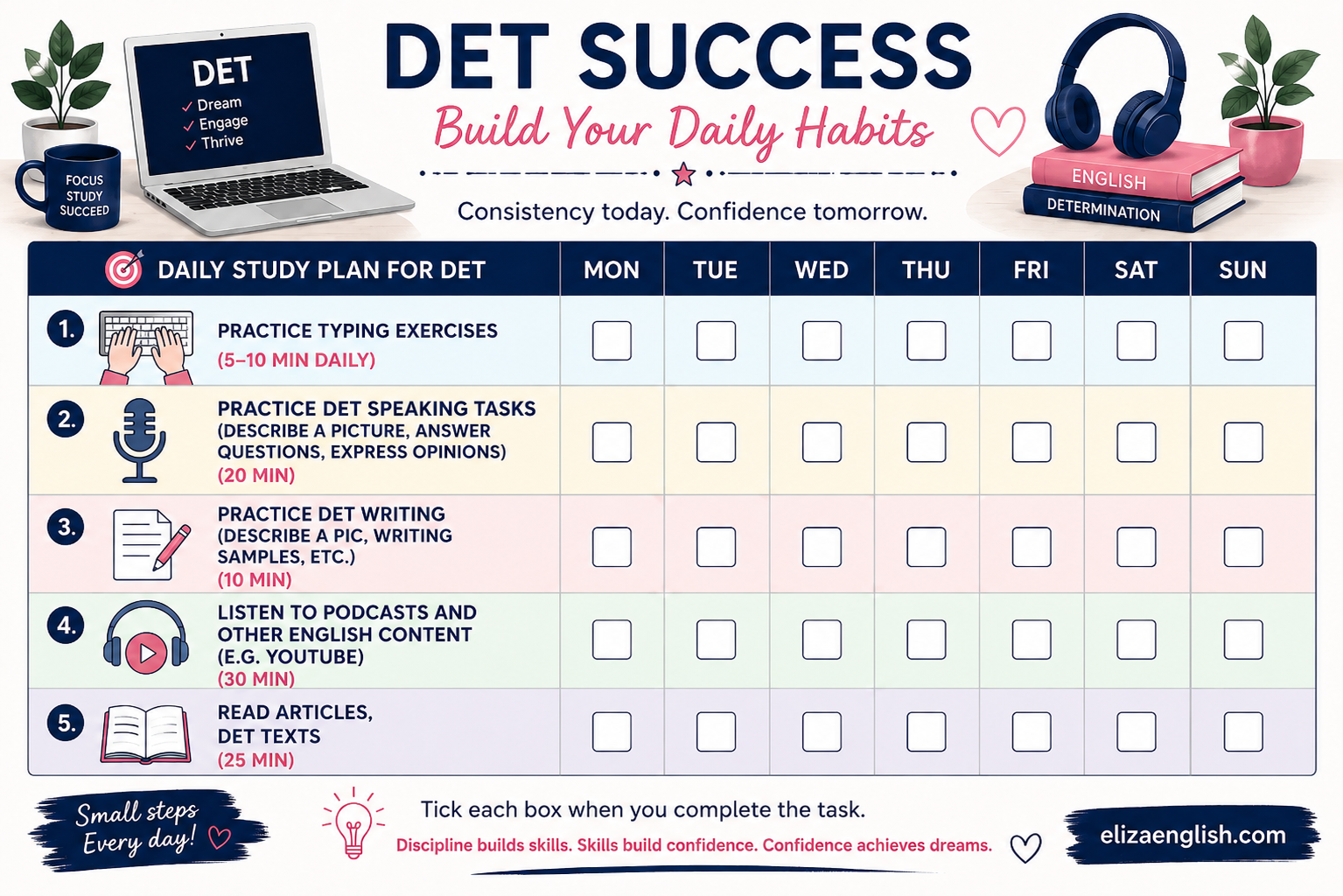
Every completed task gives students an immediate sense of accomplishment. Instead of wondering whether they have studied enough, they finish the day with visible proof of progress. The goal is not perfection. The goal is consistency.
2. The Mystery Advent Calendar
Students love surprises, regardless of their age.
One activity I sometimes create looks like an Advent calendar. Instead of seeing a list of tasks in advance, students open one numbered window each day to discover today’s mission.
Their daily challenge might be:
- Watch a five-minute TED Talk and write down three useful expressions.
- Record yourself answering an IELTS Speaking Part 2 question.
- Read one BBC News article without using a dictionary.
- Shadow an English speaker for two minutes.
- Write a short email using five new vocabulary items.
- Learn five phrasal verbs and use each one in a sentence.
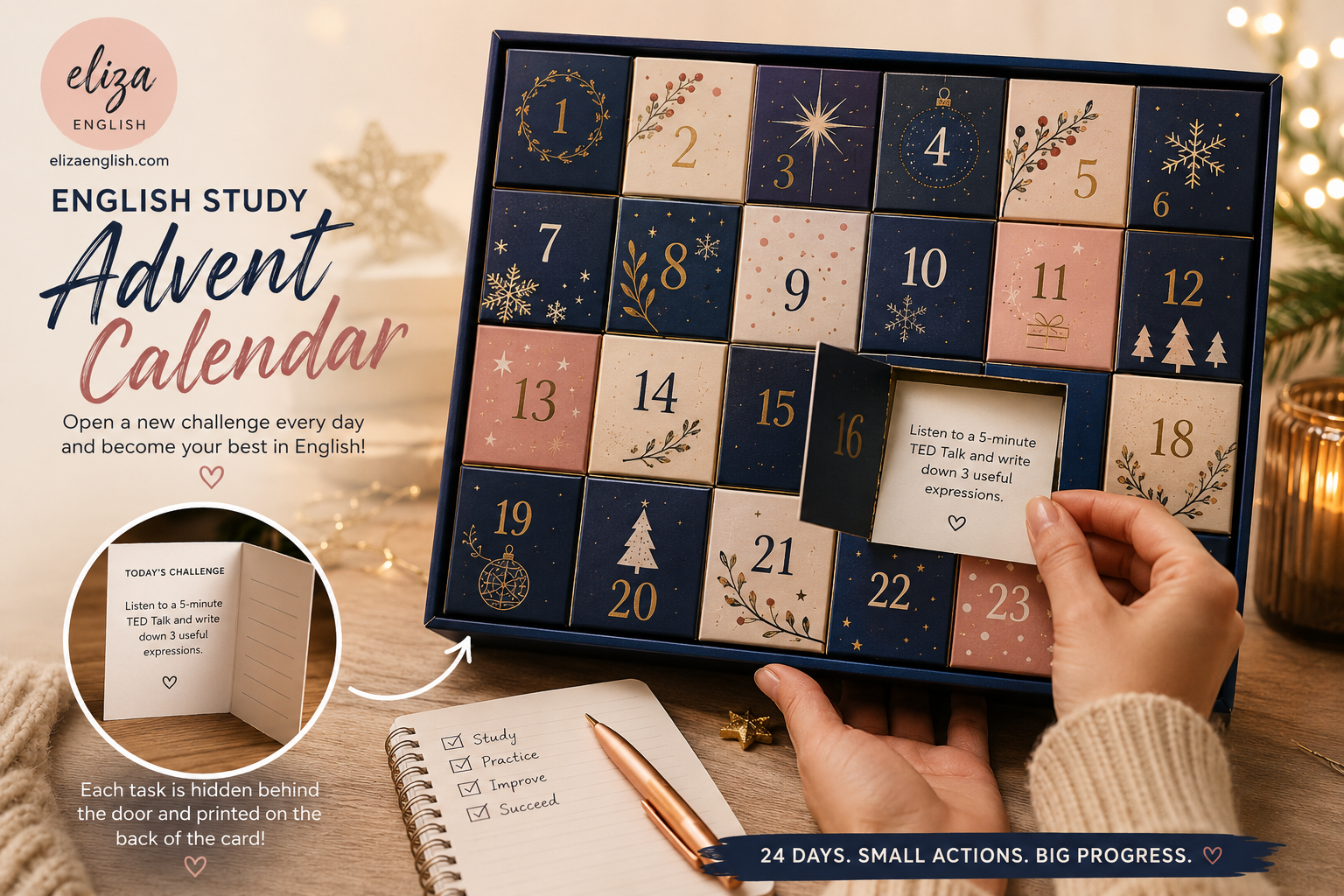
Because students never know what is waiting behind each window, curiosity becomes part of the learning process. Studying feels less like another obligation and more like opening a daily surprise.
3. Build a Study Streak
People naturally dislike breaking a streak.
That simple psychological principle explains why language-learning apps are so addictive, and you can recreate the same effect without using any technology.
Simply print a monthly calendar and ask students to colour one square every day they study English.
That’s it.
After a week or two, students become emotionally invested in protecting their streak. Missing a day suddenly feels like losing something valuable. Before long, the focus shifts away from studying English and towards maintaining the streak. Ironically, that often leads to far more studying.
4. The English Dice Challenge
Sometimes students spend more time deciding what to study than actually studying.
Remove the decision altogether.
Assign each number on a dice to a different skill:
- 🎲 1 = Speaking
- 🎲 2 = Listening
- 🎲 3 = Reading
- 🎲 4 = Writing
- 🎲 5 = Vocabulary
- 🎲 6 = Grammar
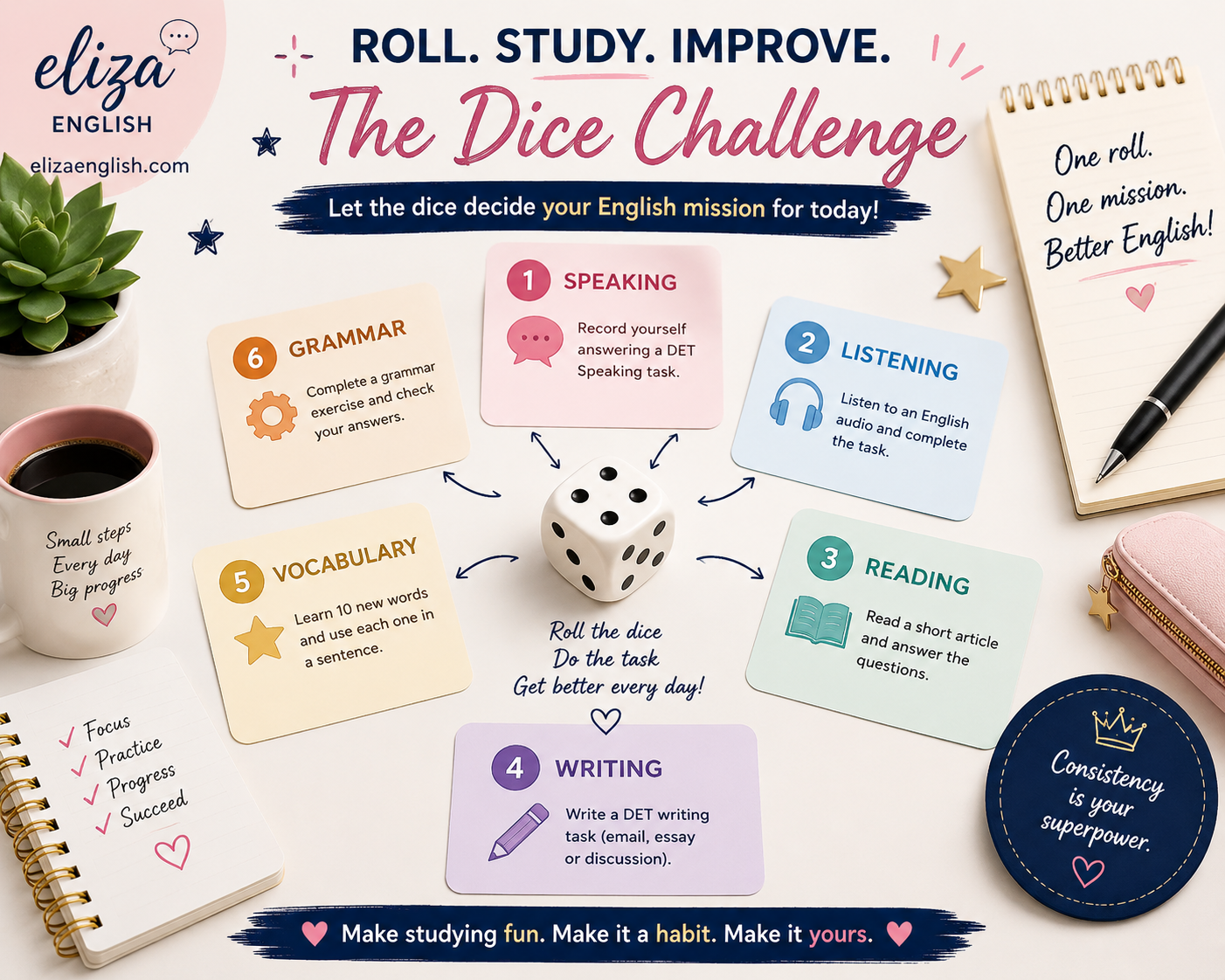
Once the dice is rolled, today’s mission is decided automatically. You can even prepare several activities for each category, so every roll feels different. This simple game eliminates decision fatigue while ensuring that every language skill receives attention over time.
5. Earn XP Instead of Counting Study Hours
Video games never reward players simply for showing up.
They reward completed missions.
Apply exactly the same principle to English learning by introducing Experience Points (XP).
Students earn points for every completed activity, for example:
- Learn 10 new words = 10 XP
- Watch an English YouTube video = 15 XP
- Complete one writing task = 25 XP
- Speak with a language partner = 40 XP
- Finish a mock test = 60 XP
Students then level up.
- Level 1 = 100 XP
- Level 2 = 250 XP
- Level 3 = 500 XP
- Level 4 = 800 XP
- English Master = 1,000 XP
Something fascinating happens when students stop counting hours and start collecting points. Instead of saying, “I have to study tonight,” they begin saying, “I’m only twenty XP away from Level 4.” It may sound simple, but it is surprisingly effective, even with adult learners.
6. The Weekly Boss Battle
Every great game ends each level with a boss battle.
Your English course can too.
At the end of every week, challenge students to complete one larger task that combines everything they have practised over the previous few days.
Examples include:
- giving a three-minute presentation
- writing a formal email
- recording a mock speaking test
- completing a full reading section under timed conditions
- participating in a 20-minute conversation without switching languages
Students begin to see the purpose behind the smaller daily exercises because they know they are preparing for something meaningful.
7. Unlock the Treasure Chest
People enjoy earning rewards much more than receiving them randomly.
Create a digital “Treasure Chest” filled with small surprises that students can unlock after completing a full week of consistent study.
Rewards could include:
- an exclusive AI prompt
- a premium worksheet
- a pronunciation mini-course
- a vocabulary pack
- an interesting podcast recommendation
- a printable idiom guide
- a fun grammar escape room
- bonus speaking questions
The anticipation of discovering the next reward often becomes just as motivating as the reward itself.
Why Gamification Works
Many teachers assume that gamification means making learning childish.
In reality, it simply means making progress visible.
Good gamification removes friction, provides frequent moments of success, encourages students to celebrate small wins and transforms studying into something they actually look forward to. Instead of relying solely on motivation, students begin relying on routines, and routines eventually become habits.
That is exactly what James Clear explains throughout Atomic Habits. We do not rise to the level of our goals. We fall to the level of our systems.
As teachers, our responsibility extends far beyond explaining grammar or correcting pronunciation. We also design learning systems that help students succeed long after the lesson has finished.
Bottom Line
If your students constantly tell you that they “don’t have time” to study, the real problem may not be a lack of time at all.
More often than not, studying simply feels too difficult to begin.
By introducing a few elements of gamification, you lower the barrier to getting started. Whether you use a daily checklist, a mystery calendar, streak tracking, XP points, dice challenges or weekly boss battles, the underlying principle remains exactly the same: make daily practice easy, enjoyable and rewarding.
Remember what Atomic Habits teaches us. Extraordinary results are rarely produced by extraordinary effort. They are the product of ordinary actions repeated consistently over weeks, months and years.
English works exactly the same way.
Help your students show up every day, even if only for ten minutes. Thanks to the power of consistency and the compounding effect, those small daily sessions will eventually lead to remarkable progress.