Why the Duolingo English Test May Have Arrived at the Perfect Moment
A funny thing happened while the education world was busy debating online exams.
Artificial intelligence quietly changed the rules.
For decades, English proficiency tests had a fairly straightforward purpose. Universities wanted a reliable way to assess applicants, students needed proof of their language skills, and examination boards worked tirelessly to create assessments that were fair, accurate, and internationally recognised.
Then AI entered the picture and complicated matters.
Millions of people suddenly found themselves interacting with machines in ways that would have seemed extraordinary only a few years ago. They were asking ChatGPT to explain difficult concepts, using Claude to analyse documents, relying on Gemini to organise information, and experimenting with a growing collection of AI tools for work and study. The quality of these interactions often depended on a surprisingly simple factor: how clearly the user could communicate.
That observation brings us to one of the most famous statements in the AI world.
“The hottest new programming language is English”
In January 2023, AI researcher Andrej Karpathy posted a sentence that quickly spread across the technology community:
“The hottest new programming language is English.”
The remark was memorable because it captured a genuine shift in the way humans interact with computers. Karpathy is not merely an internet personality with a talent for catchy phrases. He was one of the founding researchers at OpenAI, later led AI development for Tesla’s Autopilot project, and remains one of the most respected voices in machine learning.
His point was not that traditional programming languages had suddenly become obsolete. Software engineers are unlikely to abandon Python or Java anytime soon. Rather, modern AI systems increasingly allow users to describe what they want in natural language instead of writing complicated technical instructions.
A carefully written prompt can generate computer code, draft a business report, create a lesson plan, summarise a research paper, or even produce a reasonably convincing holiday itinerary. Anyone who has experimented with AI quickly discovers that vague instructions often produce vague results, while clear and well-structured requests tend to generate much better output.
Karpathy is not alone in making this observation. Researchers and technology leaders have repeatedly noted that communication skills are becoming increasingly valuable in an AI-driven world. As large language models improve, the ability to explain a problem clearly, provide relevant context, and evaluate the resulting information becomes an increasingly practical skill.
In a sense, English is becoming a kind of interface.
This does not mean that AI only works in English. Modern systems can communicate in dozens of languages, and multilingual capabilities continue to improve at an impressive pace. Yet English remains the dominant language of much of the internet, scientific publishing, software development, and international business, giving it a particularly important role in today’s digital economy.
That raises an interesting educational question.
If clear communication increasingly influences the quality of AI output, what kind of English skills should schools and language examinations actually reward? Should students spend countless hours memorising isolated grammatical patterns, or should they learn to interpret information, organise ideas, respond quickly, and communicate effectively under pressure?
As it happens, one modern English exam seems surprisingly well suited to this new reality.
The exam nobody expected to shake up the industry
Compared with established names such as IELTS and TOEFL, the Duolingo English Test, usually known as the DET, is remarkably young. The project first emerged in 2014 before evolving into the modern examination format that launched in 2016, and it has continued to develop ever since.
At first, many educators were understandably sceptical.
An English proficiency test taken entirely online, from the comfort of a student’s home, sounded almost too convenient to be taken seriously. Traditional language exams typically required candidates to book months in advance, travel to an authorised test centre, and pay substantial fees for the privilege.
The DET offered a radically different approach.
Candidates could register online, sit the exam at home under secure testing conditions, and receive certified results much more quickly than many traditional alternatives. Unsurprisingly, parts of the educational world greeted the idea with polite suspicion.
Then circumstances intervened.
A pandemic accelerated a quiet revolution
The COVID-19 pandemic changed higher education in ways that few people could have predicted.
Universities closed campuses, international travel became difficult, and many testing centres suspended operations. Students still wanted to study abroad, and admissions offices still needed reliable evidence of English proficiency, but the traditional testing infrastructure faced unprecedented challenges.
The Duolingo English Test happened to offer a practical solution at exactly the right moment.
Its advantages suddenly became impossible to ignore:
- Candidates could take the exam from home.
- There was no need to travel long distances to a testing centre.
- Results were available relatively quickly.
- The cost was considerably lower than many competing examinations.
Universities that might otherwise have waited several years before considering a new assessment suddenly had strong practical reasons to evaluate the DET. Many institutions introduced temporary acceptance policies during the pandemic, but a significant number later decided to continue recognising the qualification after reviewing the available evidence.
This was not simply a case of convenience triumphing over tradition.
Universities wanted reassurance that the exam was genuinely measuring the skills students would need to succeed in an English-speaking academic environment.
Why universities took the DET seriously
Universities are not generally famous for making hasty decisions. Many institutions have centuries of history behind them, and admissions departments are understandably cautious when evaluating new qualifications.
A modern English test needs more than clever technology and a user-friendly website. It must demonstrate that its scores are reliable, valid, and consistent across different groups of candidates.
This is where psychometrics enters the story.
The word sounds intimidating, but the basic idea is surprisingly straightforward. Psychometrics is the science of educational and psychological measurement, and its goal is to ensure that assessments genuinely measure what they claim to measure.
A well-designed language test should satisfy several important conditions:
- It should assess relevant language skills rather than random knowledge.
- It should produce reasonably consistent results.
- It should minimise the influence of luck.
- It should provide a fair experience for candidates from different backgrounds.
Researchers associated with the Duolingo English Test have published validation studies examining its reliability and effectiveness, and universities have monitored how students with DET scores perform after admission. As evidence accumulated, confidence in the assessment gradually increased.
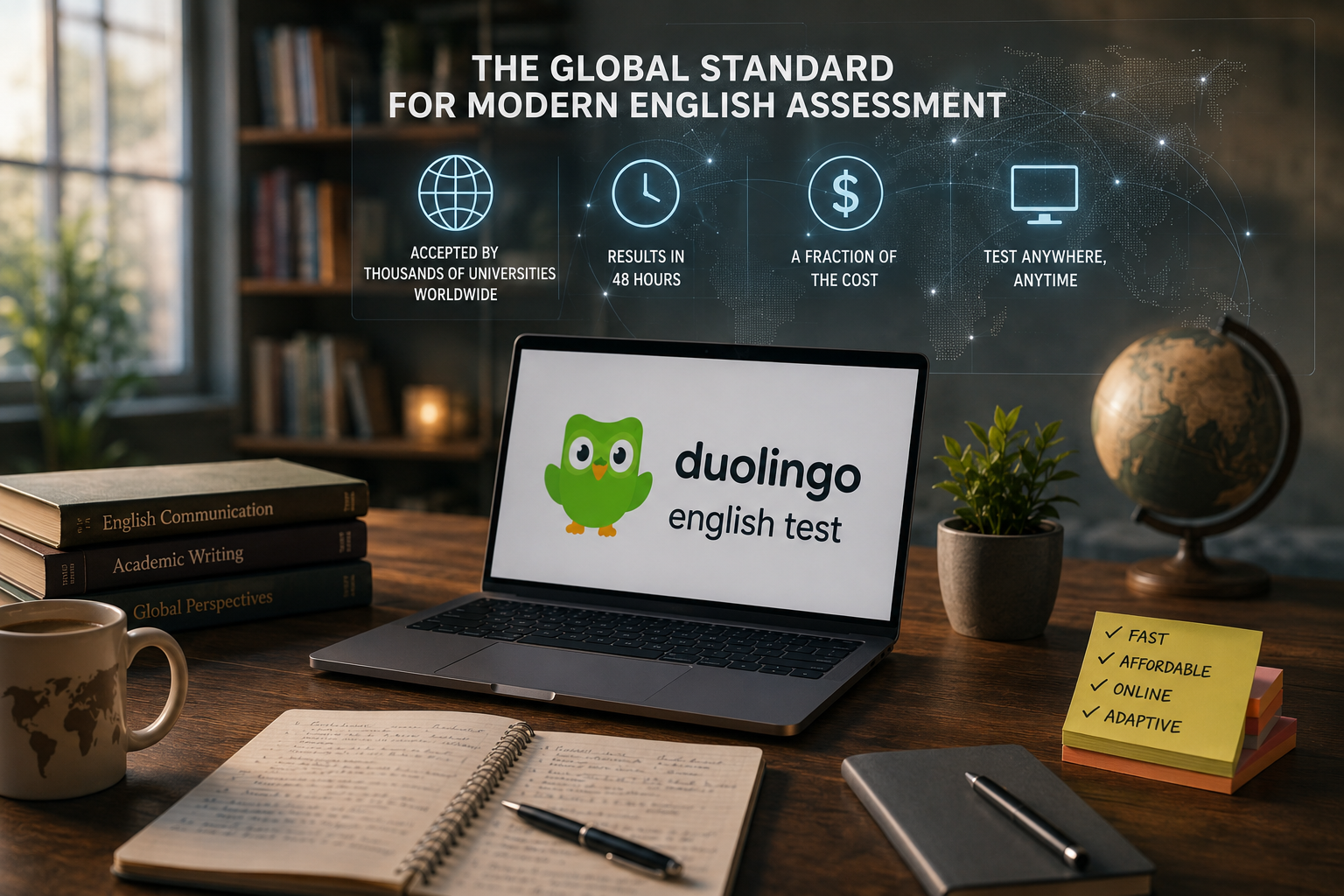
Today, thousands of institutions around the world accept the Duolingo English Test as evidence of English proficiency, although students should always check the specific requirements of individual universities because admissions policies continue to evolve.
The DET did not become widely recognised because it was fashionable.
It gained acceptance because institutions found growing evidence that it could do the job.
Four advantages that changed the conversation
When students and teachers discuss the Duolingo English Test, four practical benefits tend to dominate the conversation.
It is fast.
Candidates can usually arrange the test without lengthy waiting periods, and certified results are generally available much sooner than many traditional alternatives.
It is affordable.
For many students, especially those applying to several universities, examination costs can become a significant financial burden. The DET helps reduce that obstacle by offering a lower-cost option.
It is online.
Students living far from major cities no longer need to spend additional time and money travelling to authorised testing centres, which can make the application process considerably less stressful.
It is adaptive.
This final advantage is perhaps the most interesting because it reflects some of the most sophisticated ideas in modern educational assessment.
What exactly is adaptive testing?
Imagine two students sitting an English exam.
The first candidate answers a question correctly, so the system responds by presenting a slightly more challenging task. The second candidate struggles with a similar question, and the system adjusts by selecting one that is somewhat easier. As the examination continues, both students follow different pathways designed to provide the most useful information about their language ability.
That, in simple terms, is adaptive testing.
Instead of giving every candidate an identical sequence of questions, the system adjusts the difficulty level according to individual performance. The objective is not to catch students out or make the test more stressful. Rather, it aims to measure proficiency more efficiently and accurately.
A highly proficient candidate does not need twenty elementary questions to demonstrate advanced language skills. Equally, an intermediate learner should not spend an hour battling tasks that are far beyond their current level.
The system continually adjusts, selecting questions that help build a clearer picture of the candidate’s abilities. In a rather interesting way, the assessment itself becomes interactive, responding to the student’s performance instead of treating every test taker as though they were identical.
Although adaptive testing may sound futuristic, the underlying principles have been studied for decades and are firmly rooted in established psychometric research.
Communication over memorisation
Perhaps the most fascinating aspect of the Duolingo English Test is not its technology but its underlying philosophy.
Traditional language education has often rewarded memorisation. Students learn vocabulary lists, practise predictable exercise formats, and commit grammatical rules to memory in the hope that they will appear in the examination.
There is nothing inherently wrong with these activities. A strong vocabulary and a solid understanding of grammar remain essential components of language proficiency.
The difficulty arises when memorisation becomes the primary objective rather than a tool for genuine communication.
Real life rarely presents us with perfectly rehearsed situations. Successful language users constantly interpret incomplete information, make educated guesses, connect ideas from different sources, and adapt their responses as new details emerge. They summarise conversations, describe people and events, identify patterns, and organise their thoughts under time pressure, often without consciously realising that they are performing these complex mental tasks.
Interestingly, many of these same abilities are becoming increasingly valuable when interacting with modern AI systems.
Whether we are communicating with another person or with an intelligent machine, effective communication depends on understanding context, selecting relevant information, expressing intentions clearly, and producing responses that are logical and well organised. The better we perform these tasks, the more likely we are to achieve the outcome we want.
This does not mean that the Duolingo English Test was secretly designed to prepare humanity for the age of artificial intelligence.
It was not.
The timing, however, is difficult to ignore.
An examination created to assess practical communication skills happens to reward many of the same cognitive abilities that are becoming increasingly valuable in an AI-driven economy. That may be a coincidence, or it may reflect broader changes in the way educators think about language learning and real-world communication.
Either way, it leads to an intriguing possibility.
Students preparing for the Duolingo English Test may be developing far more than the skills needed to gain university admission. They may also be building habits of clear thinking, rapid information processing, and effective communication that will prove increasingly useful in a future where success depends on interacting confidently with both humans and intelligent machines.
And that is where the story becomes particularly interesting.
In the next section, we will examine every major component of the Duolingo English Test and ask an unexpected question: could preparing for the DET also be training some of the most valuable communication skills of the AI age?
Why Preparing for the Duolingo English Test May Be Training You for the AI Age
At this point, a sceptical reader might raise an eyebrow.
Surely we are not suggesting that preparing for the Duolingo English Test turns students into AI experts or future Silicon Valley entrepreneurs. That would be an impressive marketing slogan, but unfortunately reality tends to be less dramatic.
The claim is far more modest and, arguably, more interesting.
Preparing for the DET develops a collection of communication and cognitive skills that are becoming increasingly valuable in an economy where humans regularly collaborate with artificial intelligence.
This is not because Duolingo secretly designed the exam with ChatGPT in mind. The modern version of the DET predates the explosion of generative AI by several years. Rather, the test was built around practical communication, rapid processing, and authentic language use, and these same abilities happen to align surprisingly well with the demands of interacting with intelligent systems.
The connection becomes clearer when we examine the individual tasks.
As someone who has spent years teaching English and preparing students for high-stakes examinations, I have noticed an interesting pattern. Students often assume that they are simply practising for a language test, while in reality they are exercising a much broader set of mental muscles.
Let’s look at what those muscles actually are.
Many students initially underestimate Interactive Reading.
After all, reading a text and answering questions hardly sounds revolutionary. Schoolchildren have been doing something similar for generations.
The DET version, however, introduces an important twist.
Candidates often encounter incomplete texts, missing sentences, or passages that require them to reconstruct meaning by combining several clues. Success depends less on memorising vocabulary and more on understanding context and relationships between ideas.
A strong candidate needs to:
- identify patterns;
- infer missing information;
- connect separate pieces of evidence;
- distinguish important details from distractions;
- maintain an overall understanding of the text.
These are remarkably practical skills.
Consider what happens when you ask an AI assistant to summarise a lengthy report. The output may be excellent, but it still requires human evaluation. You need to notice what information has been included, what has been omitted, and whether the conclusions actually follow from the evidence presented.
In other words, you are performing a sophisticated reading task.
Interactive Reading encourages students to become active readers rather than passive consumers of information. Instead of collecting isolated facts, they learn to construct meaning from incomplete evidence.
Ironically, that may be one of the most valuable abilities in an era overflowing with information.
Interactive Listening: understanding before responding
Listening has always been one of the most challenging language skills.
Unlike reading, it offers very little opportunity to pause and admire a particularly difficult sentence for several minutes. Real conversations move forward whether we are ready or not.
The DET reflects this reality.
Interactive Listening requires candidates to process spoken information, remember important details, and respond appropriately as the conversation develops. Rather than treating listening as a memory competition, the task rewards comprehension and logical interpretation.
Students need to:
- identify key information;
- predict what may come next;
- understand implied meaning;
- connect earlier details with later developments;
- react within limited time.
These skills have obvious applications beyond examinations.
Anyone who has worked with AI tools knows that the first answer is not always the final answer. Users frequently need to evaluate responses, refine instructions, and adjust their approach based on new information.
Good communication with AI often resembles a conversation rather than a single command.
The same flexibility that helps a DET candidate navigate Interactive Listening can help a professional collaborate more effectively with intelligent systems.
As a teacher, I have often noticed that stronger students are not necessarily those who understand every single word they hear. They are usually the ones who remain calm, identify the essential information, and make sensible inferences when details are missing.
That turns out to be a useful life skill as well.
Write About the Photo: turning observation into language
Few DET tasks confuse students more than Write About the Photo.
Many beginners assume the goal is simply to identify visible objects.
There is a man.
There is a dog.
There is a tree.
Technically, those statements may be correct.
They are also spectacularly unhelpful.
Strong responses require something more sophisticated. Candidates need to observe carefully, select relevant details, organise information logically, and make reasonable assumptions about what may be happening.
A successful description often combines several elements:
- observation;
- interpretation;
- organisation;
- appropriate vocabulary;
- coherent sentence structure.
Interestingly, modern AI development has produced a field known as multimodal AI, where systems combine text, images, and other forms of information.
Humans increasingly need similar skills.
A business professional may interpret graphs during a meeting. A journalist may analyse photographs from an event. A teacher may explain diagrams to students. A doctor may discuss medical imaging with colleagues.
Communication increasingly involves translating visual information into clear language.
The DET quietly rewards exactly that ability.
One practical piece of teaching advice deserves mention here.
The best photo descriptions rarely attempt to describe absolutely everything. Strong candidates identify the most important details and organise them into a coherent narrative.
Oddly enough, that is also one of the secrets of good prompt engineering.
Speak About the Photo: organised thinking under pressure
Speaking tasks reveal an interesting truth about language learning.
Many students know far more English than they think they do.
The real challenge is retrieving that knowledge quickly enough to produce a coherent response.
Speak About the Photo combines several demanding processes.
Candidates must:
- analyse visual information;
- organise their thoughts;
- select appropriate vocabulary;
- speak fluently;
- maintain coherence under time pressure.
There is very little opportunity for perfectionism.
As teachers, we often see students pause because they are searching for the perfect adjective or the ideal grammatical structure. Unfortunately, real communication rarely waits politely for inspiration.
The DET rewards effective communication rather than flawless performance.
That philosophy aligns surprisingly well with modern workplaces.
Professionals increasingly need to explain charts, presentations, photographs, and data visualisations during online meetings. The ability to describe what you see quickly and logically has practical value that extends well beyond examination halls.
Interestingly, interacting with AI often involves similar habits. Users frequently need to explain situations clearly, provide relevant context, and focus on essential details instead of overwhelming the system with unnecessary information.
Clear thinking tends to produce clear communication.
Interactive Writing: building ideas collaboratively
Interactive Writing may be one of the most underestimated parts of the DET.
Unlike traditional essay writing, the task encourages candidates to develop ideas through several connected stages rather than producing a single polished masterpiece from the very beginning.
This process develops important habits.
Students learn to:
- generate ideas quickly;
- organise information logically;
- adapt their responses;
- maintain coherence;
- expand simple arguments into more developed ones.
There is an interesting parallel here with the way many people use AI.
Few experienced users expect a perfect answer from the first prompt. They ask follow-up questions, request clarification, refine the task, and gradually improve the result through interaction.
Prompt engineering, despite its slightly intimidating name, often involves exactly this process of iterative improvement.
The strongest DET writers often approach the task in a similar way. They build an argument step by step, adding detail while maintaining a clear overall structure.
The ability to develop ideas progressively may become increasingly valuable in workplaces where human creativity and AI assistance complement one another.
The Speaking Sample: thinking aloud
The Speaking Sample often intimidates candidates because it feels less predictable than many traditional examination tasks.
There are no multiple-choice answers to hide behind.
Students receive a prompt and must organise their thoughts into a coherent spoken response.
The task develops several practical abilities at the same time.
Candidates need to:
- understand the question;
- select relevant ideas;
- organise information logically;
- support opinions with examples;
- communicate clearly within a limited timeframe.
This is not merely a language exercise.
It is structured thinking.
Many professional situations demand exactly these skills. Job interviews, university seminars, business presentations, and workplace meetings all require people to respond thoughtfully without unlimited preparation time.
AI has added another interesting dimension.
Users increasingly need to explain complex problems to intelligent systems. A poorly structured prompt often produces confusing results, while a clear and logically organised request tends to generate far more useful output.
The habit of organising thoughts before speaking may be more valuable than students realise.
The Writing Sample: communicating with purpose
The Writing Sample allows candidates to demonstrate their ability to communicate ideas independently and coherently.
Success depends on far more than grammatical accuracy.
Strong responses require:
- planning;
- organisation;
- critical thinking;
- clear argumentation;
- appropriate examples;
- logical conclusions.
These qualities have always mattered in academic writing.
What has changed is the growing importance of evaluating AI-generated text.
Ironically, one of the most useful skills in the age of artificial intelligence may be the ability to recognise weak writing.
Students who have learned to structure arguments and support claims with evidence are often better equipped to assess whether AI-generated content actually makes sense.
They know that a polished sentence is not necessarily a persuasive argument.
That distinction may become increasingly important.
The hidden skill behind every DET task
Looking at the tasks individually is useful, but an even more interesting pattern emerges when we step back and examine the exam as a whole.
The DET repeatedly rewards a similar collection of cognitive abilities.
Candidates are encouraged to:
- interpret information rather than memorise it;
- make reasonable inferences;
- synthesise evidence from different sources;
- organise thoughts efficiently;
- communicate under time pressure;
- adapt to changing situations;
- produce structured responses.
These are not exclusively AI skills.
They are human skills.
Artificial intelligence has simply made them more visible and, in many cases, more economically valuable.
The most successful AI users are rarely those who possess the most technical knowledge. Quite often, they are people who can ask good questions, identify useful information, communicate clearly, and think critically about the answers they receive.
That observation should make language teachers quietly optimistic.
For years, educators have argued that communication matters more than mechanical memorisation. They have encouraged students to think, interpret, analyse, and express themselves rather than simply reciting rules.
The rapid development of AI has not weakened that argument.
If anything, it has strengthened it.
A final thought before we compare the exams
It would be easy to exaggerate the connection between the Duolingo English Test and artificial intelligence.
Preparing for the DET will not automatically make someone an expert prompt engineer. It will not replace technical skills, coding knowledge, or professional training.
Those claims would be unrealistic.
A more balanced conclusion is both simpler and more persuasive.
The Duolingo English Test rewards practical communication abilities that are becoming increasingly useful in an AI-driven world. Students learn to interpret information, describe visual content, organise ideas, respond quickly, and express themselves clearly under realistic conditions.
These skills help candidates perform well in an English examination.
They also happen to prepare them for university study, modern workplaces, and a future where interacting effectively with both humans and intelligent machines is likely to become an increasingly ordinary part of daily life.
And that leads to another intriguing question.
If the DET has embraced many of these communication-centred ideas, are other major English examinations beginning to move in a similar direction?
The answer, as we shall see in the next section, is more interesting than you might expect.

TOEFL 2026: Is the World’s Most Famous English Test Moving in a Similar Direction?
Imagine telling a TOEFL teacher in 2015 that one day the exam would become adaptive, shorter, and increasingly focused on efficient real-world communication.
The reaction might have been polite scepticism.
After all, the TOEFL iBT was already one of the world’s most established English proficiency tests. Developed by ETS, the Educational Testing Service, it had been accepted by universities for decades and was regarded as one of the gold standards for academic English assessment.
Why change something that already worked?
The answer is surprisingly simple.
The world changed.
Students changed.
Universities changed.
Technology changed.
And language testing, despite its reputation for moving at the speed of continental drift, eventually had to adapt as well.
What exactly is changing in TOEFL 2026?
In 2025, ETS announced a significant transformation of the TOEFL iBT, with major updates taking effect from January 2026. According to ETS, the aim is to create a test that is fairer, more efficient, and more closely aligned with the communication demands faced by modern students.¹
Several headline changes immediately caught the attention of teachers and candidates.
The updated TOEFL includes:
- adaptive Reading and Listening sections;
- revised task formats;
- a shorter overall testing experience;
- faster score reporting;
- a new 1 to 6 score scale alongside the traditional scoring system during a transition period;
- updated content intended to reflect contemporary academic and real-life situations.
For long-time TOEFL teachers, these are not minor adjustments.
They represent one of the most substantial reforms in the history of the examination.
Interestingly, some of these developments may sound rather familiar to readers who have spent time exploring the Duolingo English Test.
That observation deserves a closer look.
A careful comparison
Before we compare the two exams, one important point should be made.
Adaptive testing is not a Duolingo invention.
Educational researchers have studied adaptive assessment for decades, and organisations such as ETS have extensive experience in psychometrics and computer-based testing. It would therefore be inaccurate to suggest that one organisation simply copied another.
At the same time, it is perfectly reasonable to notice that some recent developments bear interesting similarities.
Both examinations appear to reflect broader trends in language assessment.
Both place increasing emphasis on efficiency.
Both seek to measure communication skills more dynamically.
Both attempt to create testing experiences that feel relevant to modern learners.
Perhaps the most interesting conclusion is that the industry itself may be evolving.
Similarity one: adaptive testing
The most obvious comparison concerns adaptivity.
As we discussed earlier, the DET adjusts task difficulty according to candidate performance. The redesigned TOEFL also introduces multistage adaptive elements in its Reading and Listening sections.
The basic philosophy is similar.
Rather than giving every candidate exactly the same experience, the examination adjusts to gather more useful information about language ability.
There are several potential advantages to this approach.
Adaptive systems may:
- improve measurement precision;
- reduce unnecessary questions;
- shorten testing time;
- provide a more personalised experience;
- reduce candidate fatigue.
Students sometimes worry that adaptive testing means the exam is trying to trick them.
The reality is rather less dramatic.
The goal is to measure proficiency efficiently, not to catch people making mistakes.
Ironically, many students already experience adaptive technology every day without thinking about it. Streaming platforms recommend films, navigation apps suggest routes, and social media algorithms decide what appears on screen.
Language examinations are gradually joining that technological ecosystem.
Similarity two: communication over quantity
Traditional examinations often followed a simple philosophy.
If some questions are good, more questions must surely be better.
Modern assessment research does not necessarily agree.
The redesigned TOEFL aims to reduce testing time while maintaining measurement quality. ETS has repeatedly stated that shorter does not mean easier. Rather, the objective is to create a more efficient assessment experience.²
The DET has followed a similar philosophy from the beginning.
Neither exam appears particularly interested in exhausting candidates through sheer volume.
Instead, both seek to gather meaningful evidence of communication ability.
This reflects an important educational shift.
Students increasingly need to demonstrate what they can do with language rather than simply proving how long they can survive an examination.
That distinction may sound subtle, but it has significant implications for teaching.
Similarity three: integrated skills
Modern communication rarely happens in isolated compartments.
People do not spend twenty minutes reading before suddenly switching to a completely separate listening mode, followed by a carefully isolated writing session.
Real life is messier.
We read emails while listening to colleagues.
We take notes during presentations.
We respond to messages while interpreting graphs and photographs.
Modern English examinations increasingly recognise this reality.
The TOEFL has long included integrated tasks combining multiple language skills, and recent reforms continue to support this approach.
The DET also rewards candidates who can process information from different sources and respond appropriately.
This reflects an important educational principle.
Language is not simply a collection of independent skills.
It is an interconnected system for making sense of the world.
Interestingly, this is also one of the reasons AI communication can be challenging. Effective prompts often require users to combine reading, analysis, organisation, and clear expression.
Similarity four: efficiency matters
There was a time when lengthy examinations carried a certain prestige.
A six-hour test somehow felt more serious than a two-hour test.
Educational researchers are not necessarily convinced.
A longer examination can increase fatigue without always improving measurement quality.
The redesigned TOEFL seeks to reduce unnecessary complexity and administrative burden. Faster score reporting and streamlined processes also reflect a broader effort to improve the candidate experience.
The DET has championed similar ideas from its early days.
This does not mean that convenience has replaced academic standards.
Rather, there seems to be growing recognition that an effective examination should test English proficiency rather than a candidate’s ability to tolerate logistical inconvenience.
That may sound obvious.
History suggests otherwise.
An interesting comparison
The similarities become easier to see when viewed side by side.
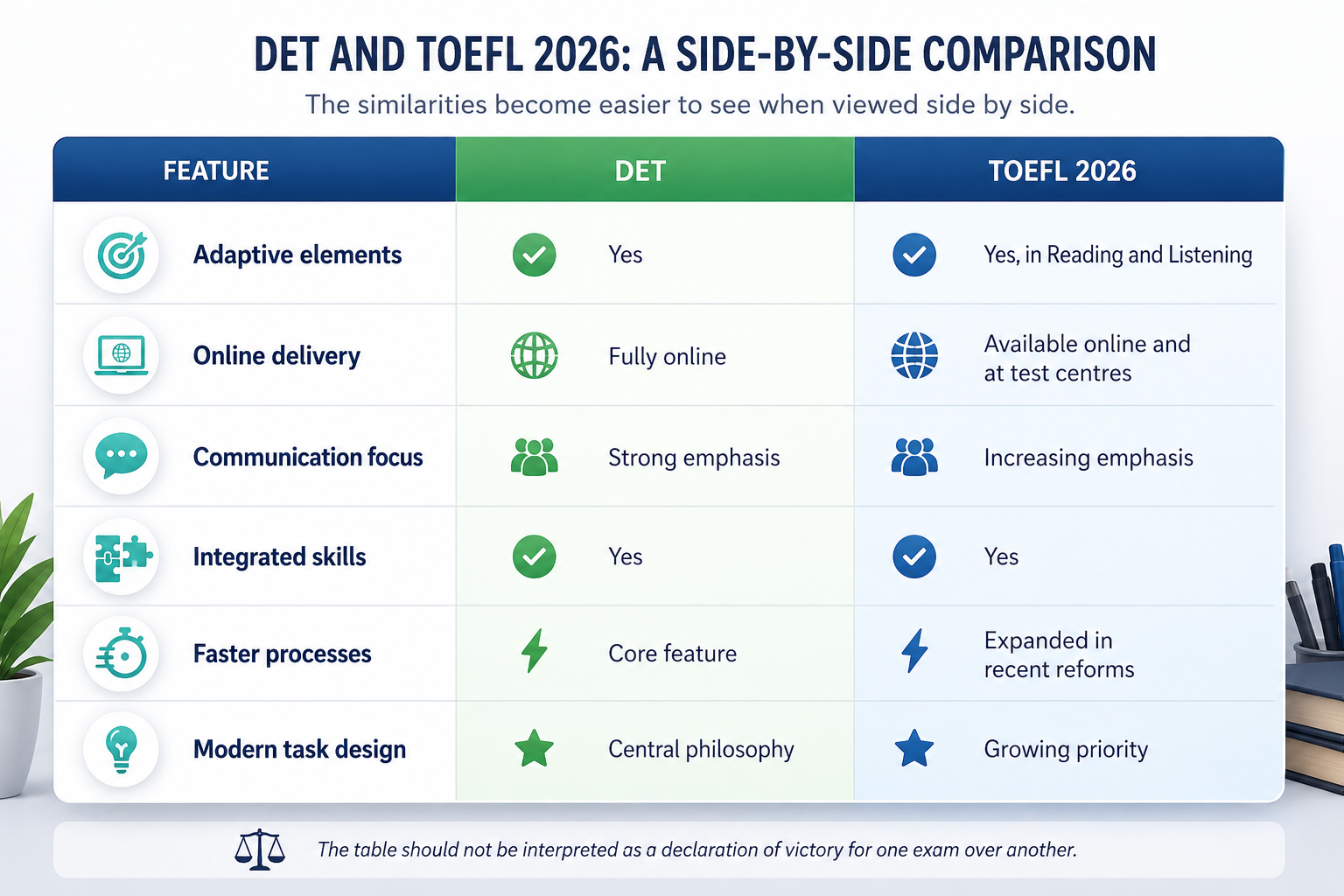
The table should not be interpreted as a declaration of victory for one exam over another.
That would oversimplify a much more complicated picture.
Each examination serves slightly different purposes and appeals to different candidates.
The interesting point is that they appear to be moving in comparable directions.
What teachers are likely to notice
As someone who works with language learners, I suspect the most significant consequences will appear not in examination halls but in classrooms.
Teachers tend to adapt to the demands of major examinations.
If tests reward memorisation, teaching often focuses on memorisation.
If tests reward authentic communication, classroom activities gradually evolve to reflect that reality.
The redesigned TOEFL may encourage greater emphasis on:
- critical reading;
- integrated communication;
- efficient information processing;
- practical language use;
- flexible thinking.
DET teachers may find much of this surprisingly familiar.
Some of the classroom techniques developed for Duolingo English Test preparation could transfer naturally to aspects of the updated TOEFL.
That does not mean the examinations are identical.
It simply suggests that successful language teaching increasingly rewards broadly transferable communication skills.
So, is TOEFL becoming more like DET?
The honest answer is both yes and no.
No, because the TOEFL remains its own examination with its own history, research base, scoring system, and academic focus. The recent reforms should not be interpreted as an attempt to imitate another test.
Yes, because some developments bear interesting similarities to trends that the DET embraced relatively early.
Both examinations appear to recognise several important realities.
Modern learners value flexibility.
Universities want reliable evidence of communication skills.
Psychometric research supports more sophisticated assessment methods.
Technology can improve testing experiences when used thoughtfully.
Most importantly, language proficiency is increasingly viewed as an active process rather than a static collection of memorised facts.
That observation brings us to an even bigger question.
If the TOEFL, one of the world’s most established examinations, is evolving alongside broader educational and technological trends, what might happen to another global giant?
In the next section, we turn to IELTS, perhaps the most recognisable English proficiency test on the planet, and ask a delicate question.
Could IELTS eventually face similar pressures to evolve, or has it already found the perfect balance between tradition and innovation?
Sources for factual claims:
- ETS announced major TOEFL reforms, including adaptive elements and revised scoring beginning in January 2026.
- ETS states that the redesign aims to improve fairness, efficiency, and relevance while maintaining measurement quality.
What About IELTS? Can a Global Giant Afford to Stand Still?
Mention English proficiency tests almost anywhere in the world, and sooner or later someone will bring up IELTS.
It is hardly surprising.
For millions of students, professionals, and immigrants, the International English Language Testing System has become almost synonymous with proving English ability. Universities accept it, employers recognise it, governments rely on it for visa applications, and language schools across the globe have built entire courses around its format.
In short, IELTS is not simply another English exam.
It is an institution.
That makes the next question rather delicate.
If the Duolingo English Test has embraced innovative task types and the redesigned TOEFL is introducing significant reforms, does IELTS face similar pressures to evolve?
The answer is more complicated than a simple yes or no.
Before we speculate about the future, it is only fair to acknowledge why IELTS became so successful in the first place.
Why IELTS became a global standard
IELTS has one enormous advantage that newer examinations cannot easily replicate.
Trust.
The examination was developed through a partnership involving Cambridge English, the British Council, and IDP, organisations with decades of experience in language assessment and international education.
Over time, the exam built an impressive reputation for academic rigour and reliability.
Students know it.
Universities know it.
Immigration authorities know it.
Teachers have spent years understanding its requirements.
That familiarity has enormous practical value.
Choosing an English proficiency test can be stressful enough without wondering whether a university admissions officer has ever heard of it.
IELTS solved that problem long ago.
Its strengths are substantial.
The examination offers:
- worldwide recognition;
- strong academic credibility;
- carefully researched assessment methods;
- extensive preparation materials;
- clear scoring criteria;
- versions designed for different purposes, including academic and general training.
These are not small achievements.
Building international trust takes decades, and IELTS has invested considerable time and research into establishing its reputation.
There is another strength that often receives less attention.
The examination has remained remarkably stable.
Students preparing for IELTS generally know what to expect, and teachers can develop reliable preparation strategies based on well-established formats.
Stability can be reassuring.
It can also create an interesting challenge.
The problem with success
History contains many examples of highly successful technologies that eventually discovered an uncomfortable truth.
Success can make innovation feel unnecessary.
The typewriter worked perfectly well until computers arrived.
Paper maps performed admirably until navigation apps became common.
DVD rental shops had a rather successful business model until someone had the awkward idea of streaming films online.
Language examinations are not immune to similar pressures.
A successful test must maintain reliability while responding to changes in education, technology, and society.
Change too quickly, and institutions may lose confidence.
Change too slowly, and the examination risks becoming disconnected from the real world.
IELTS has generally chosen the cautious approach.
That is understandable.
When millions of candidates rely on an examination every year, dramatic experimentation is not particularly attractive.
At the same time, the educational landscape is changing.
Artificial intelligence is altering the way students study.
Digital communication has transformed workplaces.
Universities increasingly expect learners to process information from multiple sources and communicate across different media.
That raises an intriguing question.
Are traditional examination formats still measuring everything that modern learners need?
What IELTS already does well
Before anyone rushes to redesign the examination, it is worth remembering that IELTS already assesses many valuable communication skills.
The speaking test, for example, remains one of its strongest components.
Candidates engage in a face-to-face conversation with a trained examiner, creating an interaction that feels considerably more natural than reading scripted responses into a microphone.
The writing tasks also encourage organisation and logical argumentation.
Academic Task 1 requires candidates to interpret visual information such as graphs and charts, while Task 2 assesses the ability to develop and support an opinion.
Reading and listening sections demand concentration, vocabulary knowledge, and careful attention to detail.
Many of these abilities remain highly relevant in both academic and professional contexts.
This is important because discussions about educational innovation sometimes create a false impression that older examinations have become obsolete.
That is simply not true.
IELTS continues to assess many essential communication skills effectively.
The more interesting question is whether it could assess additional skills in the future.
Could IELTS become more adaptive?
Now we enter the realm of informed speculation.
To be absolutely clear, there has been no official announcement that IELTS intends to introduce fully adaptive testing similar to the DET or aspects of TOEFL 2026.
What follows should therefore be read as a possibility rather than a prediction.
Adaptive testing offers several theoretical advantages.
It may improve efficiency, reduce unnecessary questions, and provide more personalised assessment experiences.
Given the broader trends in educational technology, it would not be surprising if major examination providers continued exploring adaptive approaches over time.
Would this happen tomorrow?
Probably not.
Large international examinations tend to move carefully, and any significant reform would require extensive research and pilot testing.
Could it happen eventually?
It seems entirely plausible.
Could IELTS become more interactive?
One interesting feature of the DET is the way candidates actively engage with different forms of information.
Interactive Reading and Interactive Listening require ongoing decisions rather than passive responses.
Could IELTS move in a similar direction?
Again, nobody outside the organisations responsible for the examination knows.
There are, however, several reasons why more interactive task types could become attractive.
Modern communication increasingly involves:
- responding to changing information;
- interpreting multiple sources;
- making decisions under time pressure;
- adapting to unexpected situations;
- combining different language skills.
University students already perform these tasks regularly.
Professionals encounter them almost daily.
Future examinations may seek to reflect these realities more closely.
Whether IELTS chooses this path remains an open question.
What about visual communication?
This may be one of the most fascinating developments in education.
The modern world is remarkably visual.
People communicate through photographs, infographics, diagrams, social media posts, presentations, maps, and data visualisations.
Artificial intelligence has accelerated this trend even further.
A growing number of AI systems can interpret both images and text, creating entirely new forms of communication.
Interestingly, IELTS Academic Task 1 already includes visual interpretation through graphs and charts.
Could future examinations expand this concept?
Perhaps candidates might one day describe photographs, compare visual information, or interpret more complex multimedia content.
To emphasise once again, this is speculation rather than an official proposal.
The broader educational trend, however, seems difficult to ignore.
Communication increasingly involves more than words alone.
Digital integration seems almost inevitable
If there is one prediction that feels relatively safe, it is this.
Digital technology will continue influencing language assessment.
This does not necessarily mean that traditional paper-based examinations will disappear overnight. Many candidates and institutions still value familiar formats.
At the same time, digital delivery offers practical advantages.
It can improve accessibility, simplify administration, speed up score reporting, and support innovative task design.
IELTS has already embraced computer-delivered testing in many locations.
Future developments could potentially include:
- richer multimedia tasks;
- more flexible scheduling;
- enhanced candidate feedback;
- improved accessibility features.
None of these possibilities would fundamentally change the purpose of the examination.
They would simply reflect broader technological developments affecting education as a whole.
Will AI score future IELTS exams?
This question appears in almost every discussion about the future of language assessment.
The short answer is that AI is already involved in various aspects of educational technology, but fully automated high-stakes scoring remains a complex and carefully managed issue.
It is important to separate fact from speculation.
Factually, many testing organisations use technology to support different stages of assessment and quality control.
Speculatively, AI systems may play a greater role in assisting human examiners over time.
The key word here is assisting.
High-stakes examinations involve important decisions affecting university admissions and immigration applications. Complete reliance on automated scoring would raise difficult questions about fairness, transparency, and accountability.
A more realistic possibility may involve hybrid systems where technology supports trained human experts rather than replacing them entirely.
That approach would reflect developments in many other professions.
IELTS versus DET: perhaps this is the wrong question
Students often ask which examination is better.
As teachers, we are occasionally tempted to answer with our personal favourites.
The reality is more nuanced.
IELTS and the Duolingo English Test have different histories, different strengths, and often serve different purposes.
The more interesting question may not be IELTS versus DET.
Perhaps the better question is what both examinations reveal about the future of language assessment.
Looking at recent developments, several common themes emerge.
Successful examinations increasingly value:
- authentic communication;
- practical language use;
- integrated skills;
- efficient assessment;
- real-world relevance.
The methods may differ, but the overall direction appears surprisingly similar.
That observation should not worry IELTS enthusiasts.
If anything, it should reassure them.
Strong educational systems evolve.
They preserve what works while gradually adapting to new realities.
A teacher’s prediction
Allow me one carefully labelled prediction.
I do not believe that the IELTS of 2030 will look exactly like the IELTS of today.
I also do not believe that it will abandon the principles that made it successful.
My guess is that the examination will continue balancing tradition with innovation. Grammar will remain important. Academic writing will still matter. Speaking coherently will not suddenly become optional simply because artificial intelligence exists.
At the same time, I would not be surprised to see greater digital integration, richer task types, and assessments that reflect the increasingly multimedia nature of modern communication.
After all, universities are changing.
Workplaces are changing.
Technology is changing.
Language examinations rarely exist in isolation from the societies they serve.
And that observation leads naturally to another fascinating part of our story.
If IELTS, TOEFL, and the Duolingo English Test are all evolving in different ways, what about perhaps the oldest and most respected family of English qualifications of them all?
In the next section, we turn our attention to the Cambridge English exams, where tradition, academic excellence, and a few delightfully old-fashioned question types coexist in a relationship that can best be described as both admirable and occasionally puzzling.
Cambridge English Exams: Brilliant, Respected… and Occasionally Stuck in Another Century?
Mention the world’s most prestigious English qualifications, and Cambridge English exams inevitably enter the conversation.
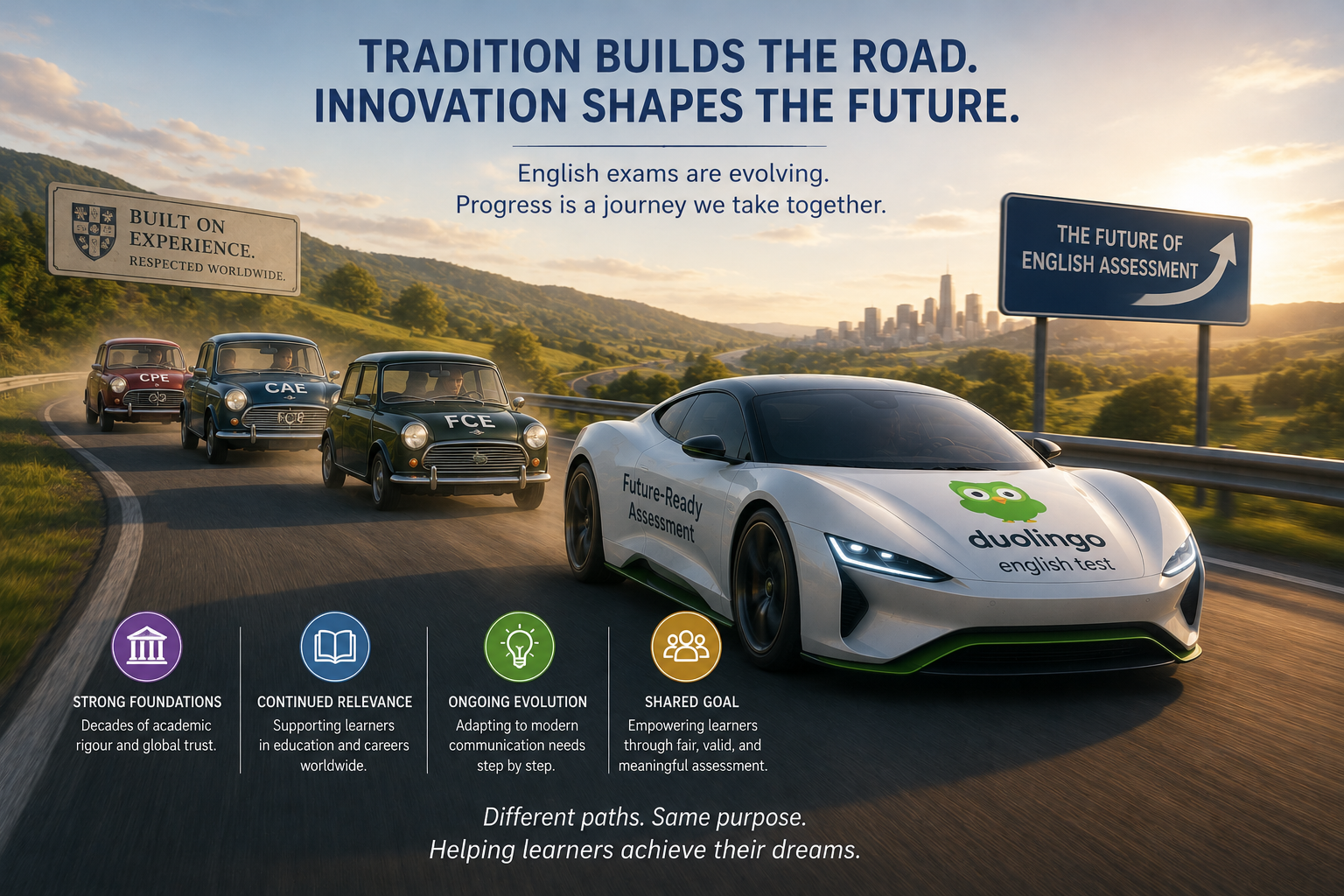
For many teachers, including myself, they occupy a rather special place in the language-learning universe. Passing the First Certificate in English, now known as B2 First, used to feel like joining a rather exclusive club. C1 Advanced, formerly CAE, became a badge of serious academic ability, while C2 Proficiency, the legendary CPE, acquired an almost mythical reputation among ambitious learners.
Cambridge qualifications have survived political upheavals, educational reforms, and enough changes to the English language to make Shakespeare slightly uncomfortable.
That longevity deserves admiration.
It also creates an interesting question.
Can examinations with such a rich history continue evolving fast enough for a world increasingly shaped by digital communication and artificial intelligence?
The answer, much like the examinations themselves, is rather sophisticated.
The Cambridge English story began long before anyone had heard of the internet, smartphones, or asking ChatGPT to explain quantum physics in the style of a pirate.
The Certificate of Proficiency in English was introduced in 1913.
Pause for a moment and appreciate that fact.
When the first CPE candidates sat the examination, the Titanic had sunk only a year earlier, commercial aviation barely existed, and the word “computer” referred to a person rather than a machine.
The examination itself was famously demanding.
Early candidates were expected to translate texts, demonstrate extensive literary knowledge, and write essays on topics that would make many modern students question their life choices.
Over time, Cambridge developed additional qualifications designed for different proficiency levels.
The modern family includes:
- B2 First;
- C1 Advanced;
- C2 Proficiency.
These examinations are recognised by universities, employers, and educational institutions around the world. Their reputation rests on decades of research, careful test development, and a commitment to maintaining high academic standards.
This is important to remember.
Any discussion about modernisation should begin with respect for what Cambridge has achieved.
What Cambridge gets right
As teachers, we occasionally become so familiar with an examination that we forget to appreciate its strengths.
Cambridge qualifications have several qualities that deserve recognition.
First, they reward depth of language knowledge.
Candidates need more than survival English. They must demonstrate an understanding of complex grammar, sophisticated vocabulary, and subtle differences in meaning.
Second, the examinations encourage precision.
A Cambridge candidate cannot simply communicate an approximate idea and hope for the best. Accuracy matters, and that emphasis helps learners develop careful language habits.
Third, the exams promote extensive reading and broad vocabulary development.
Many students preparing for Cambridge discover books, newspapers, podcasts, and articles that they might never have explored otherwise.
Finally, the qualifications have extraordinary academic credibility.
Universities know what the certificates represent, and employers often view them as evidence of serious commitment and strong language ability.
These are considerable achievements.
The goal of educational progress should not be to discard such strengths but to build upon them.
The world has changed
At the same time, language itself does not exist in a museum.
The way people communicate today differs significantly from the way they communicated twenty years ago.
University students collaborate online.
Professionals work across multiple digital platforms.
Meetings involve presentations, charts, photographs, and multimedia materials.
Artificial intelligence systems increasingly require users to communicate clearly and efficiently through natural language.
This raises an uncomfortable but necessary question.
Do all traditional examination tasks reflect the communication challenges of modern life?
The answer is probably not.
That observation is not unique to Cambridge. Similar questions could be asked about almost any long-established educational system.
Cambridge simply provides particularly interesting examples.
The curious case of certain task types
Let me begin with a confession.
As a teacher, I have spent countless hours helping students master Cambridge task formats.
I know the techniques.
I know the strategies.
I also occasionally find myself wondering how often some of these situations occur outside examination rooms.
Take certain matching exercises.
Candidates may spend considerable time connecting isolated paragraphs with missing headings or matching statements to different speakers.
These tasks certainly require concentration and careful reading.
At the same time, one might reasonably ask whether modern communication more often involves synthesising information from multiple sources rather than solving carefully engineered puzzles.
The same observation applies to some highly controlled transformation exercises.
Students may convert one sentence into another while preserving meaning and using a particular grammatical structure.
This undoubtedly tests linguistic precision.
It also raises a slightly mischievous question.
How many people have ever attended a business meeting and thought, “If only I could rewrite this sentence using exactly three words and the passive voice”?
Probably very few.
The point is not that such exercises lack educational value.
Rather, they may represent only one aspect of language proficiency.
Letter writing in the twenty-first century
Another interesting example involves traditional writing genres.
Cambridge examinations have evolved over time, and task types have changed considerably. Nevertheless, many teachers can recall preparing students for highly structured letters, reports, reviews, and formal proposals.
Some of these formats remain extremely useful.
Formal emails continue to play an important role in professional communication.
Reports are common in business and academia.
Reviews appear regularly online.
Other genres feel slightly less central to modern life than they once did.
Young professionals may spend far more time writing collaborative documents, online discussions, presentation summaries, or structured AI prompts than carefully formatted formal letters.
This does not mean that traditional writing should disappear.
It simply suggests that future assessments might benefit from reflecting a broader range of authentic communication contexts.
Vocabulary deserves context
One of Cambridge’s greatest strengths has always been vocabulary development.
Students preparing for B2 First or C1 Advanced often acquire an impressive range of lexical knowledge.
The challenge lies in how that knowledge is sometimes assessed.
Certain tasks encourage learners to focus on isolated word combinations, fixed expressions, or individual lexical items separated from broader communication.
There is educational value in this approach.
Precise vocabulary matters.
Collocations matter.
Idioms matter.
At the same time, modern communication increasingly rewards the ability to use vocabulary flexibly in realistic situations.
Knowing an advanced word is useful.
Knowing when to use it, when not to use it, and how to adapt it for different audiences may be even more valuable.
Artificial intelligence offers an interesting parallel.
Large language models know an astonishing number of words.
The real challenge is using them appropriately within context.
Perhaps human learners deserve similar priorities.
What could Cambridge borrow from the future?
This section is intentionally speculative.
Nothing here should be interpreted as an official proposal from Cambridge English.
Rather, these are ideas that emerge naturally from broader educational trends.
Future Cambridge examinations could potentially include greater emphasis on:
- interpreting visual information;
- evaluating multiple sources;
- integrating reading and writing tasks;
- responding to changing scenarios;
- summarising complex information;
- collaborating with digital content.
Notice what is absent from that list.
Grammar has not disappeared.
Vocabulary has not disappeared.
Academic rigour has not disappeared.
The suggestion is evolution rather than revolution.
The best educational reforms rarely throw away valuable traditions.
They adapt them.
A surprising connection with AI
At this point, some readers may wonder what any of this has to do with artificial intelligence.
The connection is simpler than it first appears.
Modern AI communication increasingly rewards the ability to:
- interpret information;
- identify relevant details;
- evaluate evidence;
- summarise complex ideas;
- organise thoughts logically;
- communicate with precision.
These are not entirely new skills.
Cambridge examinations already assess many of them.
The opportunity may lie in expanding their role while reducing reliance on tasks that feel more mechanical than communicative.
Ironically, the growth of AI may strengthen the case for authentic language assessment.
If machines can memorise grammar rules and vocabulary lists effortlessly, human education may increasingly focus on interpretation, judgement, creativity, and meaningful communication.
Those happen to be qualities that Cambridge has often valued throughout its history.
A teacher’s gentle complaint
Permit me one small complaint from the classroom.
Every Cambridge teacher has experienced the following conversation.
Student: “Will I ever use this in real life?”
Teacher: “Well…”
Student: “So the answer is no?”
Teacher: “Let’s call it character building.”
Humour aside, this exchange highlights an important educational principle.
Students are generally willing to work hard when they understand the purpose of a task.
The closer examination activities resemble meaningful communication, the easier it becomes to maintain motivation.
Fortunately, Cambridge has repeatedly updated its qualifications over the years, demonstrating a willingness to refine and improve task types.
There is every reason to believe that this process will continue.
Respecting tradition while embracing change
It would be easy to write a dramatic article declaring that traditional examinations are outdated and that every assessment should immediately resemble an interactive AI conversation.
Such claims might attract attention.
They would also be rather silly.
Cambridge English examinations remain among the most carefully researched and academically respected qualifications in the world.
Their emphasis on precision, depth, and high standards continues to provide enormous value for learners.
At the same time, educational history suggests that successful institutions survive because they adapt.
The Cambridge of 2026 already looks very different from the Cambridge of 1913.
The Cambridge of 2030 will almost certainly continue that process of gradual evolution.
Perhaps the most interesting lesson from the DET, TOEFL 2026, IELTS, and Cambridge English exams is that they all face the same challenge.
How do you preserve academic rigour while preparing students for a rapidly changing world?
That question turns out to be far more complicated than simply inventing new task types.
It also leads us to perhaps the biggest mystery in the entire language-testing industry.
Who actually decides when an English examination changes, and why does the process sometimes take years?
The answer involves psychometrics, university research, expert panels, pilot studies, and a surprising amount of patience. In the next section, we shall take a look behind the curtain and discover who really shapes the future of English examinations.
The Hidden Benefit Nobody Talks About
When we began this discussion, we started with a simple observation from the world of artificial intelligence.
Andrej Karpathy suggested that “the hottest new programming language is English”, a statement that initially sounded like an amusing exaggeration. As we explored the changing relationship between language, technology, and education, that remark began to look rather less like a joke and rather more like a useful insight.
Artificial intelligence has not reduced the importance of communication.
If anything, it has increased it.
Modern technology rewards people who can explain problems clearly, provide useful context, evaluate information critically, and organise their thoughts effectively. Those abilities improve conversations with other people, and they also improve interactions with increasingly sophisticated digital tools.
What makes the Duolingo English Test particularly interesting is that many of these same habits appear throughout the examination itself.
The DET was not designed to prepare students for the age of artificial intelligence. Its primary purpose is much more straightforward: to provide a practical, accessible, research-based assessment of English proficiency for university admissions.
Yet the skills it rewards happen to fit remarkably well with the demands of modern communication.
Throughout this article, we have also seen that the DET is not alone. TOEFL is introducing significant reforms, IELTS continues to evolve, and Cambridge English qualifications balance long-standing traditions with gradual innovation. Although these examinations differ in many respects, they appear to be responding to similar educational realities.
Language learning is becoming less about memorising isolated facts and more about using knowledge effectively.
Students increasingly need to interpret information, solve problems, communicate across different contexts, and adapt to unfamiliar situations. They need to work with written texts, spoken language, visual information, and digital technologies, often combining several of these skills at the same time.
Artificial intelligence has accelerated this trend, but it did not create it.
Good communication has always mattered.
Scientists rely on it when explaining discoveries.
Doctors depend upon it when speaking with patients.
Teachers use it every day in their classrooms.
Business leaders need it when making decisions and building teams.
Researchers use it to share ideas, and students use it to demonstrate what they have learned.
The growing influence of AI simply reminds us that the ability to communicate clearly remains one of the most practical and valuable human skills.
This brings us back to the central question of the article.
What is the hidden benefit of preparing for the Duolingo English Test?
The obvious answer is that a strong score may help students gain admission to universities and pursue international educational opportunities.
There may, however, be another benefit that receives far less attention.
Every reading task encourages careful analysis.
Every listening exercise develops active comprehension.
Every speaking activity requires organised thinking.
Every writing task strengthens the ability to communicate ideas with clarity and purpose.
Every photo description encourages observation and interpretation.
Individually, these are examination activities.
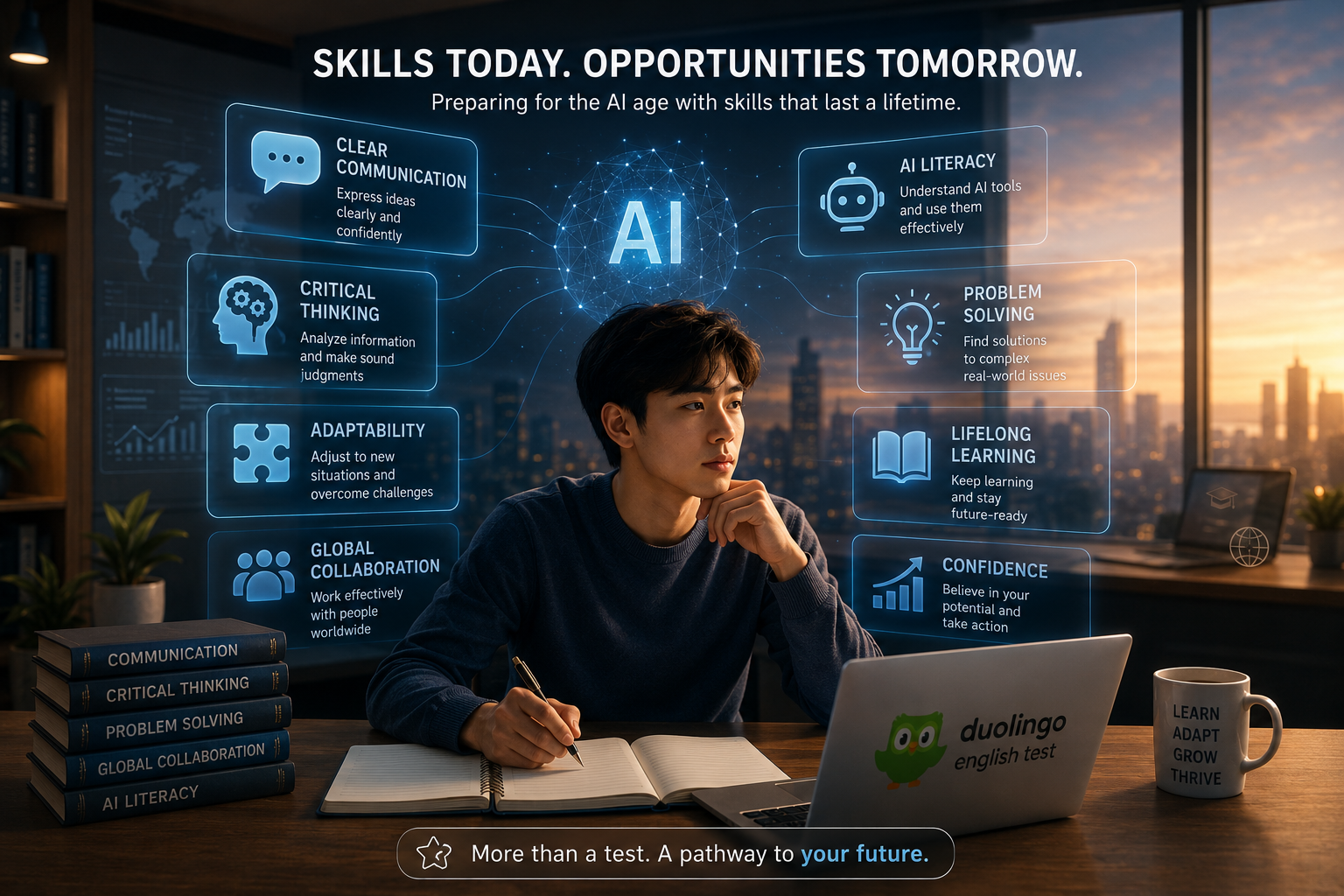
Collectively, they represent a form of training for many of the communication challenges students are likely to encounter at university, in their professional lives, and in a world where collaboration with intelligent technologies is becoming increasingly common.
Perhaps that is the most encouraging conclusion of all.
The future does not belong exclusively to the people who can write the most sophisticated computer code, nor to those who can memorise the longest vocabulary lists. It is likely to reward people who can think critically, learn continuously, adapt to new situations, and communicate effectively with a wide variety of audiences.
If you are preparing for the Duolingo English Test today, your immediate goal may be to achieve the score required for your chosen university.
That is an excellent objective.
At the same time, you may be developing habits of clear thinking, structured communication, and practical problem-solving that will continue serving you long after the examination itself has been forgotten.
For an English proficiency test, that is a surprisingly impressive side effect.
And perhaps that is the real story hidden behind the DET.
Students believe they are preparing for an exam.
They may also be preparing for the future.