




How to Make Your English Speech Magnetic
Learn how to make your English speech more magnetic with powerful words, vivid metaphors, sensory language and memorable expressions for public speaking, presentations, networking and storytelling.
Whether you’re taking the IELTS or Duolingo English Test, attending a job interview, pitching an idea to a client, giving a presentation or making small talk at a networking event, you’ve probably experienced the same frustrating phenomenon. One day, your English flows naturally. The next, you freeze, forget simple words and start doubting your abilities.
Here’s the first thing you need to know: your English hasn’t suddenly become worse.
Many learners assume that their language level and speaking performance are the same thing. They aren’t. Your overall English knowledge is your potential. Your actual performance depends on the situation, your emotional state and the amount of pressure you’re under. In other words, knowing English and accessing that knowledge when the stakes are high are two completely different skills.
The good news is that high-pressure speaking can be trained. Surprisingly, many of the most effective strategies have little to do with language itself.
As a business coach, I’ve noticed that strong communicators rarely try to eliminate stress. Instead, they learn to work with it.
Before any important conversation, develop a short routine that helps calm your nerves. Different techniques work for different people, so experiment and find what suits you.
Ideas include:
The goal is simple: teach your brain that this situation is familiar rather than threatening.
Science suggests that stress and excitement feel remarkably similar. A racing heart and sweaty palms don’t necessarily mean you’re going to fail. They might simply mean your body is preparing you for action.
Instead of thinking, “I’m so stressed.” Try, “I’m excited.” “My body is giving me extra energy.” This small shift can make a surprisingly big difference.
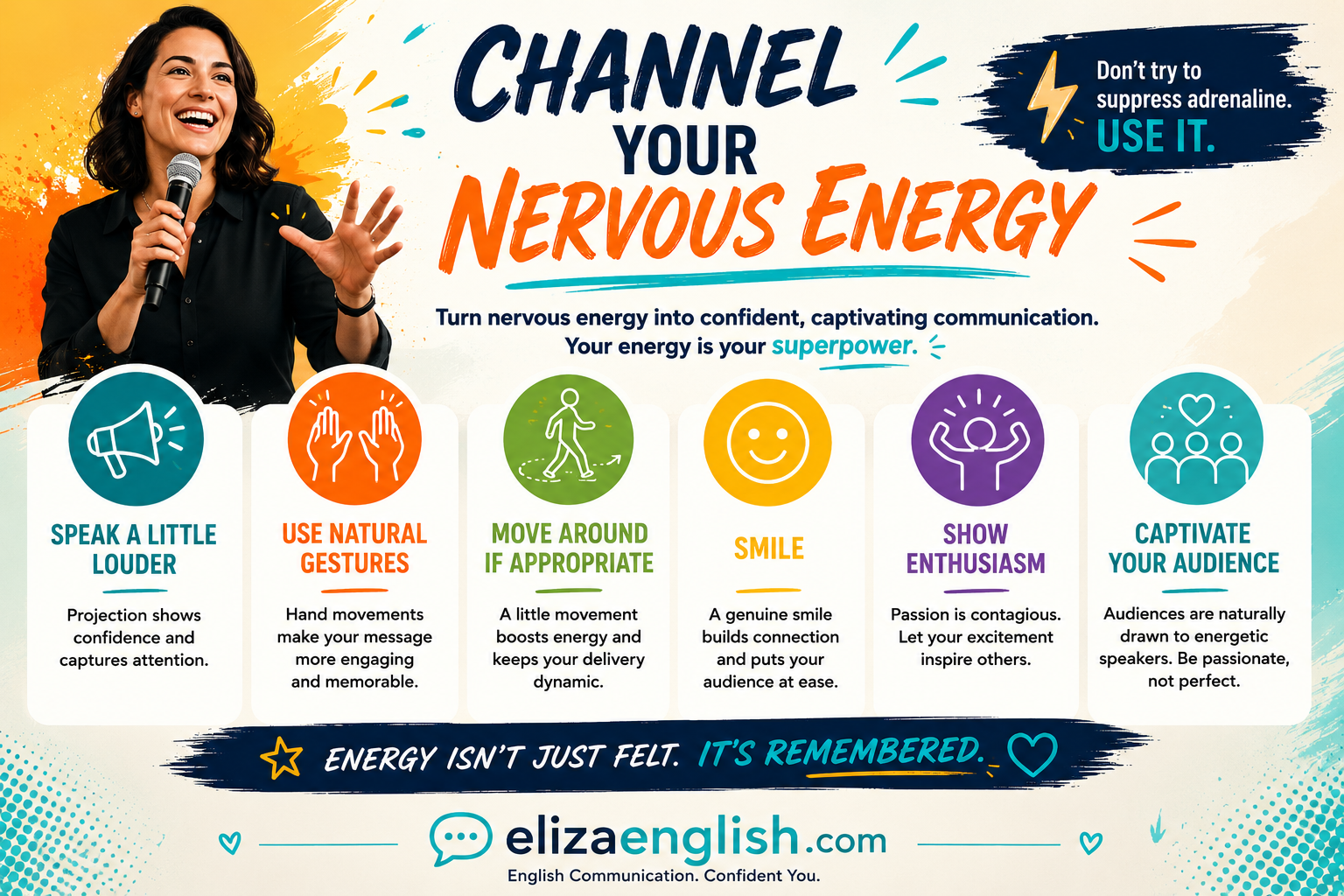
Confidence has surprisingly little to do with appearance.
We’ve all met unusual-looking people with colourful hair, tattoos or quirky clothes who seem completely at ease with themselves. At the same time, countless conventionally attractive people struggle with self-esteem.
The lesson is clear: Confidence comes from self-acceptance, not perfection.
Stop worrying about your accent. Stop assuming people are judging every grammatical mistake. Shift your attention from your insecurities to the value you can bring to the conversation.
Did you know that many professional athletes rely on pre-competition rituals? Some wear a lucky pair of socks, others listen to a particular song or follow the exact same warm-up routine before every game. Contrary to popular belief, these rituals don’t magically bring good luck. What they do is something far more powerful: they reduce anxiety and create a sense of control.
Part of their effectiveness can be explained by the placebo effect. If you genuinely believe that a routine will help you perform better, that belief alone can boost your confidence. There’s another reason these rituals work, though. Our brains crave familiarity. Faced with uncertainty, they naturally look for predictable patterns that signal safety. A simple pre-performance routine creates a small island of certainty in an otherwise stressful situation, helping you feel calmer, more focused and better prepared to perform at your best.
Before an important conversation:
Think of it as creating a small comfort zone in a sea of uncertainty. The first few minutes are often the hardest. If you start well, you’re likely to stay confident.
Many learners think fluent speakers never make mistakes.
In reality, native speakers hesitate, restart sentences and occasionally lose their train of thought. The difference is that they recover naturally.
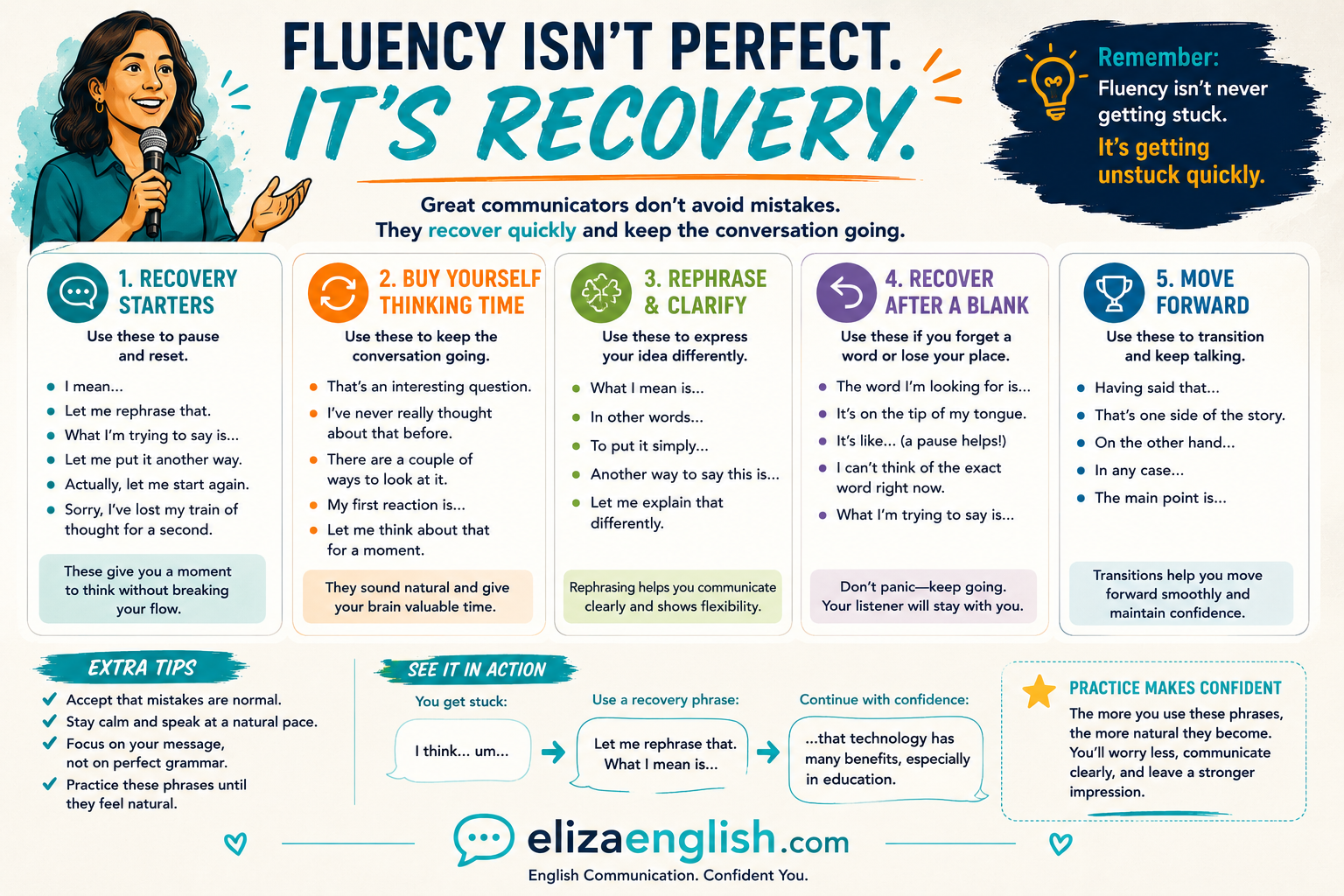
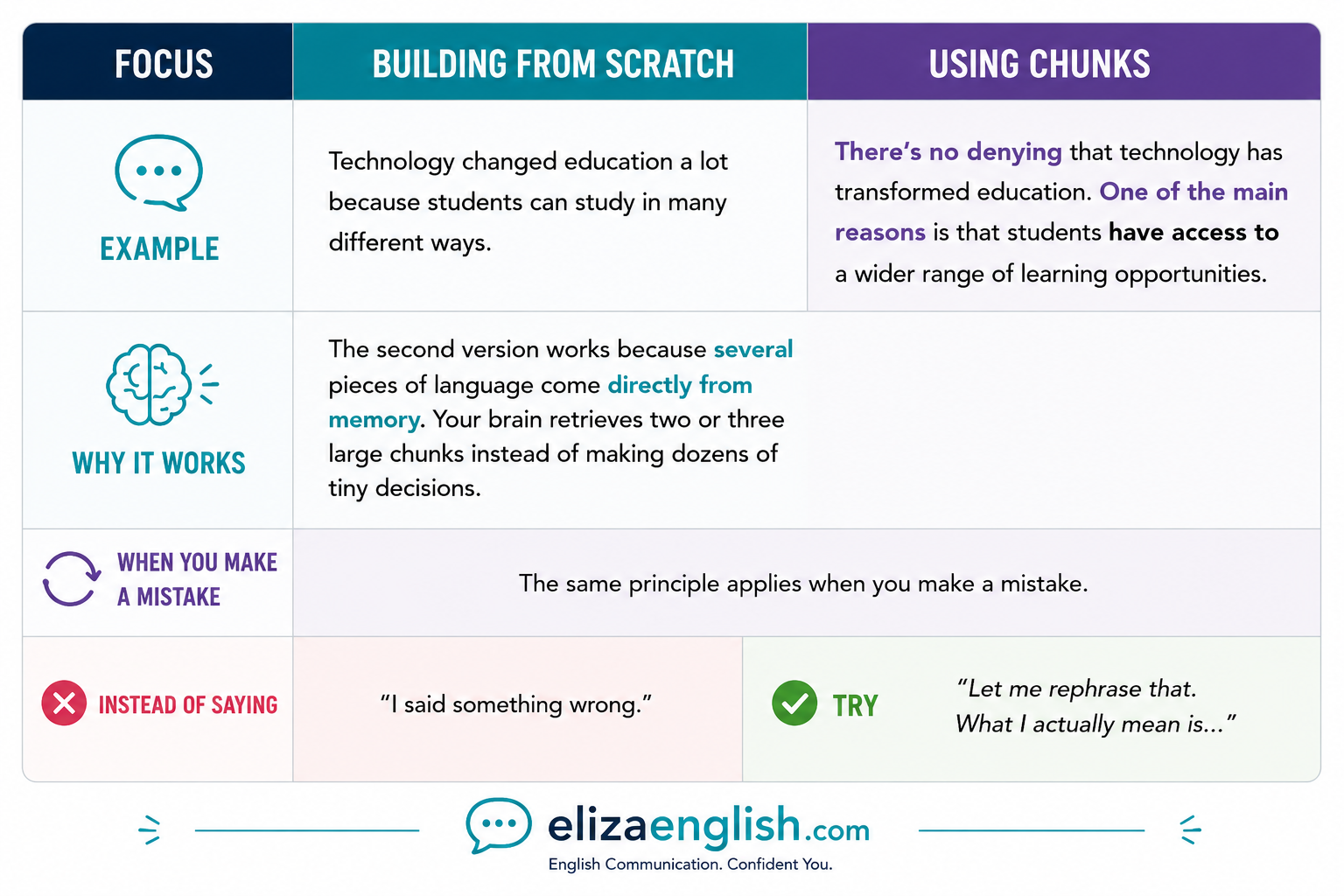
This is one of the most effective strategies for speaking under pressure. When stress levels rise, grammar often disappears. However, chunks do survive. Instead of constructing every sentence from scratch, rely on ready-made pieces of language.
Useful chunks include:
Think of chunks as LEGO blocks. It’s much easier to build a sophisticated sentence from three or four large pieces than to create every word individually.
Many English learners spend years trying to perfect individual sounds while overlooking something equally important: the melody of English. Native speakers don’t simply produce words correctly. They vary their pitch, pause strategically and highlight key information through intonation.
Pauses are a great place to start. Many learners speak until they run out of breath, producing one long stream of words:
❌ Ithinkthattechnologyhaschangedourlivesbecause…
| ✅ I think that technology has changed our lives. | In particular, | it has transformed education. |
Short pauses make you sound more confident and give your brain extra thinking time.
Breathe at punctuation, not when you’re desperate for air. Short pauses give your brain extra thinking time and help your listener process what you’re saying.
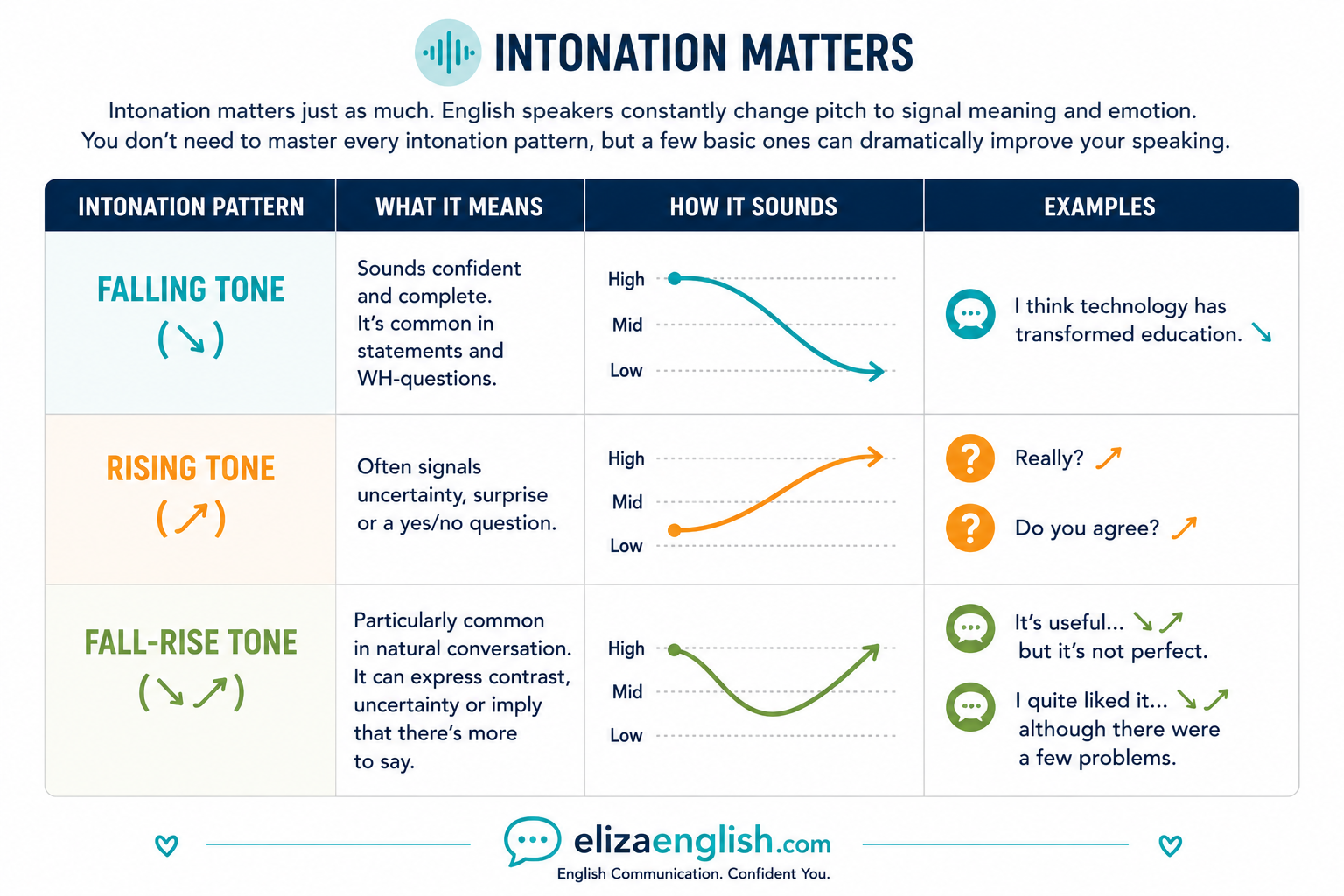
Another useful tip is to stress content words rather than every single word equally.
Compare these versions:
❌ I THINK that TECHnology HAS changed OUR lives.
✅ I think that technology has changed our lives.
The stressed words carry the meaning, while the smaller grammatical words become less prominent.
Finally, don’t be afraid of silence. Many learners think a short pause makes them sound less fluent. In reality, the opposite is often true. Professional speakers, experienced teachers and skilled communicators deliberately pause before important points because pauses create emphasis, build anticipation and project confidence.
Remember, fluent English isn’t just about choosing the right words. It’s about delivering them in a way that’s easy and enjoyable to listen to. A well-placed pause, natural rhythm and varied intonation can make a bigger difference than a perfectly pronounced individual sound.
Pressure often makes people ramble. A simple framework can help.
One of the easiest is PREP.
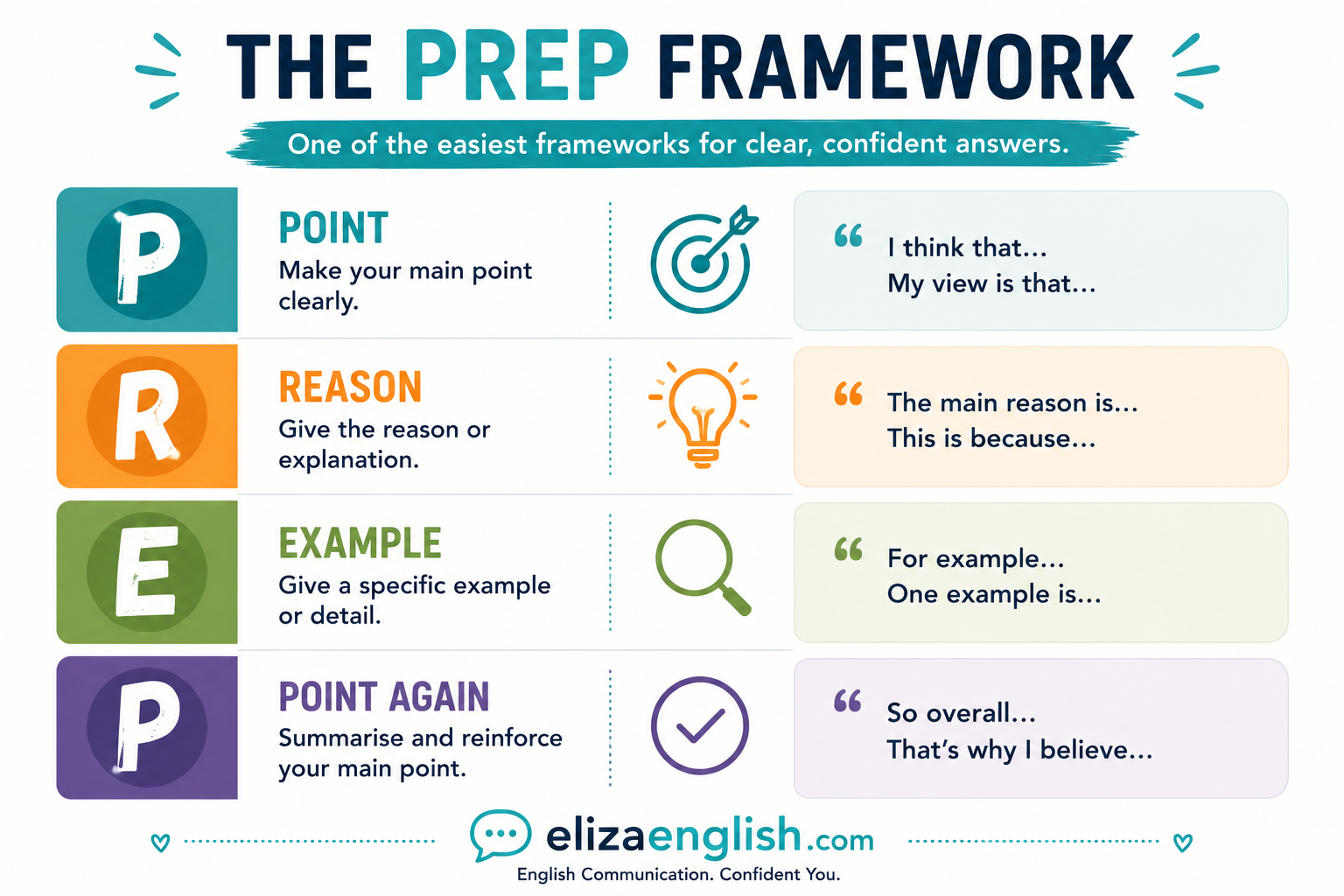
Question:
Should schools ban mobile phones?
Answer:
“I think they should. The main reason is that mobile phones can distract students from learning. For example, many teenagers spend more time checking social media than paying attention in class. Overall, I believe schools should limit their use.”
This structure works for interviews, presentations and speaking exams alike.
Many learners memorise model answers. Professionals memorise stories. Prepare five stories from your own life about:
You can adapt these stories to countless situations, including speaking exams, job interviews, university admissions and networking events. Stories are easier to remember and far more engaging than memorised scripts.
High-stakes speaking isn’t simply a test of your English level. It’s a test of how well you can access your knowledge under pressure.
Before your next important conversation, remember these principles:
Most importantly, stop chasing perfect English. Whether you’re taking a speaking exam, attending a job interview or giving an important presentation, people are far more interested in your ideas than in the occasional grammatical mistake.
The strongest communicators aren’t the ones with the biggest vocabulary or the most advanced grammar. They’re the ones who stay calm, connect with their audience and keep communicating when things don’t go exactly according to plan. Fortunately, that’s a skill anyone can learn.
If you’d like personalised feedback and practical coaching, I’d be delighted to help. I work with learners preparing for the IELTS and Duolingo English Test, job interviews, university admissions, business presentations, networking events and other high-pressure speaking situations. My one-to-one lessons are tailored to your goals, whether you’re aiming for a higher exam score, preparing for an important interview or simply wanting to communicate with greater confidence.
You can connect with me on italki, follow me on LinkedIn for regular English learning and communication tips, or explore more resources on elizaenglish.com. I’d love to be part of your English-learning journey and help you perform at your best when the stakes are high.
Learn how to make your English speech more magnetic with powerful words, vivid metaphors, sensory language and memorable expressions for public speaking, presentations, networking and storytelling.
Is English homework necessary for adults? Discover research-backed strategies for effective EFL homework, from active consolidation and retrieval practice to fun English videos, podcasts and hobby-based learning.
B2 vs C1 English explained clearly. Learn the key differences, take a quick diagnostic test, and discover effective strategies to improve your English from B2 to C1. SEO/AEO excerpt
Join the list for printable worksheets, free resources, and articles for English teachers.